
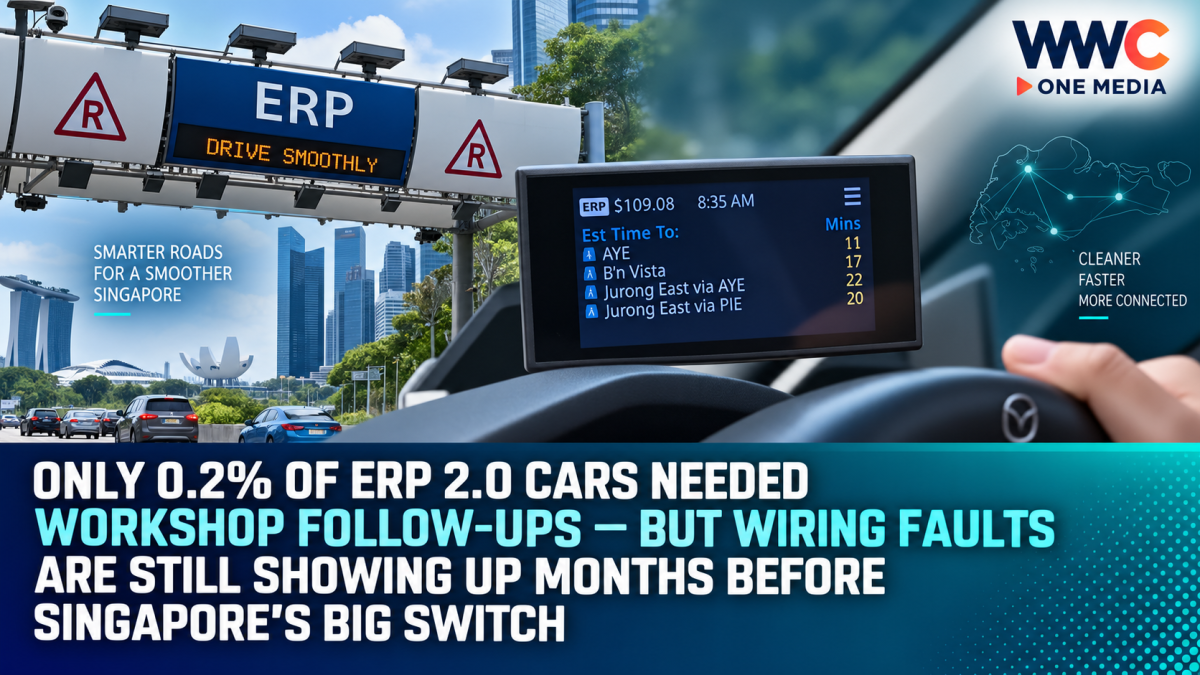
SINGAPORE — Singapore is only months away from making its biggest change to road pricing in nearly three decades.
The good news is that problems with the new ERP 2.0 equipment appear to be becoming much less common.
The less comfortable news is that wiring remains the single most frequently encountered fault, some motorists are still making repeated workshop visits, and at least one fleet vehicle has reportedly had to go back three to four times before its issues were resolved.
According to the Land Transport Authority, around 1,500 cars — about 0.2% of roughly 700,000 cars fitted with the new on-board unit as of July — required workshop follow-up.
That proportion is substantially lower than the 1.3% recorded in May 2025.
Most cases appear to be resolved without major complication.
But LTA said an average of around six cases each month require additional troubleshooting and multiple visits.
And with ERP 2.0 becoming mandatory for almost every Singapore-registered vehicle from Jan. 1, 2027, the remaining failures matter disproportionately.
Because next year, a malfunctioning OBU will no longer be an inconvenience attached to a future transport project.
It will be part of the system Singapore relies on to charge motorists for using priced roads.
Wiring is still the most common problem
The issue is not necessarily that every OBU is built incorrectly.
The harder challenge is installing a standardised electronic system inside thousands of different vehicle configurations.
LTA has previously said wiring problems arise partly because internal layouts differ substantially across vehicle makes and models. Other reported issues have included hardware malfunctions, device faults and cases where wiring or components were suspected of having been tampered with after installation.
The ERP 2.0 unit for cars is also more complicated than the old in-vehicle unit motorists have used for decades.
It consists of a processing unit, antenna and optional touchscreen display.
Motorcycles use an integrated single-piece version.
LTA says the larger, three-part automotive design is needed because ERP 2.0 requires more computing power, satellite positioning and additional wireless functions.
More capability inevitably means more components and more connections.
And every additional wire, connector and installation point is another potential place where something can go wrong.
Workshops are seeing flickering displays and power loss too
CNA spoke to authorised OBU inspection operators VICOM and Indeco, which said overall rectification numbers remained low.
But the symptoms motorists report are varied.
Indeco said it had encountered error messages, blank or flickering screens, intermittent operation and vehicle-identification-number verification notices.
VICOM said the most common issue at its inspection centres was loss of power, which can have several possible causes.
It said most cases were isolated and could generally be diagnosed and corrected in a single visit.
That is reassuring at the system level.
For the individual driver, however, a small statistical failure rate offers little comfort if a vehicle has to return repeatedly.
One rental company received 40 to 50 inspection notices
That problem becomes particularly expensive for fleet operators.
Car rental company MV Auto told CNA that it had received roughly 40 to 50 notices asking for vehicles fitted with OBUs to be returned for inspection.
Rental cars are often already being used by customers.
So a notice can require the company to contact the renter, arrange to retrieve the vehicle, provide a replacement and send the affected car to an inspection centre.
MV Auto sales manager Darren Ang said inspections can take around half a day.
One vehicle was sent back three or four times.
He said the company was sometimes told that wiring, card readers or displays had been changed without receiving a clear explanation of the underlying fault.
That is where a low failure percentage can still create substantial operational cost.
For a private driver, one workshop trip is an annoyance.
For a fleet business, repeated visits across dozens of vehicles can mean vehicle downtime, manpower and replacement-car costs.
An NUS professor says repeated visits deserve special attention
Professor Lee Poh Seng, head of mechanical engineering at the National University of Singapore, told CNA that some failures are inevitable in a nationwide installation programme of this scale.
But he drew a distinction between isolated cases and repeated failures.
If the same car keeps returning, he said, technicians may be fixing a symptom instead of identifying the root cause.
His proposed response is essentially to make the rollout smarter as the installed base grows.
Recurring problems should be documented.
Patterns should be identified.
And installation and troubleshooting procedures should increasingly become specific to individual vehicle models.
That matters because Singapore now has enough OBU experience to turn earlier failures into a database of known problems.
If a particular model repeatedly experiences a specific wiring issue, the next technician should ideally not have to rediscover the solution from scratch.
LTA says it will help difficult cases move faster
LTA said it will continue working with vehicle distributors, authorised dealers and workshops to identify model-specific installation requirements.
For more difficult cases, it will help expedite appointments at OBU Care Centres and provide on-site technical support.
The authority’s current guidance says motorists who receive an inspection notice should return to the workshop that carried out the original installation or follow the instructions in the notice.
Drivers who suspect a problem even without receiving a letter are also advised to visit the original workshop.
That recommendation is partly practical.
The original installer has the records of how the OBU was fitted and is therefore better placed to diagnose what changed.
Motorists should not rewire the unit themselves
This is especially important for drivers tempted to hide, reposition or modify OBU components.
LTA says unauthorised work on the system can affect functionality and may void warranty coverage.
Each OBU comes with a five-year warranty beginning from its first installation, covering manufacturer defects subject to exclusions including misuse, tampering, accidents and unauthorised work.
LTA also says unauthorised OBU modification can become an offence under the ERP 2.0 regulatory framework.
That is worth remembering because early criticism of the system included complaints about component placement and aesthetics.
Drivers can choose not to install the optional touchscreen display and use compatible smartphone functions instead.
But rewiring or relocating system components independently is a different matter.
Car park detection problems have also fallen sharply
One of the most visible early OBU problems was not ERP charging at all.
It was getting into and out of car parks.
Some motorists reported that parking gantries failed to detect the new unit.
LTA now says feedback involving Electronic Parking System gantry detection has fallen substantially and averages only around two cases a month.
Not every failure indicates a defective OBU.
The Ministry of Transport has explained that some vehicles may be positioned so their OBU antenna falls outside the effective range of a car park antenna.
The problem can sometimes be solved by repositioning the vehicle or recalibrating the car park antenna.
MOT also noted that antenna-range issues existed under the old ERP 1 system.
So a car park barrier refusing to lift is not automatically proof that the new OBU itself is broken.
The latest 1,500 figure needs careful historical context
There is one numerical issue worth clarifying.
In September 2025, then Acting Transport Minister Jeffrey Siow told Parliament that around 9,000 cars had required a return to workshops for rectification works since the OBU rollout began.
The latest CNA/LTA figure says around 1,500 cars, or 0.2% of approximately 700,000 OBU-equipped cars, required workshop follow-ups as of July 2026.
Those published figures should not automatically be interpreted as meaning the cumulative number somehow fell from 9,000 to 1,500.
The publicly available reports do not clearly reconcile the definitions, reporting periods or categories used in the two measurements.
The safest comparison is the one LTA itself explicitly makes in the latest report:
the rate requiring follow-up was 0.2% in July 2026, down from 1.3% in May 2025.
That provides clearer evidence that the incidence of recent follow-up problems has fallen.
The rollout itself is almost complete
The number of affected vehicles also needs to be seen against the scale of the project.
As of May, LTA said more than 96% of Singapore-registered vehicles had been fitted with ERP 2.0 OBUs.
That percentage includes motorcycles, goods vehicles and other vehicle classes, whereas CNA’s latest roughly 700,000 figure refers specifically to cars.
Back in January, around 930,000 vehicles had already been equipped at more than 300 authorised workshops.
So this is no longer a limited pilot.
ERP 2.0 hardware is already installed across almost the entire national vehicle fleet.
The next challenge is making sure that installed equipment works reliably when the charging system itself changes.
Jan. 1, 2027 is the real deadline
From Jan. 1 next year, Singapore will move to ERP 2.0 for road-use charging.
OBUs will be mandatory for Singapore-registered motor vehicles using public roads, apart from limited exemptions such as certain classic and vintage vehicles.
ERP 2.0 will use Global Navigation Satellite System technology, allowing the OBU to determine when a vehicle crosses an ERP charging location without relying on the physical gantry structures motorists recognise today.
Existing gantries will progressively be removed.
New signs and road markings are being used to show motorists where charging points are located.
In June, about 1,000 motorists participated in testing the full location-based charging experience, including alerts before reaching charging zones.
That means next January’s switch is not simply a change in hardware.
It changes the visual experience of ERP itself.
But Singapore is not introducing distance-based charging in January
This is another frequent misconception.
Because ERP 2.0 knows a vehicle’s location using satellite technology, it can technically support charging based on distance travelled.
That does not mean Singapore will start charging motorists per kilometre on Jan. 1.
The Ministry of Transport has explicitly said it does not intend to implement distance-based charging in the immediate term.
Jeffrey Siow told Parliament that the initial priority is to make the ERP 2.0 experience as similar as possible to the current system while motorists become accustomed to it.
If distance-based charging is pursued later, MOT says motorists will receive adequate notice.
The government also intends to study how such a system could affect groups who drive long distances as part of their work and could therefore pay more under usage-based charging.
So the immediate 2027 change is location-based satellite charging at existing-style charging points, not nationwide per-kilometre road pricing.
ERP 2.0 is replacing a system that dates to 1998
That broader context helps explain why Singapore is changing a system many motorists considered reliable.
The current electronic road pricing system has operated for more than 25 years.
LTA says its hardware is reaching the end of its operational life, while replacement components and maintenance have become increasingly difficult and expensive.
ERP 2.0 removes dependence on large physical gantries and creates a platform that can support additional services over time.
LTA says these include traffic and safety alerts, parking functions, checkpoint payments and other services.
Some have already begun appearing.
Motorists can receive information about incidents and flash floods, while roadside electronic parking has been introduced across hundreds of designated locations.
From the government’s perspective, the OBU is therefore not simply a replacement CashCard reader.
It is intended to become a broader in-vehicle transport platform.
That ambition raises the reliability bar
The more functions a device handles, the more important reliability becomes.
Under the existing ERP arrangement, a malfunctioning IU primarily affects road-pricing and parking transactions.
ERP 2.0 is designed eventually to interact with more transport functions.
That creates a simple expectation from motorists:
if the government requires the device, it has to work consistently.
A failure rate of 0.2% is low in percentage terms.
Across hundreds of thousands of vehicles, however, even a small percentage still translates into more than a thousand people potentially losing time to troubleshooting.
That is the difference between statistical reliability and lived reliability.
A four-trip repair matters more than a 99.8% success rate to the owner involved
This is the tension inside the latest numbers.
From an engineering perspective, 1,500 follow-up cases among roughly 700,000 fitted cars means the overwhelming majority apparently did not require such follow-up.
From a customer-service perspective, a motorist asked to spend half a day at a workshop several times may reasonably see the experience very differently.
That is why Professor Lee’s distinction between one-off faults and repeated failures is important.
A scalable national system should become easier to troubleshoot as more data is accumulated.
Repeated failures should become more predictable, not merely repeatedly repaired.
Accurate charging becomes the next test
The final phase of the rollout will therefore be less about how many OBUs are installed.
Nearly all vehicles already have one.
The focus shifts to whether the system:
detects charging locations correctly;
deducts the right amount;
works consistently with payment systems;
communicates errors clearly;
and lets faults be fixed without multiple disruptive visits.
Professor Lee told CNA that as Singapore moves toward the full switch, accurate charging should become a central priority.
That is ultimately what motorists will judge.
Most drivers will not care whether an error comes from a wiring harness, an antenna, a card reader or a processing unit.
They will care whether the barrier opens.
Whether the display works.
Whether the system charges them correctly.
And whether fixing a fault requires one workshop visit — or four.
ERP 2.0’s biggest reliability test has not actually happened yet
So far, the OBU network has been operating during a transition period while the familiar ERP system remains in use.
On Jan. 1, 2027, the new architecture becomes the main road-pricing system.
Physical gantries stop being the essential trigger.
Satellite-based location becomes central.
And almost every Singapore-registered vehicle will depend on its OBU to participate in that system.
The latest fault data is encouraging.
The proportion of cars needing follow-up has dropped substantially.
Workshop operators say serious rectification cases remain uncommon.
Parking-detection complaints have fallen to around two a month.
But the final standard is not whether ERP 2.0 has fewer problems than it did a year ago.
It is whether motorists barely notice the technology when it becomes mandatory.
Singapore has already installed the hardware in almost every vehicle.
Now it has only a few months left to make sure the remaining wiring faults do not become the story when the old gantries finally give way to ERP 2.0.




Leave a Reply