
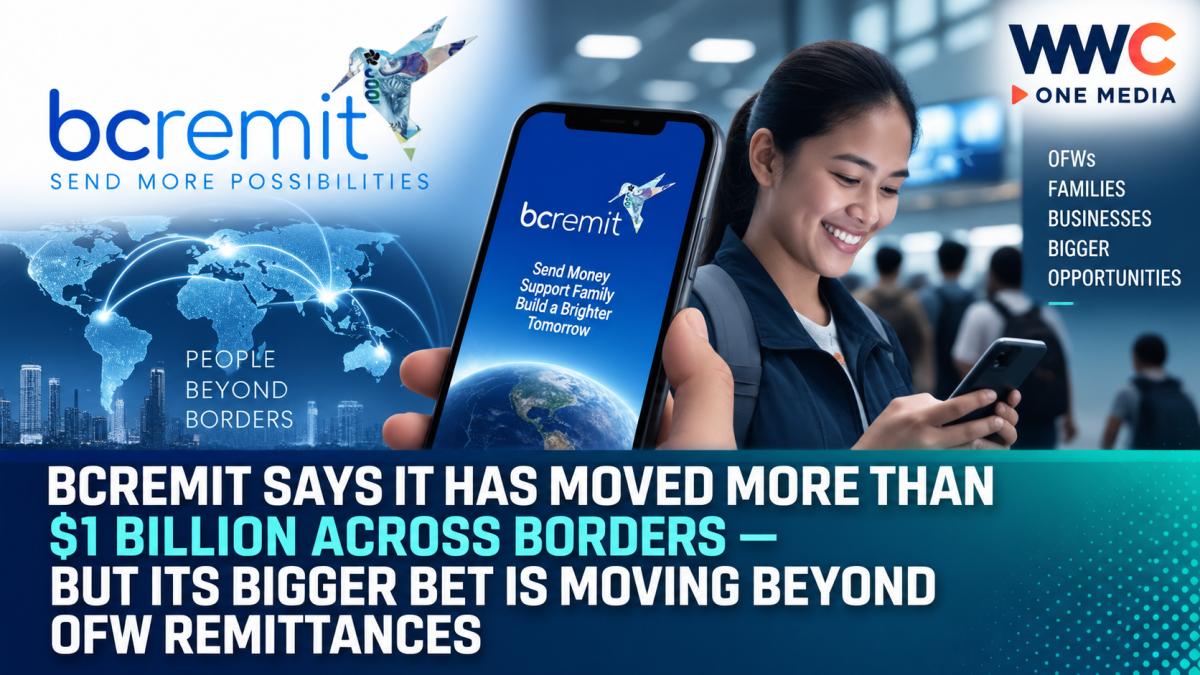
MANILA — A Filipino-founded money-transfer company that began by helping overseas workers send cash home says it has now processed more than US$1 billion in cumulative cross-border transactions.
That is the eye-catching number.
But BCRemit’s next move may be more consequential than the milestone itself.
After spending roughly a decade building a digital remittance network around overseas Filipinos, the company is now trying to turn the same infrastructure into something much larger: a cross-border payments platform for businesses, freelancers, financial institutions and migrant communities beyond the Philippine diaspora.
BCRemit says it has processed more than one million transactions since launch and now operates across a network spanning 24 countries. The company is preparing expansion into Saudi Arabia, Australia, Japan and South Korea while developing enterprise payment products and white-label services for other financial firms.
That represents a strategic change.
BCRemit was built around one of the Philippines’ most dependable financial flows — money sent home by overseas Filipinos.
Its future increasingly depends on proving the technology behind those transfers can serve a much larger market.
The $1 billion figure sounds enormous — but it needs context
The first thing investors and consumers should understand is what BCRemit’s milestone actually measures.
The company is not saying it earned US$1 billion.
It is saying more than US$1 billion has passed through its platform in processed cross-border payments since the business began operating.
Those are very different numbers.
Money-transfer companies typically earn only a fraction of transferred value through service fees, foreign-exchange spreads or other payment charges.
So transaction volume indicates the scale of payment activity.
It does not reveal BCRemit’s revenue, profit or valuation.
The US$1 billion total is also company-reported. BCRemit is privately held, and the cumulative number has not been presented in the sources reviewed here as an independently audited public financial metric.
That does not make the milestone insignificant.
It simply means it should be described accurately.
The company says volume has accelerated sharply
There is another intriguing detail.
In February 2026, BCRemit said it had already processed more than US$600 million in transactions.
By September, it was reporting more than US$1 billion.
If those figures are calculated on a consistent basis, that implies its stated cumulative processed volume increased by at least US$400 million in roughly seven months.
That would represent a meaningful acceleration compared with the company’s earlier years.
But because BCRemit has not published detailed monthly audited transaction data alongside those announcements, the exact growth curve cannot be independently reconstructed from public disclosures.
The safest conclusion is simply that the company says transaction activity has expanded significantly as its geographic reach widened.
One million transactions also provides another clue
BCRemit says the US$1-billion-plus total came from more than one million transfers.
Using those rounded figures alone would imply an average transaction size around US$1,000 or more.
That should not be treated as an exact customer average because both figures are reported as thresholds — “more than” one million transactions and “more than” US$1 billion.
Different customer segments also send very different amounts.
An overseas worker may send a few hundred dollars.
A property payment can be larger.
A business transaction may be larger still.
And BCRemit’s push into enterprise payments could gradually increase average transaction values even if consumer remittances remain its core business.
BCRemit started with the Filipino remittance problem
The company traces its origins to founder and CEO Oliver “Bong” Calma, a former overseas worker, and his son Jose Angelo “Gio” Calma.
BCRemit says its original mission was straightforward: make it cheaper and easier for Filipinos overseas to send money home.
The company marks 2026 as its 10th year of operations and celebrated its anniversary in August.
It first built its presence around the United Kingdom and Philippines before adding additional markets.
The company later entered Spain through BC Remittance S.L., expanded into Canada and the United States, and progressively widened its European coverage.
Banco de España currently lists BC Remittance S.L. among payment-relevant financial institutions in Spain, and regulatory notifications in other European jurisdictions identify the Spanish entity as a payment institution supervised by Banco de España.
That European structure matters because cross-border payments are not simply a technology problem.
They are a regulatory problem too.
Every new country creates another compliance challenge
A payment company cannot simply launch an app in dozens of countries and begin moving money freely.
Cross-border payments are heavily regulated because the same systems that send legitimate family remittances can potentially be abused for fraud, money laundering or sanctions evasion.
Different jurisdictions impose rules involving customer identification, transaction monitoring, safeguarding, anti-money-laundering procedures and financial reporting.
In the Philippines, money-service businesses fall within the broader framework supervised by the Bangko Sentral ng Pilipinas and are subject to anti-money-laundering obligations.
In Canada, money-service businesses are required to register with FINTRAC before operating.
BCRemit says its operations fall under frameworks involving regulators including the BSP, UK authorities, Banco de España, FINTRAC and the Bank of Canada.
The company’s global expansion therefore depends as much on licences, compliance systems and banking relationships as it does on software.
Saudi Arabia may be the most important next market
Among the four priority expansion markets named by BCRemit, Saudi Arabia stands out.
Saudi Arabia is already one of the largest sources of remittances sent to the Philippines.
BSP data shows it accounted for roughly 6.6% of Philippine cash remittances in 2025, behind only the United States and Singapore in the central bank’s published rankings.
That puts it among the most commercially important corridors for any company focused on Filipino migrant workers.
A successful Saudi launch would therefore place BCRemit inside one of the biggest existing remittance channels feeding the Philippines.
It would also expose the company to intense competition.
Global remittance giants, banks, exchange houses and digital-payment firms already compete for Filipino customers in the Gulf.
BCRemit would have to win business through price, convenience, speed or customer experience rather than simply being present.
Japan is another major Filipino corridor
Japan is also one of the Philippines’ leading remittance sources.
BSP data shows Japan contributed around 5% of Philippine cash remittances in 2025.
That gives BCRemit’s expansion strategy a clear logic.
The company is not simply entering random countries to increase the number on its corporate map.
At least two of its named priority markets — Saudi Arabia and Japan — are already among the largest sources of Filipino remittance flows.
Australia and South Korea also host substantial Filipino communities and represent established Asia-Pacific payment corridors.
The challenge will be converting that addressable market into meaningful transaction share.
Philippine remittances are enormous compared with BCRemit’s cumulative milestone
BCRemit’s US$1-billion lifetime processed volume sounds especially large until it is placed beside the entire Philippine remittance market.
The BSP recorded US$35.63 billion in cash remittances through the banking system in 2025 alone.
Broader personal remittances — which include additional forms of transfers — reached about US$39.62 billion.
So the Philippines receives in roughly ten days an amount comparable to BCRemit’s cumulative decade-long US$1-billion milestone.
That does not diminish the achievement of a relatively young fintech company.
It illustrates how enormous the underlying market is.
For BCRemit, even a very small increase in share across major Filipino corridors can translate into hundreds of millions of dollars in additional payment volume.
Remittances remain one of the Philippines’ economic anchors
This is why so many financial companies compete aggressively for Filipino remittance business.
The flows are exceptionally resilient.
Filipinos abroad send money home for food, tuition, medical bills, mortgages, debt payments, savings and everyday household spending.
BSP data shows cash remittances increased 3.3% in 2025 to US$35.63 billion.
During the first half of 2026, cash remittances reached about US$17.15 billion, up from US$16.75 billion in the same period a year earlier.
The central bank has repeatedly described remittances as an important source of foreign exchange and support for household consumption.
That stability makes the market attractive to fintech companies even as competition pushes fees downward.
BCRemit says it can send money for about 1%
That is one of the company’s biggest marketing claims.
BCRemit says its use of digital infrastructure, blockchain technology and U.S.-dollar stablecoins has helped reduce average transaction costs to about 1%, with no hidden fees.
That number would be highly competitive compared with global averages.
The World Bank’s Remittance Prices Worldwide database reported that sending remittances globally cost an average of about 6.36% of the amount sent in its latest published global reading.
The United Nations Sustainable Development Goals call for reducing average remittance costs below 3% by 2030.
On BCRemit’s own figures, its average would already be well below that target.
But the comparison requires an important caveat.
“1%” is not necessarily the price every customer pays
Money-transfer costs can be measured in several ways.
There may be an explicit transaction fee.
There can also be an exchange-rate margin between the wholesale foreign-exchange rate and the rate offered to the customer.
Some payout methods cost more than others.
Fees can change depending on the country, transfer amount and payment instrument.
BCRemit’s website, for example, currently displays flat transaction fees such as $2.99 for some transfers, while exchange rates vary separately.
The World Bank’s global average is designed to capture the total cost of sending a standard remittance, including both fees and exchange-rate margins.
BCRemit’s reported 1% should therefore be described as the company’s own average-cost claim rather than assumed to be directly comparable across every corridor and every transaction.
Consumers should compare the total amount paid with the amount the recipient actually receives.
Stablecoins are becoming part of the remittance infrastructure
BCRemit says one factor behind its cost structure is its use of U.S.-dollar stablecoins and blockchain technology.
That does not necessarily mean customers themselves are buying cryptocurrency.
Stablecoins can operate behind the scenes as a settlement mechanism.
Traditionally, moving money between countries can involve correspondent banks, prefunded accounts, multiple intermediaries and settlement delays.
A regulated payment company can potentially use tokenised dollars to move value between parts of its own infrastructure more quickly, then deliver conventional local currency to the recipient.
For the customer, the experience may still look like an ordinary money transfer:
pounds, euros or dollars go in;
Philippine pesos arrive in a bank account, wallet or cash-pickup point.
The blockchain layer can remain invisible.
But stablecoins do not eliminate regulation
This is another important distinction.
Blockchain settlement does not mean payments can bypass financial rules.
A regulated remittance provider still needs customer verification.
It still needs sanctions screening.
It still needs anti-money-laundering controls.
It still needs procedures to trace suspicious transactions.
And depending on the jurisdiction, using stablecoins can introduce additional regulatory requirements rather than fewer.
So the business case for stablecoins is mainly about settlement efficiency and liquidity — not escaping oversight.
That distinction becomes increasingly important as governments around the world introduce formal frameworks for tokenised money and digital assets.
BCRemit is trying to move beyond the OFW market
The more important strategic change may be happening on the customer side.
Earlier this year, BCRemit said it was expanding beyond retail remittances into payment solutions aimed at small and medium-sized businesses, BPO companies and freelancers.
Those customers behave very differently from OFW households.
A migrant worker may send one or two payments to family each month.
A business can make hundreds or thousands of cross-border payments.
A BPO company may need international payroll or contractor settlements.
A freelancer may need to receive money from clients overseas.
A financial institution may require a payout network capable of sending funds into many local banks and e-wallets.
That means enterprise payments could increase transaction volumes much faster than relying solely on individual remittance customers.
It is also offering its infrastructure to other financial firms
BCRemit says it is developing white-label payout integrations.
In simple terms, another financial company could potentially use BCRemit’s infrastructure behind its own branded service.
Customers might never see the BCRemit name.
The partner company would own the customer relationship while BCRemit provides part of the payment rail underneath.
This is strategically different from competing directly with Western Union, Wise, Remitly or traditional remittance outlets for individual users.
It turns BCRemit into infrastructure.
And infrastructure businesses can potentially scale far more rapidly because one institutional partnership can bring in thousands of transactions.
The RTGS.global partnership supports that direction
In March, BCRemit signed a strategic partnership with RTGS.global, a London-based cross-border payments infrastructure company.
The partnership was explicitly designed to extend BCRemit’s capabilities beyond retail customers and support banks, payment providers and other financial institutions.
RTGS.global said the combination would enable faster and more scalable international payments for both consumers and businesses.
That partnership helps explain why BCRemit’s current messaging is increasingly about payment rails rather than simply remittances.
The company wants to become part of the plumbing of cross-border finance.
This is where the market becomes much larger than OFW transfers
Global migrant remittances are enormous.
Business-to-business cross-border payments are vastly larger.
Companies pay overseas suppliers.
Multinationals move money between subsidiaries.
Freelancers invoice foreign clients.
Digital marketplaces pay sellers.
Banks settle customer transactions.
BPO companies pay contractors and staff.
Each transaction creates a potential role for payment infrastructure that can move money quickly between jurisdictions.
That market also brings heavier competition.
BCRemit would be competing not only with traditional remittance firms but with international banks, card networks, payment processors, fintech platforms and stablecoin-based infrastructure providers.
The company’s US$1-billion consumer-remittance history therefore gives it experience.
It does not guarantee success in enterprise payments.
The advantage may be its Philippine payout network
One practical strength is BCRemit’s ability to deliver money through multiple Philippine channels.
Its consumer service supports transfers to major banks, e-wallets and cash-pickup partners.
The company’s materials identify institutions and outlets including BDO, BPI, Metrobank, LandBank, UnionBank, GCash and numerous pawnshop and remittance networks.
BCRemit Pay also allows customers to make payments for Philippine obligations such as SSS and Pag-IBIG contributions, property expenses, loans and other bills.
Those functions reflect something important about remittances.
OFWs are not always simply “sending money home”.
Many are remotely managing an entire financial life in the Philippines.
They may be paying a mortgage.
Funding tuition.
Making government contributions.
Paying a developer.
Sending money directly to a wallet.
That creates room for financial products beyond the basic send-money button.
BCRemit has already talked about becoming an all-in-one platform
Earlier company announcements mentioned longer-term ambitions involving loans, wallets, stablecoin services and investment products.
Those products are not all part of the company’s mature current offering, and each would carry separate regulatory and commercial requirements.
So they should be viewed as part of the company’s stated roadmap rather than established lines of business.
Still, the direction is clear.
BCRemit wants each overseas customer relationship to include more than remittances.
That is the same logic used by many fintech companies worldwide.
Once a platform has verified a customer and gained trust for one financial activity, adding another service can be cheaper than acquiring an entirely new user.
The company still faces much larger rivals
The challenge is scale.
Global remittance companies operate across hundreds of corridors and spend heavily on marketing, compliance and technology.
Western Union is still expanding its Philippine distribution footprint and recently announced a partnership with JuanPay covering about 1,400 locations initially.
Digital players such as Remitly, Wise and WorldRemit have also made low-cost mobile transfers increasingly normal.
Banks continue to handle a large portion of remittance flows.
E-wallets have made digital payouts much easier.
The market BCRemit entered a decade ago has therefore become significantly more competitive.
Its Filipino identity may strengthen customer familiarity in OFW communities.
But price and nationality alone are unlikely to be enough as the business expands globally.
Speed is becoming a commodity
BCRemit says many transfers can arrive nearly instantly, compared with the multi-day settlement associated with some older bank routes.
That was once an extraordinary selling point.
It is becoming less distinctive.
Many modern remittance apps can deliver funds to bank accounts or mobile wallets within minutes.
Real-time payment networks are spreading.
Card-based payouts are faster.
Stablecoin settlement is gaining ground.
As speed becomes expected, competition shifts toward other factors:
exchange rates;
reliability;
consumer protection;
regulatory coverage;
customer service;
and integration with local financial ecosystems.
The more mature digital remittances become, the harder it becomes to win simply by being digital.
Trust may matter more than the technology
Cross-border payments operate on an unusual psychological model.
Customers hand over money in one country and expect it to appear safely thousands of kilometres away.
For an OFW, a failed transaction can mean a missed tuition payment or unpaid medical bill.
For a business, it can mean an unpaid supplier.
That means payment companies are selling trust as much as technology.
Regulatory registrations, transaction monitoring and customer support therefore become commercial advantages rather than simply compliance obligations.
BCRemit’s move from a niche Filipino transfer company toward institutional payments will raise the stakes further.
A financial institution choosing an infrastructure provider will examine uptime, settlement risk, cybersecurity and regulatory controls far more aggressively than an individual choosing a remittance app.
The Philippines gives BCRemit an unusually strong home market
Few countries depend on remittances as heavily as the Philippines.
The World Bank reports remittances equivalent to roughly 8.7% of Philippine GDP in 2024, while BSP figures show enormous inflows continued through 2025 and 2026.
That means Filipino fintech companies have something close to a natural laboratory.
Millions of households already understand cross-border money transfers.
Banks and e-wallets are accustomed to receiving them.
Government agencies understand their economic importance.
And overseas Filipino communities create established corridors around the world.
BCRemit’s challenge is turning knowledge gained from that unusually deep domestic ecosystem into a global product.
Saudi Arabia, Australia, Japan and Korea will test whether that can work
Those four markets represent the company’s next major test.
Saudi Arabia and Japan already send large amounts of money to the Philippines.
Australia has a significant Filipino population and mature digital-payments sector.
South Korea combines a growing Filipino workforce with one of Asia’s most technologically sophisticated banking markets.
Success in those countries could materially expand BCRemit’s consumer base.
Failure would demonstrate how difficult it is for even an established local fintech to break into heavily regulated and competitive foreign payment systems.
The company has not publicly disclosed final launch dates for all four markets in the sources reviewed here.
So they should be described as priority expansion markets, not as fully live operations today.
The $1 billion milestone matters mostly because of what comes next
BCRemit began by solving a familiar Filipino problem:
how to get money home faster and at lower cost.
A decade later, the company says more than US$1 billion has flowed through the system it built.
That is meaningful for a Filipino-founded private fintech.
But the Philippine remittance market itself moves more than US$35 billion through the banking system every year.
And the global cross-border payments market is vastly larger still.
So US$1 billion is not an endpoint.
It is proof that the platform has reached enough scale for BCRemit to attempt something much more ambitious.
The company now wants to turn a service created for OFWs into infrastructure used by businesses, freelancers, banks and financial platforms across multiple continents.
That shift also changes the question investors and customers should ask.
It is no longer simply:
Can BCRemit help Filipinos send money home?
After more than a million transactions, the company says it has already demonstrated that.
The harder question is whether the same Filipino-built payments network can compete when the customer is no longer just an OFW sending a few hundred dollars —
but a global company moving money at industrial scale.



Leave a Reply