
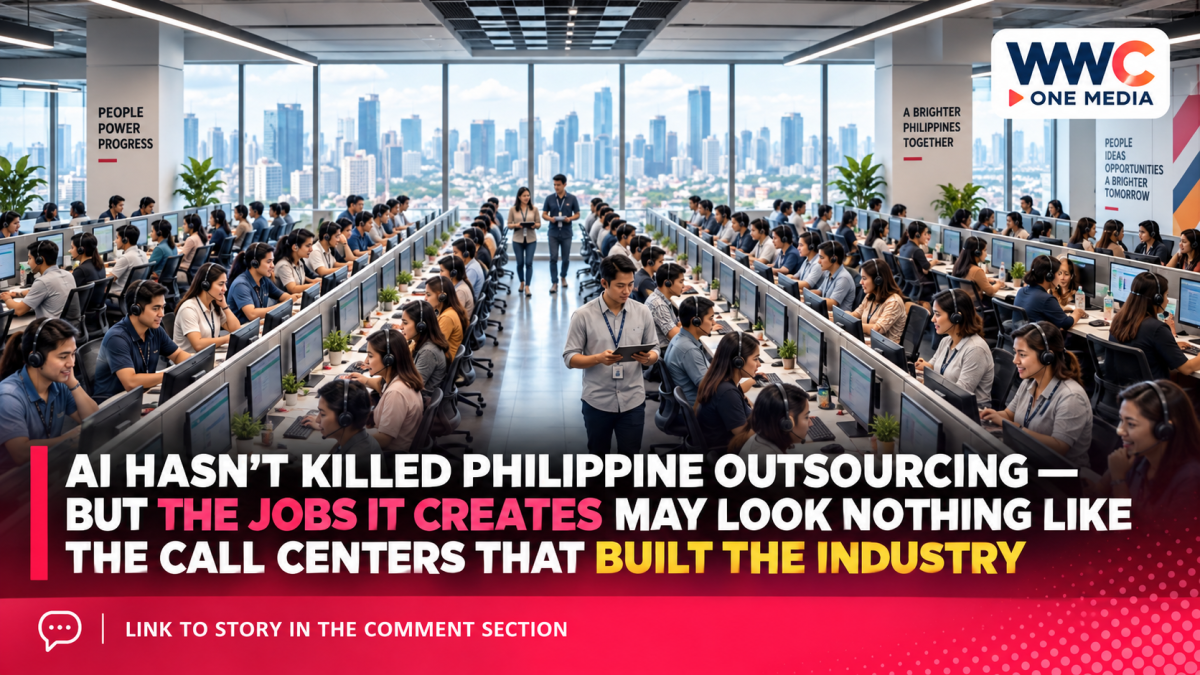
MANILA — For years, one of the most uncomfortable questions hanging over the Philippines’ massive outsourcing industry has been brutally simple:
What happens when artificial intelligence learns to do the work Filipinos were hired to perform?
Customer-support scripts can now be handled by conversational AI.
Software can summarise documents in seconds.
AI systems can review claims, verify information, generate code, draft responses and perform parts of legal, accounting and back-office work that once required armies of employees.
On the surface, that sounds like an existential threat to a Philippine industry employing around 1.9 million people and generating more than US$40 billion in annual revenue.
But the newest data tells a more complicated story.
ING THINK says Philippine outsourcing and digitally delivered services have continued growing despite the explosion of generative AI.
What is changing is not simply the quantity of work.
It is what the Philippines is being paid to do.
Routine processing is becoming easier to automate.
Financial services, software development, analytics, technology, risk work and other higher-value functions are becoming more important.
And the country’s outsourcing machine is gradually moving from a model built around large numbers of relatively standardised jobs toward one in which fewer people may be expected to produce more value with AI sitting beside them.
That transition could preserve one of the Philippines’ most important export industries.
But it may also make the path into that industry much harder for the next generation of workers.
Philippine outsourcing is still growing
ING’s analysis reaches a conclusion that runs against the most dramatic predictions about generative AI:
there is little evidence so far of a broad AI-driven collapse in Philippine services exports.
Combined telecommunications, computer and business-services exports increased to about 7.1% of Philippine GDP by mid-2026, compared with roughly 6.3% before the COVID-19 pandemic.
That is particularly important because outsourcing is not merely a large employer.
It is one of the country’s major sources of foreign currency.
ING estimates telecommunications and business-services exports were worth roughly 7% of GDP in 2025, more than enough to offset a current-account deficit equal to about 3.5% of GDP.
In practical terms, dollars earned by Philippine service companies help support the balance of payments and provide an important recurring source of foreign exchange for the economy.
That makes the AI question much bigger than the future of call-center employment.
It affects the peso, consumer spending, commercial real estate, tax revenues and the financial position of the country itself.
The industry crossed $40 billion anyway
The IT and Business Process Association of the Philippines said the IT-BPM industry generated more than US$40 billion in export revenue in 2025, up around 5% from 2024.
Employment reached approximately 1.9 million workers, up around 4%.
IBPAP said Philippine industry growth exceeded the roughly 3% growth of the global IT-BPM market that year.
So the first years of widespread ChatGPT-style AI adoption did not produce the mass contraction many feared.
Companies still expanded.
Jobs still increased.
Revenue still climbed.
But those headline numbers hide the most important transformation.
The Philippines is selling a different mix of services
ING examined a broader category called digitally delivered services, or DDS.
These are services exported through computer networks and include computer services, finance, consulting, research, management, legal work and other professional or business functions that can be delivered remotely.
Since 2022, Philippine digitally delivered services exports have increased about 24%, according to ING’s analysis of WTO data.
The country’s overall share of the global market has remained broadly stable rather than rising dramatically.
But the mix underneath that total is changing.
Financial-services exports have increased at an average pace of about 25% annually since 2022, according to ING.
Computer services have also expanded strongly.
Traditional business services, meanwhile, have moderated after the surge that followed the pandemic.
That is the real AI story.
The Philippines is not simply losing outsourced tasks.
It is increasingly moving into different ones.
The classic call-center model is under pressure
That does not mean traditional BPO work is safe.
Large language models are particularly good at tasks that are repetitive, text-heavy, structured and governed by predictable rules.
ING specifically points to customer support, document verification, legal review, claims processing and data entry as areas where AI can substantially improve productivity.
Voice systems are also becoming more capable of handling customer-service interactions without a human agent completing every step.
Coding is changing too.
AI assistants can now produce software, debug code, write documentation and automate portions of development work.
A developer may therefore accomplish in one day what previously required substantially more human time.
For outsourcing companies, that is attractive.
For workers whose jobs consist largely of those tasks, it is disruptive.
AI exposure does not mean 25% of Filipino jobs will disappear
This distinction is essential.
International Labour Organization research estimates that roughly 12.7 million Philippine jobs — more than one-quarter of total employment — have some degree of potential exposure to generative AI.
That sounds frightening until the exposure categories are examined more carefully.
Only around 3% to 4% of Philippine jobs fall into the ILO’s highest-exposure category, where automation creates a comparatively elevated risk of outright job displacement.
For most exposed workers, the likely effect is different.
Parts of the job can be automated.
The remaining tasks become more important.
The employee works with AI rather than necessarily disappearing because of it.
The ILO therefore cautions that exposure should not be treated as synonymous with elimination.
Clerical and administrative work faces the greatest pressure
That does not mean the disruption is evenly distributed.
The ILO says clerical support occupations are among those with the highest exposure to generative AI across Southeast Asia.
That matters enormously for the Philippines because much of the country’s outsourcing success was originally built around precisely the kinds of structured processes AI handles increasingly well.
A customer emails a standard complaint.
A document needs categorisation.
A claim needs preliminary review.
A customer asks a frequently answered question.
An employee has to summarise a call.
A record needs information transferred from one system to another.
Historically, thousands of workers could be hired to perform those tasks.
Increasingly, software can perform the first pass.
The human may only handle the difficult exceptions.
One worker can therefore handle more work
That is where the future of headcount becomes complicated.
Suppose AI allows one customer-service agent to manage twice as many interactions.
The company could keep the same workforce and serve twice as many customers.
It could keep the same workload and employ fewer people.
Or it could use the productivity gain to move existing employees into more complicated work.
All three outcomes are possible.
That is why rising revenue does not automatically guarantee equally fast employment growth.
The Philippine industry itself is now acknowledging that reality.
IBPAP quietly lowered its long-term ambitions
In July, IBPAP revised the targets contained in its industry roadmap.
When the roadmap was released in 2022, the sector had aimed for as much as US$59 billion in revenue and 2.5 million jobs by 2028.
Those targets have now been reduced substantially.
Under IBPAP’s new best-case scenario, revenue reaches about US$50.5 billion in 2028.
Under the downside scenario, it reaches only about US$43.3 billion.
Employment ranges from 1.85 million workers in the downside case to 2.14 million in the best case.
Those numbers do not describe an industry expecting to disappear.
But they do describe an industry expecting to create fewer jobs than it once thought it would.
The 2026 target is still growth
For this year, IBPAP expects revenue to reach around US$42.3 billion, up from approximately US$40.3 billion in 2025.
Headcount is expected to rise from 1.9 million to roughly 1.96 million workers.
So the near-term picture remains expansion.
The deeper warning appears further out.
The sector can continue earning more money without adding employees at anything like the historical rate.
That is exactly what AI-driven productivity would be expected to produce.
Revenue per worker may become more important than worker count
IBPAP president and CEO Jack Madrid has described the transition as a move from capacity to capability.
For decades, one measure of Philippine outsourcing success was simple:
How many seats could a company fill?
How many agents could a delivery centre hire?
How many thousands of workers could be assigned to an international account?
Increasingly, the question is how much value each worker can produce.
That means higher revenue per employee may eventually be considered success even when employment expands more slowly.
For shareholders and outsourcing clients, that can be attractive.
For policymakers trying to create hundreds of thousands of middle-class jobs, it presents a much harder challenge.
The Philippines is betting on global capability centers
One major part of the new strategy is the growth of global capability centers, or GCCs.
Unlike a traditional outsourced call centre performing a narrow service contract, a GCC is typically an internal unit established by a multinational company to perform important work for the global organisation.
That can include finance, technology, cybersecurity, analytics, compliance, engineering, risk management and product development.
IBPAP says the Philippines now hosts around 200 such centers, with roughly 10 more being added annually.
These jobs are often much closer to a multinational company’s core operations than traditional outsourced customer support.
They can also require deeper technical and professional expertise.
ING itself provides a useful example
ING Hubs Philippines illustrates the shift.
The banking group’s Manila operation says it is moving beyond execution toward end-to-end ownership of global banking technology platforms used across more than 40 countries.
Its local technology workforce exceeds 1,800 employees, and the company said earlier this year that it expected that workforce to grow by about 20% over the following 12 to 24 months.
Its employees support payments, digital channels, lending, investments, regulatory systems, wholesale banking and shared risk-and-finance platforms.
That is outsourcing in a broad sense.
But it bears little resemblance to the stereotype of an agent reading from a script at 2am.
AI is being deployed inside those operations too
ING Hubs said it has already been using automation to reduce some tasks that previously took around 30 minutes to a matter of seconds.
Employees have also piloted AI tools for content drafting and data analysis, while the company says it is simultaneously expanding workforce training.
More than 5,000 employees completed skills programmes during 2025, according to the company.
Its stated strategy is not to preserve every old task.
It is to eliminate low-value work while training employees to handle what remains.
That approach is likely to become increasingly common.
Other Philippine BPO companies are already doing the same thing
Concentrix has introduced AI systems that work alongside customer-service employees by transcribing conversations, retrieving information, reducing background noise, summarising calls and providing coaching suggestions.
The employee remains in the process.
But the software performs more of the surrounding work.
TELUS Digital Philippines has similarly described its AI strategy as augmentation rather than wholesale replacement, combining automation with training and internal mobility programmes.
The immediate effect is not necessarily an empty call-centre floor.
It can simply mean fewer people are needed to handle the same number of customer interactions.
Some companies have already downsized
The optimistic narrative therefore needs a qualification.
At a Philippine Senate hearing in February, industry participants acknowledged that some companies had reduced staff because client demand for particular services had declined as AI automation expanded.
Amazon Web Services representatives urged the Philippine sector to move aggressively into agentic AI and redesign business processes rather than simply defend old workflows.
That is important evidence because it shows that displacement is not merely theoretical.
Some tasks and positions are already disappearing.
The reason the overall industry has not contracted is that growth elsewhere has so far offset those losses.
The most vulnerable worker may be the beginner
This creates another problem.
AI often automates the easiest work first.
But easy work is traditionally how people enter an industry.
A new graduate may start by handling basic customer interactions.
A junior programmer writes relatively simple code.
A young analyst performs repetitive research.
An entry-level finance worker checks documents.
Those jobs provide training.
Over time, workers gain experience and move into harder roles.
If AI removes a large portion of that first rung, companies may still need senior workers later — while hiring fewer beginners today.
The ILO’s review of emerging evidence warns that one potential risk of generative AI is an erosion of opportunities for younger workers even where overall employment remains relatively stable.
That could become one of the defining labor-market questions of the AI era.
A country cannot create senior analysts without first creating junior analysts
That is the paradox.
The industry says it needs more workers with advanced skills.
But advanced workers are usually produced through experience.
If companies automate much of the basic work through which employees historically gained that experience, the talent pipeline has to be redesigned.
Universities may need to teach more applied technical skills.
Companies may need stronger apprenticeship programmes.
Employees may have to learn AI tools before they are hired rather than after.
And businesses may have to create new entry pathways that do not depend on repetitive work surviving indefinitely.
The latest employment data is mixed
ING says the closest available employment proxy — combining information and communications with professional, scientific and technical services — was roughly 4.5% higher over the year in the period it analysed.
That supported its conclusion that broad employment had not yet suffered an AI shock.
But the Philippine Statistics Authority’s latest July 2026 labor survey provides a more cautious snapshot.
Compared with July 2025, employment in information and communication fell by about 41,000, while professional, scientific and technical activities declined by around 28,000.
At the same time, administrative and support services — which capture other types of business-service employment — increased by around 201,000.
That does not prove AI caused any of these movements.
Monthly and annual labor-force figures fluctuate for many reasons.
But it reinforces the idea that the transition is uneven rather than uniformly positive or negative.
The word “BPO” is becoming less useful
The Philippine industry still gets called BPO because that is how it became famous.
But today’s sector increasingly includes:
software engineering;
healthcare information management;
banking operations;
fraud detection;
financial analysis;
legal support;
cybersecurity;
data science;
cloud engineering;
risk management;
artificial intelligence;
and research.
IBPAP itself uses the broader label IT-BPM, or information technology and business process management.
That change in terminology reflects a genuine change in the work.
The industry is trying to avoid being defined solely by voice calls and back-office processing.
Finance may become one of the Philippines’ biggest opportunities
ING’s data makes financial services particularly interesting.
Exports in the category have been expanding at roughly 25% annually since 2022.
The Philippines already hosts large operations belonging to international banks and financial companies.
Those centres can handle everything from customer operations to anti-money-laundering reviews, risk models, regulatory reporting, software systems and institutional banking support.
AI can automate portions of that work.
But financial institutions also operate under strict regulatory, security and accountability requirements.
Human judgment remains particularly important when errors can create financial, legal or compliance consequences.
That creates space for a hybrid model in which AI handles volume while workers take responsibility for difficult decisions.
Computer services provide another escape route
Computer services are also becoming more important in Philippine exports.
That gives the country another way to move up the outsourcing chain.
Instead of supplying only customer-service agents to a U.S. corporation, the Philippines can provide:
software engineers;
cloud specialists;
cybersecurity professionals;
data engineers;
AI implementation teams;
and platform managers.
These jobs tend to require more training.
They may also produce more revenue per employee.
That aligns directly with IBPAP’s strategy of shifting the industry toward higher-value work.
But AI can automate coding too
Moving into software is not an automatic escape from AI disruption.
ING notes that AI-assisted coding tools are making software development faster and less labor-intensive.
So the race does not end once workers move out of call centres.
AI follows them into programming.
The same logic then applies.
A developer who merely converts clear instructions into basic code faces more pressure.
A developer who designs architectures, understands business requirements, verifies security, tests complex systems and manages AI-generated code may become more valuable.
The skill premium moves upward again.
The Philippines still has several structural advantages
AI does not erase everything that made the country successful in outsourcing.
The Philippines still has a large English-speaking labor force.
It has decades of experience managing global client operations.
It has established business districts, training systems and management talent.
And multinational companies already have extensive relationships with Philippine providers.
ING estimates the country accounts for roughly 15% to 17% of the global BPO market.
That installed base matters.
Companies do not relocate complex operations every time a new technology appears.
But competitors are improving too.
India is adapting faster in some higher-value areas
ING’s comparison with India is revealing.
India’s digitally delivered services exports have increased about 45% since 2022, significantly faster than the Philippines’ 24% increase.
India has also gained global market share, helped by strong growth in business services and large global capability centers.
The Philippines, by contrast, has largely maintained its global share while changing its internal export mix.
That means the country is adapting.
But it is not necessarily winning the transition.
Competitors are moving at the same time.
And there are more competitors than India
IBPAP says countries including South Africa, Egypt, Poland, Colombia, Costa Rica and Vietnam are increasingly competing for global service investments.
Some offer lower costs.
Others offer specialised technical talent.
Some are geographically closer to major customers.
Others provide multilingual workforces.
AI can make those smaller markets more competitive because technology helps workers overcome differences in language, productivity or scale.
The Philippines therefore cannot depend indefinitely on advantages that made it dominant 15 or 20 years ago.
The industry has already cut its forecast because of more than AI
It would also be inaccurate to blame the entire reduction in IBPAP’s 2028 forecast on artificial intelligence.
Madrid cited several pressures:
AI;
global competition;
geopolitical uncertainty;
changing buyer behaviour;
infrastructure;
talent depth;
and the ease of doing business.
Global companies have also become slower about deciding where to locate investments.
So AI is one major variable in a much larger competitiveness problem.
The Philippines needs skilled workers.
It also needs dependable power, strong telecom infrastructure, cybersecurity, predictable regulation and efficient local government.
The stakes are larger than employment
The industry’s economic role makes failure unusually expensive.
ING estimates Philippine telecom and business-services exports were worth around 7% of GDP in 2025.
IBPAP says the broader IT-BPM sector directly employs around 1.9 million workers and generates more than US$40 billion annually.
Those salaries support restaurants, condominiums, retail centres, transportation, education and household consumption.
BPO offices anchor entire business districts in Metro Manila, Cebu, Clark, Iloilo, Bacolod and other cities.
A major employment shock would therefore spread far beyond the employees directly affected.
AI could also make Philippine outsourcing bigger
There is another possibility that often disappears from the discussion.
Automation can reduce the price of outsourcing.
If AI allows a Philippine company to complete a service faster and cheaper, global clients may buy more of that service.
Tasks that were previously too expensive to outsource may become commercially viable.
Small companies that could not afford large outsourcing contracts may start purchasing AI-assisted services.
Entirely new products may emerge.
That is one reason productivity improvements do not automatically translate into lower total employment.
Demand can expand in response to falling costs.
ING’s current data suggests this may already be happening in parts of the services sector.
The WTO expects AI to expand global trade
The World Trade Organization’s latest modelling suggests AI could substantially increase cross-border commerce over the longer term.
Its 2026 World Trade Report estimates artificial intelligence could increase global trade by as much as 40% by 2040, with some of the largest gains occurring in digitally deliverable services.
That could be exceptionally important for the Philippines.
The country already specialises in exactly the type of service that can be delivered digitally across borders.
So AI represents two opposing forces at once.
It makes parts of Philippine labor easier to replace.
It also expands the global market for digitally delivered work.
The outcome depends on whether the Philippines moves into the expanding categories fast enough.
The real competition is no longer human versus AI
For Philippine workers, that framing may already be outdated.
The more realistic competition is increasingly:
a worker using AI versus a worker who does not.
An accountant with AI can process more information.
A programmer with AI can write and test code faster.
A customer-service employee with AI can retrieve answers immediately.
A lawyer with AI can search documents more efficiently.
A healthcare analyst can summarise records faster.
That creates productivity gains without eliminating the human role.
But it also raises the minimum standard expected from every employee.
Two million “AI-enabled” workers is now the industry’s goal
IBPAP says it wants to build a workforce of around two million AI-enabled digital Filipino workers by 2028.
That wording captures the strategy.
The industry is no longer promising simply to employ as many people as possible.
It is trying to make the workforce valuable enough that global companies continue sending work to the Philippines even when machines can perform more of it.
That requires retraining on a scale far larger than installing ChatGPT accounts in an office.
Workers need domain knowledge.
They need data literacy.
They need to know when AI is wrong.
They need cybersecurity awareness.
They need communication and judgment skills that complement automation.
And some will need to move into entirely different occupations.
There will still be casualties
The data does not justify a claim that AI will wipe out Philippine outsourcing.
It also does not justify saying everyone will be fine.
Certain jobs will disappear.
Some companies will need fewer workers.
Entry-level hiring may slow.
Workers whose tasks remain easy to automate may struggle to maintain bargaining power.
IBPAP’s reduced 2028 employment targets are themselves evidence that the industry no longer expects headcount to expand at the pace imagined only four years ago.
The ILO similarly argues that the policy response should combine skills investment with protections for the groups most exposed to disruption, particularly women and young workers.
But the $40-billion engine is not disappearing
At least not yet.
That is the most important conclusion from the latest evidence.
Exports are growing.
Revenue is growing.
The sector is still hiring.
Digitally delivered services have expanded.
Financial and computer services are gaining importance.
Global capability centers are growing.
And the country remains one of the world’s biggest destinations for offshore business services.
What is disappearing is something more subtle:
the assumption that growth in outsourcing automatically means hiring enormous numbers of people to perform repetitive work.
The next phase could involve more revenue with fewer new employees.
More technology.
More specialised work.
Higher productivity.
And a much higher skills barrier for Filipinos hoping to enter the industry.
For two decades, the Philippines built one of the world’s great outsourcing industries by proving that Filipino workers could perform global business processes at scale.
AI is not necessarily ending that model.
It is forcing the Philippines to prove something harder: that its workers can move up the value chain faster than machines move into the jobs below them.


Leave a Reply