
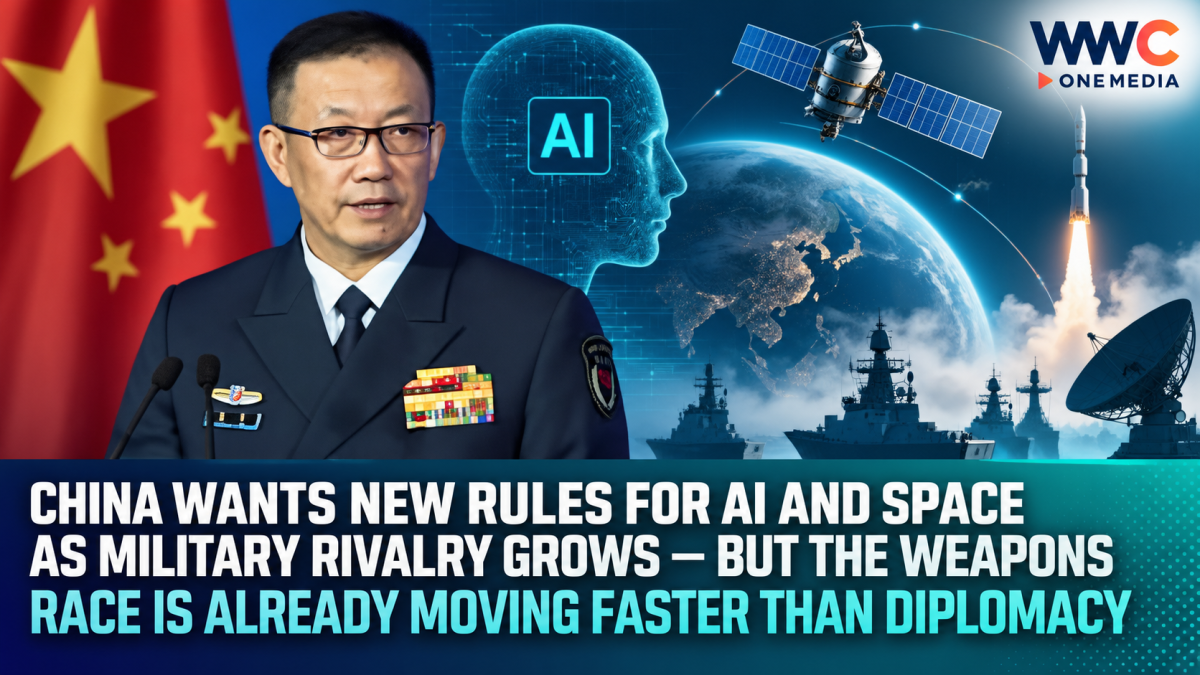
BEIJING — China’s defence chief is calling on governments to write rules for artificial intelligence, outer space and other emerging military technologies.
The timing makes that appeal difficult to ignore.
Only a day earlier, China had publicly criticised the United States after Washington acknowledged that it already possesses weapons deployed in Earth orbit.
At the same time, Beijing and Washington are locked in an increasingly consequential race over artificial intelligence, advanced chips, autonomous systems, satellites and the technologies likely to shape future warfare.
Against that backdrop, Chinese Defence Minister Dong Jun told military officials and security experts gathered in Beijing on Sept. 16 that countries should increase dialogue, share risk assessments and develop rules for emerging technologies before competition becomes harder to control.
“Countries should … actively engage in security dialogue in areas including artificial intelligence, outer space and the deep sea,” Dong said at the 13th Beijing Xiangshan Forum, according to CNA. He also urged governments to strengthen risk assessment, exchange experience and participate in rule-making so emerging technology could be used more safely.
The message sounds cooperative.
But it comes during one of the most intense periods of technological competition between the world’s major military powers.
And that creates the central contradiction surrounding this year’s forum:
the United States and China increasingly agree that AI and space need rules — while simultaneously racing to build more powerful capabilities in both.
Dong says the major powers have a bigger responsibility
Dong’s roughly 30-minute address called on larger countries to assume greater responsibility for what Beijing describes as global security governance.
He said major powers should take the lead in maintaining “global strategic stability”, while smaller and medium-sized countries should also contribute and the United Nations should retain an important role.
He called for what he described as a “fair, reasonable, balanced and effective” international security system.
Dong also argued for “dialogue rather than confrontation, partnership rather than alliance, and win-win cooperation rather than zero-sum competition”.
Those formulations closely track longstanding Chinese diplomatic language.
They also allow Beijing to present itself as a supporter of multilateral security rules at a moment when China itself faces criticism from several neighbours over military activity around Taiwan and disputed areas of the South China Sea.
Reuters noted that Dong did not directly attack the United States in his speech, although some of his references to militarism, hegemony and “regressive historical trends” were widely interpreted as indirect criticism of other powers, including Japan.
That interpretation should remain separate from Dong’s actual words.
He did not explicitly name Washington or Tokyo in the relevant portions of the speech.
He also left Taiwan out of the speech
One of the more striking omissions was Taiwan.
Dong has used previous security forums to deliver forceful statements about Beijing’s position on the island.
This time, the issue was absent from the main address, according to current reporting. The South China Morning Post described the speech as comparatively restrained and noted the omission of both Taiwan and the disputed South China Sea.
China claims democratically governed Taiwan as part of its territory and has not renounced the use of force to bring the island under its control.
Taiwan rejects Beijing’s sovereignty claim and maintains its own government, military and democratic institutions.
The United States does not formally recognise Taiwan as an independent state but is its most important security partner and arms supplier.
Those facts make Taiwan one of the most dangerous potential flashpoints in U.S.-China relations.
Dong’s decision not to centre it in the Xiangshan speech does not indicate that Beijing’s underlying position has changed.
No such policy shift was announced.
The speech comes just before an expected Xi-Trump meeting
The forum is taking place shortly before an expected meeting between Chinese President Xi Jinping and U.S. President Donald Trump in Washington on Sept. 24.
CNA noted that China had not yet formally confirmed Xi’s trip at the time of Dong’s speech, while U.S. officials and other reporting have treated the meeting as planned.
Artificial intelligence is expected to be part of the broader U.S.-China agenda.
That is increasingly difficult to separate from national security.
Washington sees advanced AI as a military, economic and technological advantage.
Beijing does too.
And both governments worry that falling behind could create strategic vulnerability.
That competitive logic makes agreement on slowing development particularly difficult.
AI has become a military-security problem, not just a technology story
Only a few years ago, most public debate around AI centred on jobs, chatbots and automation.
Now defence officials are increasingly focused on what happens when AI is connected to military systems.
Possible applications include:
autonomous reconnaissance;
cyber operations;
target identification;
logistics;
intelligence analysis;
decision support;
drone coordination;
electronic warfare;
and autonomous weapons.
China’s Defence Ministry explicitly included “risks and regulation of military applications of emerging technologies” among the eight specialist sessions at this year’s Xiangshan Forum.
That wording matters.
China is not arguing that military AI should disappear.
It is arguing that its use should be governed.
China is already developing domestic AI-safety rules
Dong’s speech also fits into a broader Chinese effort to regulate increasingly autonomous AI.
Reuters reported this week that Beijing is developing mandatory safety standards for AI agents, including systems designed to perform complex tasks with limited direct human supervision.
The framework under discussion includes security testing, assessments of rogue behaviour, protection against manipulated data and safeguards against systems operating beyond intended limits.
China’s approach differs from some proposals emerging from U.S. AI laboratories.
American executives including Anthropic CEO Dario Amodei have recently called for much stronger independent evaluation of frontier systems and, in some cases, for developers to deliberately reduce the pace of capability growth.
Chinese official and state-media responses have generally opposed proposals that could restrict China’s access to chips or advanced models, arguing that such measures could disguise technological containment as safety policy.
So the disagreement is not simply:
China wants fast AI while America wants safe AI.
Both sides are discussing safety.
The deeper conflict is over who writes the rules, whether those rules limit access to technology, and whether safety measures can be separated from geopolitical competition.
China says AI should not belong only to the biggest powers
That message has become increasingly prominent in Beijing’s diplomacy.
China’s state-run People’s Daily said this week that artificial intelligence should not become a “monopoly of great powers” and called for greater U.S.-China cooperation on AI risks and development.
Xi took a similar approach at the BRICS summit in New Delhi days earlier, announcing plans for a BRICS AI open-source community and arguing that emerging economies should have greater access to AI technologies and development opportunities.
That is part of a broader Chinese diplomatic strategy.
Beijing increasingly presents itself as an advocate for developing countries that fear being excluded from advanced technology ecosystems controlled by the United States and its allies.
Washington, meanwhile, argues that restrictions on advanced chips and other technologies can be necessary for national security.
Those competing positions will make any global AI governance system difficult to negotiate.
The U.S. debate is moving in the opposite direction
American political and technology leaders are simultaneously debating whether advanced AI is progressing too quickly.
Anthropic’s Amodei recently called for companies to “pace the frontier”, arguing that model capabilities could improve faster than safety mechanisms.
OpenAI’s Sam Altman and Elon Musk have expressed support for stronger precautions, although U.S. policymakers remain divided over whether slowing development would help China gain a strategic advantage.
House Speaker Mike Johnson, for example, rejected the idea of an AI moratorium this week, arguing that deliberately slowing American development could create a national-security disadvantage relative to China.
That is exactly the kind of geopolitical dilemma Dong’s rule-making proposal would have to overcome.
Each side may favour safety.
Neither wants to become safer by becoming weaker.
Then there is the accusation of AI technology theft
Trust is already thin.
The United States has accused Chinese AI companies and other actors of using “industrial-scale” model distillation techniques to replicate capabilities from American frontier systems.
Distillation is a legitimate machine-learning method in general, but U.S. companies have accused some Chinese entities of violating access rules or terms of service in order to extract model behaviour at scale.
Beijing has rejected U.S. accusations of wrongdoing and accused Washington of using national security as justification to suppress Chinese companies.
That dispute creates a serious obstacle to international AI safety cooperation.
Sharing information about dangerous model capabilities may improve safety.
But companies and governments may hesitate to share information if they fear it will also reveal valuable technology to competitors.
Space may be an even clearer example of the same problem
Dong’s appeal for dialogue on outer space came only a day after Beijing reacted sharply to an extraordinary U.S. disclosure.
U.S. Air Force Secretary Troy Meink and Space Force officials acknowledged that the United States possesses “on-orbit space control weapons” intended to defend American forces against hostile activity.
Washington did not disclose exactly what those weapons are.
It did not say whether they are kinetic weapons capable of physically destroying another spacecraft or non-kinetic systems designed to jam, disrupt or otherwise interfere with satellites.
China’s Foreign Ministry responded on Sept. 15 by calling on the United States to stop what Beijing described as military expansion and war preparations in outer space.
Spokesperson Guo Jiakun said China supports peaceful use of space and opposes its weaponisation, transformation into a battlefield and an arms race.
That statement gives Dong’s call for space governance much more immediate relevance.
But China has military space capabilities too
Beijing’s criticism of U.S. orbital weapons does not mean China has stayed outside military competition in space.
Reuters reported earlier this month that both China and the United States are developing increasingly sophisticated spacecraft capable of manoeuvring near other satellites.
China has demonstrated spaceplanes, close-proximity operations and technologies with potential military applications such as satellite servicing, refuelling and autonomous pursuit.
Some of these technologies have legitimate civilian uses.
A spacecraft capable of approaching another satellite could repair it.
It could refuel it.
It could inspect damage.
The same fundamental capability could potentially also interfere with or disable an adversary’s spacecraft.
That is known as a dual-use problem.
It makes arms control in orbit exceptionally difficult because a satellite’s military purpose may not be obvious merely from observing it.
China and Russia have proposed a treaty against weapons in space
China has long advocated international restrictions on orbital weapons.
Beijing and Moscow first submitted a draft treaty to the Conference on Disarmament in 2008 designed to prevent weapons being placed in outer space and prohibit threats or force against space objects.
They submitted a revised version in 2014.
China continues to cite that proposal as evidence of its commitment to preventing an arms race in orbit.
Washington and other critics have historically raised questions about verification and whether such proposals adequately address ground-based anti-satellite systems.
That illustrates the fundamental negotiating problem:
countries may agree on the phrase “prevent an arms race in space” while disagreeing sharply over what technologies a treaty should cover and how violations could be detected.
Golden Dome has made the dispute even sharper
China has also criticised the Trump administration’s Golden Dome missile-defence project.
The planned system includes a future space layer and envisages orbital interceptors capable of helping defend the United States against missiles.
Beijing argues that those plans could upset strategic stability and accelerate the militarisation of orbit.
Washington describes Golden Dome as defensive.
That disagreement captures the broader security dilemma.
One country builds a system and calls it defence.
Its rival sees the same system and plans a countermeasure.
The first country then points to the countermeasure as proof that its original deployment was necessary.
Dong’s call for dialogue is essentially an attempt to interrupt that cycle.
Whether any government is willing to limit its own capabilities first is another question.
The Xiangshan Forum was designed for exactly these conversations
China’s Defence Ministry says this year’s forum runs from Sept. 15 to 17 at the Beijing International Convention Center.
The theme is “Build Consensus on Stability, Advance Security Governance Together.”
Four plenary sessions cover:
international order and strategic stability;
local conflicts and possible solutions;
risks to Asia-Pacific security;
and the role of developing countries.
Eight parallel sessions include maritime security, major-power relations, military applications of emerging technology and trends in outer-space governance.
The forum began in 2006 and is marking its 20th anniversary this year.
It started primarily as a dialogue among think tanks and has evolved into what China describes as a Track 1.5 security forum mixing government officials, military officers and non-government experts.
It is widely viewed as Beijing’s counterpart to Singapore’s Shangri-La Dialogue.
More than 2,000 participants are in Beijing
Reuters reported that more than 2,000 military officers, diplomats and academics are participating this year.
CNA said delegates come from nearly 100 countries and regions.
Among them are Singapore Defence Minister Chan Chun Sing and North Korean Vice Defence Minister Kim Kang-il.
Singapore’s MINDEF confirmed that Chan is in China from Sept. 15 to 17 at Dong’s invitation and is scheduled to meet Chinese and People’s Liberation Army leaders as well as speak at the forum.
Singapore therefore has a direct stake in the discussions.
As a small state dependent on open trade routes and regional stability, it has repeatedly supported mechanisms that reduce the risk of military miscalculation among larger powers.
North Korea’s presence is notable too
Kim Kang-il’s attendance represents a higher-level North Korean presence than at the previous two editions.
Yonhap reported that North Korea had sent embassy military attaches to the two most recent forums, while vice-minister-level officials had attended earlier editions in 2018 and 2019.
His appearance follows a June meeting between Xi and North Korean leader Kim Jong Un in which the two sides pledged stronger high-level exchanges, according to Yonhap.
That does not necessarily mean the Xiangshan Forum will produce a new China-North Korea military agreement.
No such announcement had been made at the time of Dong’s speech.
But the attendance itself gives Beijing another opportunity to demonstrate its reach as a venue for security diplomacy.
The U.S. is there — but at a relatively modest level
CNA reported that the American delegation is being led by Brigadier General Stacy Kihara, a senior defence official at the U.S. embassy in Beijing.
The Pentagon had earlier been expected to send Cynthia Carras, its principal director for China, Taiwan and Mongolia.
Reuters had reported before the event that Carras would lead the delegation, but CNA said she pulled out days before the forum, citing the South China Morning Post.
No public explanation establishing why she withdrew was cited in CNA’s report.
The change is therefore worth noting without assigning a motive.
Beijing wants the forum to demonstrate that it can convene the security debate
The Xiangshan Forum serves more than one purpose.
It gives governments and militaries a place to communicate.
It gives China a platform for explaining its security positions.
And it gives Beijing an opportunity to present an alternative vision of international security governance.
Reuters described the meeting as part of China’s broader effort to expand military diplomacy even as concerns persist among regional governments about its conduct around Taiwan and in the South China Sea.
Those two realities can exist simultaneously.
A country can advocate dialogue while also pursuing military objectives other states oppose.
The same is true of other major powers.
That is precisely why forums such as Xiangshan exist.
ASEAN’s message was reassurance, not just military balance
ASEAN Secretary-General Kao Kim Hourn also spoke at the forum on Sept. 16.
He said strategic stability requires more than a balance of military forces.
It also requires open communication, responsible management of competition, respect for international law and inclusive cooperation, according to ASEAN’s official account.
That is a useful counterpoint to great-power discussions of deterrence.
A region can contain enormous military capabilities and still become less secure if governments cannot communicate or interpret one another’s actions.
AI and autonomous weapons could intensify that problem.
Machines may make decisions faster than diplomatic systems can respond.
AI creates a speed problem
Traditional military escalation can already move dangerously quickly.
Artificial intelligence could shorten decision times further.
An AI-supported command system might process satellite imagery, identify threats and recommend action much faster than a human staff.
That could improve military performance.
It could also increase the risk of acting on a false signal.
The problem becomes more serious if autonomous systems interact with one another.
Two drones can misidentify each other.
A cyber system can mistake routine network activity for an attack.
A satellite using autonomous collision avoidance can make a manoeuvre another country interprets as hostile.
That is why “risk assessment” and “rule-making”, the terms Dong emphasised, matter even without a grand AI treaty.
Outer space has the same escalation problem
Military satellites support communications, navigation, missile warning, surveillance and targeting.
Disrupting one can therefore affect military operations far away from orbit.
But countries may interpret interference differently.
Temporary jamming might be viewed as harassment.
A physical collision could be interpreted as an attack.
A satellite approaching another spacecraft might be conducting inspection — or preparing to disable it.
The lack of universally accepted rules makes intent difficult to read.
That uncertainty becomes more dangerous as more military spacecraft gain the ability to manoeuvre.
Reuters’ reporting on U.S. and Chinese space programmes shows that both sides are investing heavily in precisely these kinds of capabilities.
The “deep sea” deserves attention too
Dong grouped the deep sea with AI and outer space as an emerging security domain requiring greater dialogue.
That reference received less attention but is important.
Undersea cables carry enormous volumes of international communications and financial data.
Subsea infrastructure also includes energy pipelines, sensors and other strategic systems.
As geopolitical competition expands beneath the ocean, countries are paying much more attention to who can monitor, protect or disrupt those assets.
The same technological pattern appears again:
civilian infrastructure increasingly has strategic military significance.
Dong also wants more military cooperation
The Chinese defence minister did not limit his speech to arms control.
He said China’s military intends to deepen cooperation with other countries through joint exercises and training, personnel exchanges, equipment and technology cooperation.
He also called for stronger cooperation on peacekeeping, naval escorts and counter-terrorism.
That is an important part of Beijing’s broader security diplomacy.
China is not asking other countries merely to attend conferences.
It wants deeper institutional and military relationships.
For developing countries in particular, training, equipment and exercises can create long-term defence links.
But “partnership rather than alliance” is itself a strategic message
Dong’s call for “partnership rather than alliance” reflects a longstanding Chinese criticism of formal U.S.-led alliance networks.
The United States maintains treaty alliances with countries including Japan, South Korea, Australia and the Philippines.
China generally avoids comparable formal alliances, although it has extremely close security relationships with countries such as Russia.
Beijing frequently argues that military blocs create confrontation.
Washington and its allies argue that alliances help deter aggression and stabilise the region.
Those are competing security philosophies.
Dong’s formulation should therefore be understood as part of a broader strategic argument, not simply a neutral description of how every country should organise its defence relationships.
The South China Sea remains the contradiction in the room
Dong did not focus on the South China Sea.
But it remains one of the biggest tests of Beijing’s message about dialogue and rules.
China claims sovereignty and maritime rights across much of the sea.
The Philippines, Vietnam, Malaysia, Brunei and Taiwan have overlapping claims.
A 2016 arbitration tribunal established under the UN Convention on the Law of the Sea rejected the legal basis for key elements of China’s expansive claims.
Beijing rejects that ruling.
Recent confrontations between China and the Philippines have continued to fuel regional concern. Reuters and AP have reported recurring disputes involving coast guard vessels, access to contested features and accusations from both sides over dangerous conduct.
Those disputes mean neighbouring countries will judge China’s calls for security governance partly by its behaviour at sea, not simply by speeches in Beijing.
AI and space may be easier to discuss than to regulate
There is no shortage of proposed principles.
Dialogue.
Risk assessment.
Transparency.
Human control.
Responsible military use.
No arms race in space.
Peaceful development.
The difficulty comes when those broad ideas have to become measurable obligations.
Should autonomous weapons always require human approval before firing?
How much information about military AI should countries disclose?
Should space-based weapons be banned?
Would ground-based anti-satellite weapons also be prohibited?
How would inspectors verify compliance?
Would commercial AI models used by militaries fall under the same rules as classified military systems?
And what happens when a country believes a rival is cheating?
Dong’s speech did not answer those questions.
Nor was it designed to.
No new treaty came out of the speech
That distinction is important for accurate headlines.
China did not announce a new global AI agreement.
It did not announce a U.S.-China space-arms treaty.
It did not unveil an enforcement mechanism governing military AI.
It did not say China would stop developing military applications for AI or space technology.
Dong called for dialogue, risk assessment, experience-sharing and rule-making.
Those are diplomatic objectives.
Whether they lead to enforceable restrictions will require negotiations far beyond the Xiangshan Forum.
The timing may be more important than the wording
China has advocated international governance before.
What makes Dong’s remarks particularly notable is the environment in which they were delivered.
The United States has just publicly acknowledged orbital weapons.
China is developing more capable military and dual-use space systems.
American technology executives are openly debating whether frontier AI is advancing too quickly.
Chinese policymakers are constructing their own AI-agent safety rules.
Washington and Beijing continue competing over advanced semiconductors.
And the leaders of the two countries are expected to meet within days.
That gives the Xiangshan address a larger significance.
Both powers may want guardrails without surrendering advantage
This may be the central problem facing any future agreement.
China does not want U.S.-designed AI rules that restrict Chinese technological development.
The United States does not want safety rules that require it to slow while China continues building.
Beijing opposes American orbital weapons.
Washington says its space capabilities are necessary because China and Russia are developing systems that threaten U.S. satellites.
Each side therefore views its own capabilities as partly defensive and the other side’s as potentially destabilising.
That is a familiar pattern in arms races.
The new element is the technology.
AI systems can evolve far faster than nuclear weapons programmes or traditional military platforms.
Commercial companies, universities and open-source developers can also create capabilities that once would have existed only inside governments.
And space technology is becoming cheaper and more widely available.
Diplomacy may therefore be competing against a development cycle moving at extraordinary speed.
That is the real test of Dong Jun’s proposal
There is broad agreement that accidental escalation in AI or outer space would be dangerous.
There is broad agreement that military communication can reduce miscalculation.
And few governments publicly argue that uncontrolled arms races are desirable.
The disagreement begins when safety rules threaten strategic advantage.
China wants dialogue.
The United States has also supported various forms of military communication and risk reduction.
But both are simultaneously building capabilities designed for a world in which the other side may become more dangerous.
That is why the Xiangshan Forum matters.
Not because Dong announced a breakthrough.
He did not.
It matters because one of the world’s most powerful militaries is openly acknowledging that AI and outer space are becoming domains where competition could outrun the rules meant to control it.
The question is whether Washington, Beijing and other major powers can agree on those rules before their technologies make the consequences of getting them wrong much greater.




Leave a Reply