
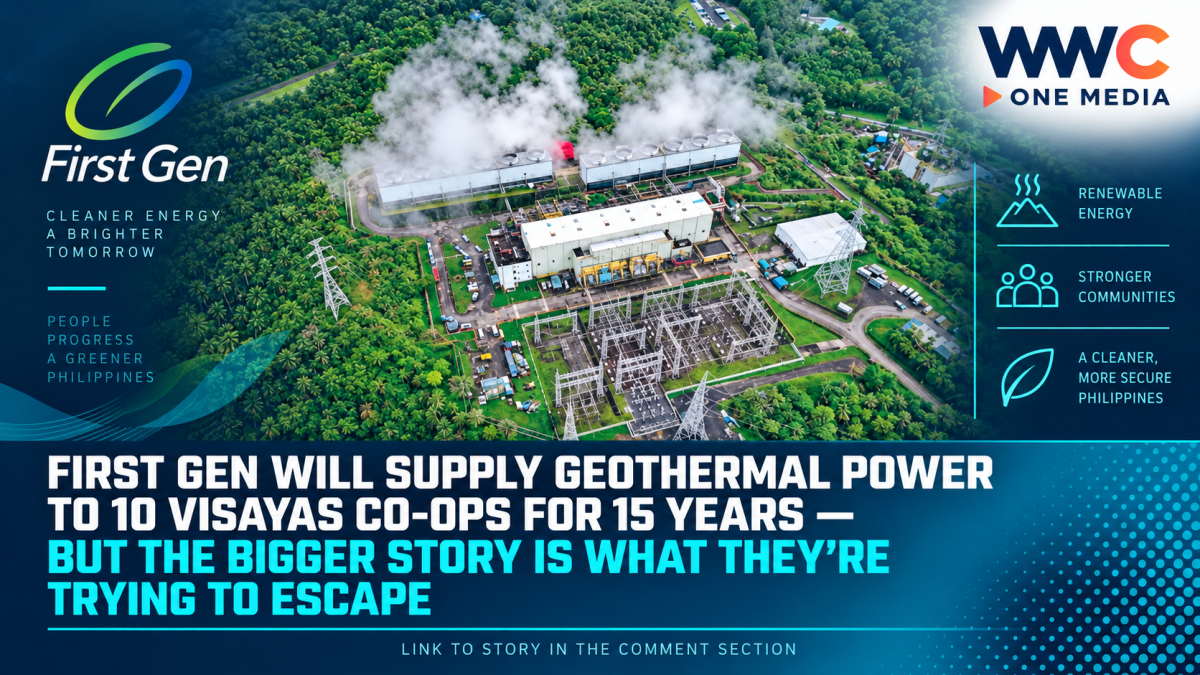
MANILA — Ten electric cooperatives across the Visayas have signed long-term agreements for geothermal electricity from the First Gen Group, locking in a round-the-clock renewable source at a moment when the region is struggling with repeated grid alerts, power-plant outages and exposure to volatile generation costs.
First Gen, through subsidiary Energy Development Corp., or EDC, will supply more than 24 megawatts of baseload geothermal power under 15-year power supply agreements secured through a government-supervised competitive bidding process.
The electricity will come from EDC’s Unified Leyte geothermal facilities, one of the country’s largest concentrations of geothermal generation.
The 10 cooperatives are:
Capiz Electric Cooperative (CAPELCO);
Cebu I Electric Cooperative (CEBECO I);
Cebu II Electric Cooperative (CEBECO II);
Guimaras Electric Cooperative (GUIMELCO);
Iloilo I Electric Cooperative (ILECO I);
Iloilo II Electric Cooperative (ILECO II);
Iloilo III Electric Cooperative (ILECO III);
Negros Occidental Electric Cooperative (NOCECO);
Negros Oriental I Electric Cooperative (NORECO I); and
Negros Oriental II Electric Cooperative (NORECO II).
The agreement sounds straightforward.
Ten utilities buy renewable electricity.
First Gen sells geothermal power.
Consumers get a more predictable energy source.
But the timing gives the deal much greater significance.
The Visayas grid has repeatedly entered red and yellow alert conditions during September, with several coal-fired units unavailable and hundreds of megawatts of generating capacity lost to outages and derating.
So the real attraction of geothermal may not simply be that it is renewable.
It is that, unlike solar and wind, it can produce electricity continuously — day and night, regardless of whether the sun is shining or the wind is blowing.
The 24 MW deal is part of something much bigger
First Gen did not independently negotiate the entire Visayas requirement.
The contracts were awarded through the Luzon and Visayas Electric Cooperatives Aggregation, or LVECA, a joint purchasing programme involving 29 electric cooperatives.
Nineteen are in Luzon.
Ten are in the Visayas.
Together, the cooperatives pooled their requirements and conducted one competitive selection process supervised by the National Electrification Administration.
The idea is simple.
One small cooperative negotiating alone may have limited bargaining power with large power producers.
Twenty-nine cooperatives negotiating as an aggregated bloc represent a much larger customer.
That can create economies of scale and potentially improve commercial terms.
NORECO II general manager Fe Marie Dicen-Tagle described the approach as more than a routine electricity procurement exercise, saying aggregation strengthened the cooperatives’ negotiating position and helped them pursue dependable and sustainable supply.
The full Visayas requirement is 120.5 MW
This is an important detail because the First Gen announcement can otherwise sound as though EDC will supply all the electricity required by the 10 cooperatives.
It will not.
NEA’s broader LVECA process covers a maximum 120.5 MW of contracted baseload capacity for the 10 Visayas cooperatives.
EDC’s more-than-24-MW geothermal commitment is only one component of that supply portfolio.
Other winning generators in the broader LVECA auction include:
Therma Visayas;
Palm Concepcion Power;
Sual Power;
Malita Power; and
Therma Luzon.
The complete LVECA procurement covers as much as 565.5 MW across Luzon and the Visayas.
Of that:
445 MW is allocated to 19 Luzon cooperatives.
120.5 MW is allocated to the 10 Visayas cooperatives.
So this is not a wholesale conversion of those cooperatives to geothermal power.
It is a diversification of their contracted supply.
Why more than one generator matters
Electric cooperatives generally do not want to depend entirely on one plant.
If that plant unexpectedly shuts down, the utility can be left exposed to the spot market or emergency purchases.
A diversified portfolio spreads risk.
One supplier can provide geothermal.
Another may provide coal-fired baseload.
Another may supply from a different location or technology.
This matters particularly in the Visayas right now.
NGCP said on Sept. 14 that the grid had only about 2,153 MW of available capacity against approximately 2,462 MW of peak demand, prompting a six-hour red alert.
Units at Therma Visayas and Panay Energy Development Corp. were among the major unavailable facilities.
The grid was losing more than 1,000 MW of potential capacity from forced outages and derated plants.
A 24-MW geothermal contract cannot solve a system-wide shortage of that scale by itself.
But it illustrates why utilities increasingly value diversified, dependable supply.
The Visayas has endured repeated red alerts
The Sept. 14 event was not isolated.
On Sept. 9, NGCP placed the Visayas grid under a nine-hour red alert, with available capacity around 2,124 MW while expected peak demand reached 2,555 MW.
On Sept. 10, available capacity was around 2,205 MW against projected demand of 2,460 MW.
The following day, red and yellow alerts continued as major generating units remained unavailable.
Several of the shortages have been connected to forced outages at coal plants.
That makes the timing of a long-term geothermal deal particularly notable.
Geothermal does not need imported coal or gas
EDC president Jerome Cainglet highlighted one of geothermal’s strongest strategic advantages:
it is an indigenous Philippine energy source.
Unlike a coal or gas-fired power plant, a geothermal plant does not need ships carrying imported fuel to keep operating.
That can reduce exposure to changes in international commodity prices, freight costs, currency movements and geopolitical disruptions.
“By choosing 100 percent indigenous geothermal energy, our partner-ECs are securing a 24/7 baseload supply that is clean, reliable and shielded from international fuel price shocks,” Cainglet said in the announcement.
That does not mean geothermal electricity has a fixed or universally cheaper price.
Plants still have operating expenses.
Steam fields require continuing investment.
Contracts contain pricing mechanisms.
And consumers still pay transmission, distribution and other charges.
But the absence of imported fuel changes one major component of cost risk.
That matters when global fuel markets become unstable
Electricity prices from thermal plants can be exposed to international coal, oil or gas markets.
A war can raise fuel prices.
A shipping disruption can increase freight costs.
A weaker peso can make imported fuel more expensive even if its dollar price does not move.
A geothermal field in Leyte is not immune from operating problems.
But its primary energy source is underground heat already located in the Philippines.
That makes geothermal valuable not only as a low-carbon technology but as an energy-security asset.
The distinction has become more important as policymakers worldwide increasingly think about energy in terms of both emissions and geopolitical vulnerability.
Unified Leyte is already a major part of the Philippine power system
The electricity for the new contracts will come from First Gen’s Unified Leyte operations.
EDC operates geothermal steamfields in Tongonan, Kananga and Ormoc City, which supply multiple power plants in Leyte.
First Gen’s disclosures show the Unified Leyte complex with hundreds of megawatts of generating capacity.
The wider EDC geothermal system also includes facilities in:
Southern Negros;
Bacon-Manito in Albay and Sorsogon;
and Mount Apo in Mindanao.
That makes the company one of the central players in Philippine renewable electricity.
First Gen is now essentially a renewable power company
The transaction also reflects a major change inside First Gen itself.
The Lopez-led group was once strongly associated with natural-gas power generation through its Batangas plants.
But after selling a controlling interest in much of that gas business, First Gen entered 2026 with an operating portfolio that it describes as entirely renewable.
As of the end of 2025, First Gen reported 1,764.2 MW of installed renewable capacity across 31 projects and installations.
That included approximately:
1,302.8 MW geothermal;
299.4 MW hydro;
150 MW wind;
and 12 MW solar.
Geothermal is therefore by far the largest component.
Geothermal also drives most of First Gen’s renewable generation
First Gen said its geothermal portfolio produced roughly 6,956.7 gigawatt-hours of electricity in 2025.
That came from facilities including Unified Leyte, Bac-Man, Tongonan, Palinpinon, Nasulo and Mindanao.
This helps explain why EDC can offer geothermal electricity as baseload rather than as occasional renewable supply.
Solar generation peaks during daylight.
Wind varies with weather.
Geothermal plants can operate much more continuously.
That characteristic is particularly useful for utilities serving households and businesses that require electricity at midnight just as much as at noon.
“Renewable” does not always mean “intermittent”
One of the most common misconceptions about renewable energy is that every renewable source requires large amounts of backup because output depends on weather.
That is true for some technologies.
It is not true in the same way for geothermal.
A geothermal station extracts underground heat, typically using hot water or steam from geothermal reservoirs to operate turbines.
Properly managed fields can therefore provide firm, dispatchable or baseload power.
Hydropower can also provide firm electricity in suitable systems, although output can be affected by water conditions.
First Gen says geothermal and hydro together account for the overwhelming majority of its installed capacity and provide dispatchable supply supporting grid stability.
That is why geothermal can complement solar and wind rather than simply compete with them.
But geothermal is much harder to build than solar
If geothermal is so useful, why is every cooperative not buying far more of it?
Because developing geothermal power is difficult.
A developer must first identify an underground resource.
Then drill expensive wells.
Some wells may fail to produce enough steam.
Developers must construct pipelines, turbines, transmission connections and supporting infrastructure.
Projects can take years.
And unlike solar panels, geothermal resources exist only in particular geological areas.
The Philippines has an advantage because it sits along the Pacific Ring of Fire and has extensive volcanic and geothermal resources.
But even here, building additional capacity is capital intensive.
That makes maintaining and expanding existing fields such as Leyte strategically important.
EDC has been adding new geothermal capacity
EDC has recently invested in smaller geothermal projects designed partly to increase generation from existing fields.
Its 28-MW Mahanagdong Binary Project began operating in November 2025.
The company has also been developing other binary facilities, including Bago in Negros and projects in Bac-Man and Mindanao.
Binary technology can recover additional energy from geothermal fluids that might otherwise not be fully used.
That allows EDC to squeeze more electricity from existing geothermal systems without necessarily developing an entirely new field.
In a grid facing persistent supply constraints, every additional dependable megawatt can matter.
The Visayas already hosts a large share of EDC’s geothermal footprint
There is another geographical logic to the new supply agreement.
The electricity is being generated within the same island grid where the cooperatives operate.
Leyte and Negros are among the Philippines’ most important geothermal provinces.
EDC has decades of operations in both.
The company has also previously supplied cooperatives in Eastern Visayas through contracts involving Leyte facilities.
In 2022, EDC said LEYECO II and LEYECO III were already receiving geothermal electricity from its group under long-term agreements.
The new LVECA contracts expand that cooperative relationship into Western and Central Visayas.
Cebu is becoming a major First Gen customer market even without a geothermal plant there
Two of the participating cooperatives are in Cebu:
CEBECO I and CEBECO II.
First Gen has also been expanding renewable-energy supply directly to commercial users in the province.
In April, the company said it was already serving 79 customers in Cebu through renewable electricity arrangements, despite not owning a physical generation facility on the island itself.
That illustrates how an interconnected grid changes electricity markets.
The power plant does not have to sit next door to the customer.
Electricity can be injected in one part of the interconnected system and contractually supplied to customers elsewhere, subject to network constraints and market rules.
Consumers should not assume their bill will automatically fall
This is perhaps the most important qualification for ordinary households.
The agreements were designed through a competitive process intended to secure least-cost and reliable supply.
But no publicly disclosed source reviewed here provides the exact peso-per-kilowatt-hour rate for EDC’s contracts with the 10 cooperatives.
So claims that the deal will definitely cut household bills by a specific amount would be unsupported.
Electric bills depend on many components, including:
generation charges;
transmission charges;
distribution charges;
system losses;
taxes and other regulated items;
and each cooperative’s mix of power contracts.
The geothermal agreement can potentially improve cost predictability and reduce imported-fuel exposure.
That is not identical to guaranteeing a lower bill every month.
Fifteen years is a very long commitment
The term itself deserves attention.
A 15-year power supply agreement gives the cooperatives long-term certainty.
They know a portion of their baseload requirement has a contracted supplier.
The generator receives predictable demand.
That can support financing and investment.
But long contracts also create risk.
Electricity technology can change.
Market prices can fall.
New generation can become cheaper.
Demand can evolve.
That is why the price formula and adjustment provisions inside a PSA matter as much as its headline capacity.
Those detailed commercial terms have not all been disclosed publicly.
Aggregation is supposed to improve the cooperatives’ bargaining position
The LVECA model attempts to address part of that problem.
Instead of each cooperative negotiating separately, the utilities combined demand and subjected the requirement to competition.
NEA’s bidding materials show the joint CSP was developed over several months, with bid bulletins, revised transaction documents and observer invitations published during the process.
That helps create price discovery among competing generators.
It also increases the commercial significance of the contract.
Winning 2 MW from one small cooperative is one kind of opportunity.
Competing for part of a 565.5-MW aggregated procurement is another.
Six generators won pieces of the overall deal
The final structure is notable because no single power company received the entire requirement.
San Miguel interests won contracts through Sual Power and Malita Power.
Aboitiz participated through Therma Luzon and Therma Visayas.
Palm Concepcion also won supply.
And First Gen participated through EDC.
The result spreads the cooperatives’ demand across several of the Philippines’ largest power groups.
That can reduce dependence on any one corporate supplier.
But it also means the overall portfolio remains a mix of renewable and conventional generation.
The First Gen portion is the explicitly geothermal component.
The power-security problem is bigger than 24 MW
Recent Visayas grid conditions put the scale in perspective.
On Sept. 14 alone, NGCP reported more than 1,075 MW of unavailable or derated capacity.
The shortage was sufficiently severe to trigger a red alert for six hours.
First Gen’s contracted geothermal supply is more than 24 MW.
That is meaningful for the participating cooperatives.
It is nowhere near enough to solve the Visayas grid’s broader capacity challenges.
The region still needs dependable generation, transmission capacity, maintenance improvements and stronger reserve margins.
So the new PSAs should be seen as one part of a wider solution rather than a cure for regional grid stress.
Grid reliability depends on more than building power plants
The Visayas has also experienced challenges involving inter-island power flows and reliance on transfers from other grids.
NGCP repeatedly cited lower imports from Mindanao as one factor contributing to recent alerts.
That demonstrates why the national grid’s interconnections matter.
Luzon, the Visayas and Mindanao are now physically linked, allowing excess power in one region to support another.
But that help is limited when the exporting region is also experiencing shortages.
Local dependable generation therefore remains valuable even in an interconnected national system.
The deal is also an energy-security story
Philippine energy policy often focuses on the renewable share of electricity generation.
The First Gen agreements reveal another reason policymakers value indigenous renewables.
Imported-energy dependence creates exposure to events completely outside Philippine control.
A war in another region can change commodity prices.
Shipping disruption can alter transport costs.
Currency depreciation can increase peso-denominated fuel expenses.
Geothermal cannot eliminate electricity-price volatility.
But it reduces one channel through which foreign shocks enter the power system.
That matters particularly for electric cooperatives serving households outside the country’s biggest urban centres.
Rural electric cooperatives are not small in social importance
NEA administrator Antonio Mariano Almeda said the broader LVECA agreements should not be judged solely by the hundreds of megawatts contracted.
Behind the numbers, he said, are millions of households, small businesses, health facilities and social services dependent on continuous power.
That is particularly relevant for cooperatives.
They often serve geographically dispersed communities where outages affect agricultural production, cold storage, water systems and small businesses in addition to homes.
A long-term supply contract therefore has consequences far beyond electricity-company balance sheets.
First Gen is making geothermal a commercial selling point
The Lopez group has increasingly marketed geothermal not merely as environmentally cleaner electricity but as “24/7” renewable power.
That messaging is strategic.
Corporate buyers want decarbonisation.
Utilities want reliability.
Geothermal offers First Gen a way to address both.
The company has already signed renewable supply agreements with businesses, property groups, universities and industrial users.
In August, Alliance Global said more than 25 MW of geothermal electricity would be supplied to selected properties under an agreement with First Gen.
Now EDC is expanding the same proposition to electric cooperatives.
First Gen’s geothermal business has become more important financially too
The shift is not only environmental.
EDC has become increasingly important to First Gen’s profits after the parent company reduced its exposure to natural gas.
InsiderPH reported that EDC’s recurring earnings nearly doubled to about ₱3.8 billion in the first half of 2026, supported by higher generation and electricity prices.
That means signing long-term geothermal customers is also central to First Gen’s post-gas business model.
The company increasingly needs geothermal, hydro, wind and solar to carry earnings that were once supported more heavily by gas-fired generation.
The 15-year contracts show geothermal is not being treated as a niche green product
That may ultimately be the most important shift.
Renewable electricity was once frequently discussed as something governments subsidised because it was cleaner.
These cooperatives are buying geothermal for a more practical reason.
They need baseload power.
They want competitive procurement.
They want longer-term supply security.
And they want less exposure to imported fuel.
Environmental benefits come with the contract.
But reliability and economics are doing much of the commercial work.
That is significant.
Because an energy transition becomes far easier when cleaner electricity is not merely purchased because it is cleaner.
It becomes easier when buyers want it because it solves an operating problem.
The deal arrives just as the Visayas is being reminded how fragile supply can become
During September, residents across the region repeatedly saw red and yellow grid warnings.
Major power plants went offline.
Imports were constrained.
Available supply dropped below what the system needed.
Now 10 cooperatives are locking in a portion of their requirements from geothermal fields that have been producing electricity in the Visayas for decades.
More than 24 MW will not fix the grid.
Nor does signing a geothermal PSA guarantee consumers will immediately receive cheaper electricity.
But it does offer something that becomes especially valuable every time another power plant unexpectedly shuts down:
a long-term source of electricity whose fuel does not arrive on a ship — and whose output does not disappear when the weather changes.


Leave a Reply