
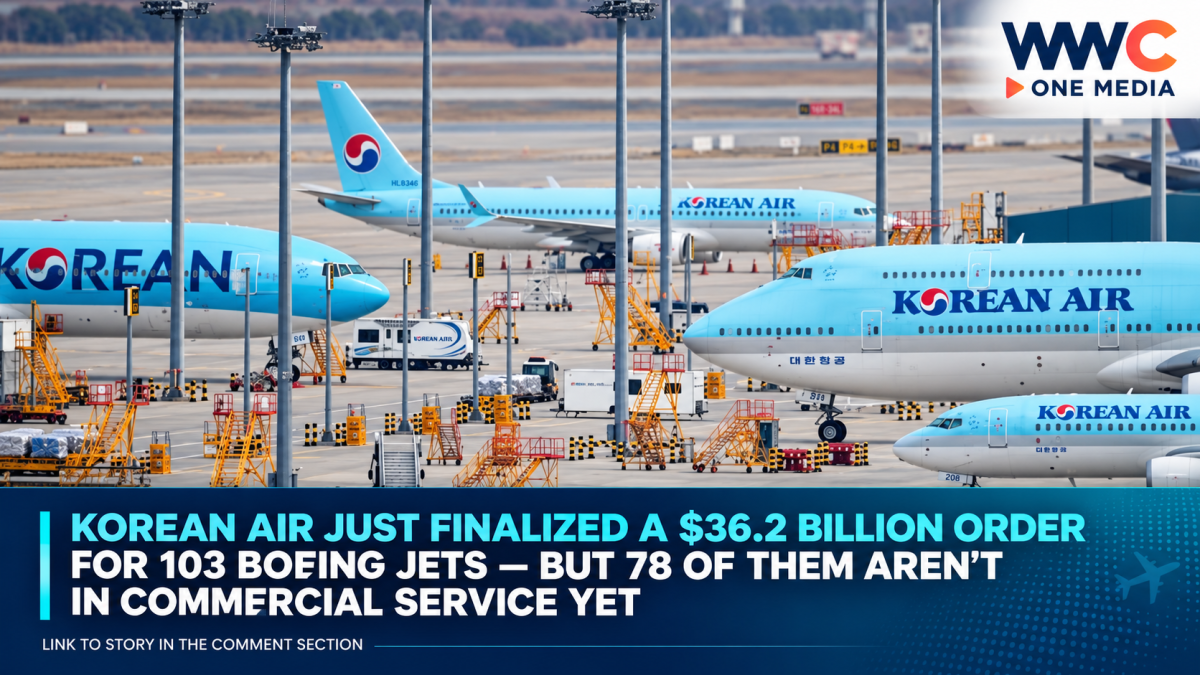
SEOUL — Korean Air has turned one of the biggest aircraft commitments in Asian aviation into a firm order, finalizing the purchase of 103 Boeing jets valued at $36.2 billion as it prepares to absorb Asiana Airlines and reshape itself into a much larger global carrier.
The record order includes 20 Boeing 777-9s, 25 787-10 Dreamliners, 50 737-10s and eight 777-8 Freighters, Korean Air and Boeing announced Wednesday, September 16.
It is the largest aircraft order in Korean Air’s history.
But there is a striking detail behind the headline number.
Of the four aircraft types Korean Air has committed to buy, only the 787-10 is currently certified and operating commercially.
The 737-10 is still completing certification work. The long-delayed 777-9 is targeting certification and first delivery in 2027. And the 777-8 Freighter remains under development, with Boeing targeting its first delivery in 2028.
That makes Korean Air’s purchase much more than a fleet expansion.
It is also a multibillion-dollar bet on Boeing delivering its next generation of aircraft on schedule.
The 103-plane deal is finally firm
Korean Air originally announced its intention to buy the 103 aircraft in Washington in August 2025, during South Korean President Lee Jae Myung’s visit to the United States.
More than a year later, Boeing confirmed the commitment has now become a finalized order.
The aircraft portion is worth about $36.2 billion based on published list values.
But the overall U.S.-linked procurement package is even bigger.
Korean Air separately finalized about $8.6 billion in agreements with GE Aerospace and CFM International covering 21 spare engines and long-term maintenance services.
That takes the combined finalized package to approximately $44.8 billion, or around 60 trillion won.
The engine arrangements include a 15-year maintenance agreement covering engines on 28 aircraft, according to Korean Air.
The $36.2 billion headline aircraft figure should not necessarily be read as the exact amount Korean Air will ultimately pay in cash. Large commercial-aircraft deals are commonly negotiated commercially, and published list values do not always reflect undisclosed discounts or financing terms.
Here’s exactly what Korean Air is buying
The order gives Korean Air aircraft for almost every major part of its future operation.
20 Boeing 777-9s will provide high-capacity long-haul passenger aircraft for major international routes.
25 Boeing 787-10 Dreamliners will add another generation of efficient widebody aircraft for medium- and long-haul services.
50 Boeing 737-10s — by far the largest single component of the order — will serve high-density short- and medium-haul markets.
And eight Boeing 777-8 Freighters will strengthen Korean Air Cargo, already one of the airline group’s strategically important businesses.
Korean Air says the new aircraft will allow it to simplify its long-term fleet around five primary next-generation families:
Boeing 777, Boeing 787, Boeing 737, Airbus A350 and Airbus A321neo.
That fleet simplification could eventually reduce training, maintenance and operational complexity while giving the airline greater economies of scale.
But 70 of the 103 aircraft rely on Boeing programs that are still being certified
That is one of the most consequential facts in the deal.
Korean Air has committed to 50 737-10s and 20 777-9s — 70 aircraft in total — even though neither model had entered commercial service as of September 16, 2026.
Boeing completed the 737-10’s final planned certification flight in July after nearly 1,000 test flights and more than 2,000 flight hours.
But certification still required completion of development-assurance reviews, system-safety assessments and final regulatory submissions to the U.S. Federal Aviation Administration.
Boeing said it remained on track for certification in 2026 and customer deliveries beginning in 2027.
The 777-9 is further along than it once was but is also years behind the schedule Boeing originally envisioned.
Boeing CEO Kelly Ortberg said in July that the company continued to work toward certification, with the first 777-9 delivery planned for 2027.
For Korean Air, those timelines matter.
An order this large can only transform the fleet if the aircraft themselves become available when planned.
And the freighter comes later
The 777-8 Freighter adds another timeline risk.
The cargo aircraft is part of Boeing’s 777X family and is designed to become one of the world’s largest and most capable twin-engine freighters.
Major assembly work has begun, but Boeing is currently targeting its first delivery in 2028.
Korean Air’s order for eight 777-8Fs is particularly significant because the airline operates one of Asia’s best-established international cargo businesses.
Boeing said when the commitment was announced that it represented Korean Air’s first order for the 777-8 Freighter.
Those aircraft could eventually replace older cargo jets while offering improved efficiency and payload capability.
But once again, Korean Air is purchasing into a program whose commercial-service history has yet to begin.
So why lock in planes this early?
Aircraft availability is one answer.
Airlines around the world are dealing with unusually long waits for new jets as Boeing and Airbus work through enormous order backlogs and suppliers struggle to keep pace with demand.
Korean Air says one reason it placed the order so far in advance was to secure delivery positions stretching into the late 2030s.
That may sound extraordinarily far away.
But commercial aircraft are assets airlines can operate for 20 to 30 years, and delivery slots for popular models can become scarce many years before production.
Boeing itself ended 2025 with a Commercial Airplanes backlog of more than 6,100 aircraft valued at a record $567 billion, illustrating how crowded the production queue has become.
For Korean Air, waiting for every model to be fully mature before ordering could mean waiting substantially longer to receive the planes.
The timing is really about Asiana
The 103-aircraft purchase makes much more sense when viewed through Korean Air’s merger with Asiana Airlines.
That integration is now only months away.
Korean Air formally approved the merger structure earlier this year and says December 16, 2026 will be the legal merger date.
The combined airline is scheduled to begin operating as an integrated Korean Air on December 17.
After that date, existing Asiana flights will begin operating under Korean Air flight numbers as booking systems and schedules are migrated. Korean Air began preparing customers for that transition in September.
The merger effectively creates a much larger airline requiring decisions about which aircraft to keep, which to retire and which fleet families should dominate for decades.
Korean Air says the Boeing purchases are intended partly to support capacity growth and modernization after that integration.
The Asiana merger has been more than six years in the making
The merger is itself one of the largest structural changes in modern South Korean aviation.
Korean Air began the acquisition process in November 2020, when the pandemic was devastating global air travel and Asiana’s financial position had deteriorated.
The South Korean government and creditors supported stabilization efforts with 3.6 trillion won in policy financing, according to Korean Air.
After years of competition reviews in multiple jurisdictions, the two airlines signed their final merger contract in May 2026.
Asiana shareholders subsequently approved the merger in August, with Korean Air reporting that 99.3% of the shares represented at the meeting voted in favor.
The result will leave South Korea with one dominant full-service airline group where two major international carriers once competed separately.
Fleet planning is therefore not simply about adding 103 aircraft.
It is about redesigning a combined airline.
Korean Air is also buying Airbus
The Boeing deal does not mean Korean Air is becoming an all-Boeing carrier.
Its future fleet strategy deliberately includes Airbus aircraft as well.
Korean Air is introducing the Airbus A350 for long-haul operations and the A321neo in the single-aisle segment, alongside Boeing’s 777, 787 and 737 families.
That gives the airline a diversified supplier strategy.
It can use Boeing and Airbus aircraft for different missions while reducing some of the risk of depending entirely on a single manufacturer.
For Boeing, however, securing 103 aircraft from one of Asia’s most prominent airlines remains strategically important.
When the commitment was announced in 2025, Boeing described it as its largest-ever widebody order from an Asian carrier.
The deal also has a Korea-US trade dimension
This was never purely an airline transaction.
The original commitment was announced during a high-profile Korea-U.S. business gathering in Washington, and the finalized order was commemorated in Seoul with senior officials from both governments present.
Boeing said the agreement was a tangible outcome of bilateral trade negotiations and highlighted its significance to the U.S.-South Korean industrial relationship.
At the Seoul ceremony, participants included Korean Air Chairman and CEO Walter Cho, Boeing Commercial Airplanes CEO Stephanie Pope, CFM International CEO Gaël Méheust, South Korea’s trade and industry minister Kim Jung-kwan and U.S. Ambassador Michelle Steel.
When the original commitment was announced, Boeing estimated the purchase could support around 135,000 jobs across the United States.
Korean Air Chairman Walter Cho described the finalized package as extending beyond an ordinary commercial transaction and as reflecting the economic and technological relationship between the two countries.
Boeing needs big orders — but it also needs deliveries
The order is undeniably positive for Boeing.
The company has spent years rebuilding production, improving quality controls and trying to restore confidence following repeated manufacturing and certification problems.
There have been signs of progress.
In July, the FAA said Boeing could resume issuing airworthiness certificates for all new 737 MAX and 787 aircraft after regulators reviewed months of production-quality data.
The FAA had previously retained greater direct oversight of the certification process.
Boeing has also been increasing production, with the 737 program reaching 42 aircraft per month by late 2025 while the company worked to stabilize 787 production at eight per month.
Orders, however, are only one side of the recovery.
The bigger commercial challenge is producing and delivering thousands of aircraft already promised to customers.
Korean Air’s contract adds another 103 airplanes to that long-term challenge.
The 787-10 is the least uncertain part of the package
Among Korean Air’s four selections, the Boeing 787-10 is the only model already established in regular airline service.
It is the largest Dreamliner variant and can carry as many as 336 passengers in Boeing’s reference two-class configuration, with a range of roughly 11,730 kilometers.
That makes it suited to high-demand international routes that do not require the extreme range of smaller 787 variants.
For Korean Air, the 25-plane commitment gives it another relatively mature long-haul aircraft while waiting for the newer Boeing models.
The 777-9, meanwhile, is intended for significantly larger passenger markets.
Boeing advertises seating for around 426 passengers in a reference two-class configuration and says the jet should use roughly 20% less fuel than the aircraft it is designed to replace.
Actual Korean Air cabin layouts and seating capacities may differ considerably from Boeing’s reference configurations.
Korean Air is planning decades ahead
That may ultimately be the most important way to understand this deal.
The 103 jets will not suddenly appear at Incheon next year.
Deliveries are expected to unfold progressively through the late 2030s.
Some will replace aging aircraft.
Others will provide additional capacity.
Some will carry passengers across the Pacific.
Others will fly shorter Asian routes.
Eight will carry freight.
And together they are meant to support an airline that will soon include the operations, passengers and network previously associated with Asiana.
That makes this less like buying 103 planes and more like deciding what Korean Air should look like 10 or 15 years from now.
The order is huge — but execution is now the story
Korean Air has committed the money.
The Asiana merger is approaching.
Boeing has secured one of Asia’s most important airline customers.
Now comes the difficult part.
Boeing has to certify the 737-10.
It has to finish the 777-9.
It has to develop and certify the 777-8 Freighter.
It has to increase production without sacrificing quality.
And then it has to deliver Korean Air’s airplanes across more than a decade while thousands of other jets are already sitting in Boeing’s backlog.
For Korean Air, the wager is equally significant.
The company is preparing to become a much larger airline just as the global aviation industry is dealing with aircraft shortages, supply-chain constraints and intensifying competition across Asia.
The 103-plane order may define Korean Air’s fleet for a generation.
But first, many of those aircraft still have to make it from Boeing’s development programs into commercial service.



Leave a Reply