
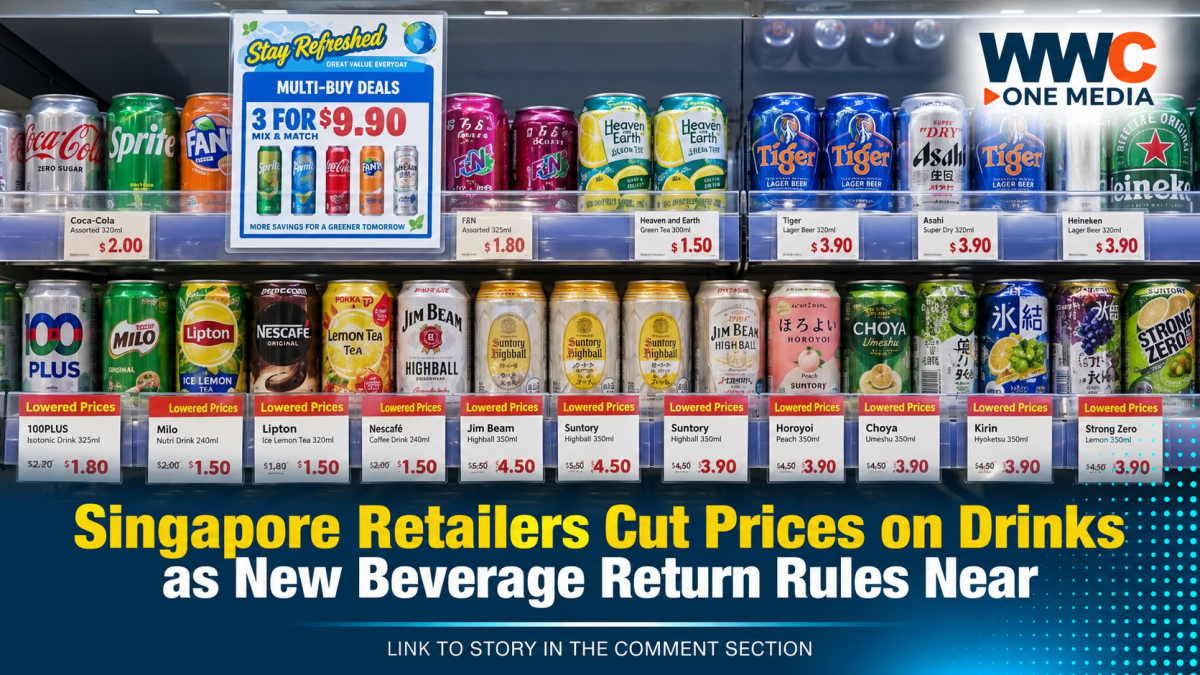
SINGAPORE — Retailers across Singapore are cutting prices on certain beverages that do not carry the required Return Right deposit mark, as businesses race to clear older stock before the country’s Beverage Container Return Scheme (BCRS) fully takes effect on October 1, 2026.
Some retailers and distributors have reportedly offered discounts of up to 50 percent on affected products. The markdowns are part of a six-month transition period that allowed businesses to sell existing inventory before the new packaging and deposit requirements become mandatory.
Why Are Stores Marking Down These Drinks?
Singapore launched the BCRS on April 1, 2026, introducing a refundable 10-cent deposit on regulated beverage containers.
The system covers plastic bottles and metal cans within the scheme’s specified size range. Consumers pay the deposit when purchasing an eligible drink and can recover it by returning the empty container through designated reverse vending machines.
More than 1,000 return machines became operational when the scheme launched, according to The Straits Times.
During the transition period, however, retailers were allowed to continue selling older beverages without the new deposit marking.
That grace period ends on September 30.
Discounts Reach Up to 50 Percent
The Straits Times reported that Japanese retailer Don Don Donki was offering discounts on beverages labelled as non-BCRS at outlets including 100AM Mall in Tanjong Pagar and Clarke Quay Central.
At the 100AM outlet, several alcoholic beverage products were observed with discounts ranging from 20 percent to 34 percent.
Separately, beer distributor Watering Hole said it had sold 1,500 cans at half price during a two-week clearance effort.
These discounts concern regulated products affected by the packaging transition and should not be interpreted as a permanent change in beverage pricing.
Businesses Race to Clear Old Inventory
K-Market, a Korean specialty grocery chain, reported having 3,258 non-labelled beverage containers across nine outlets as of September 14.
The retailer said it was using measures including markdowns, prominent displays and transfers between stores to manage remaining inventory. It has also stopped replenishing affected products.
Some imported products are proving more difficult to clear because of their niche appeal and slower or uneven demand, according to the company’s representative cited by The Straits Times.
Cold Storage and Giant, meanwhile, reported approximately 5,000 non-labelled containers across their stores. The companies said they were considering measures such as selective clearance sales, returning eligible products to suppliers and reallocating inventory between stores.
What Changes on October 1?
From October 1, regulated beverages supplied in Singapore must carry the required deposit marking and barcode under the BCRS rules.
The transition is designed to give producers, importers and retailers time to move from older packaging to containers compliant with the new system.
According to The Straits Times, supplying regulated beverages without the required marking after the deadline can result in penalties under Singapore’s Resource Sustainability Act, including fines of up to S$10,000 and/or up to three months’ imprisonment.
The 10-Cent Deposit Is Refundable
The BCRS is designed around a deposit-and-refund model rather than a permanent surcharge.
FairPrice explains that eligible drinks carry a S$0.10 deposit, which is refunded when consumers return the qualifying empty container through a Return Right machine. Containers without the deposit mark during the transition period do not carry the deposit and cannot be returned for the refund.
The system aims to improve the recovery of beverage containers and create a cleaner stream of recyclable plastic and metal.
Singapore’s Big Recycling Experiment
The clearance sales are therefore just one visible consequence of Singapore’s transition to a nationwide beverage-container return system.
For retailers, the immediate challenge is inventory management: older packaging has to be sold, returned or otherwise dealt with before the September 30 transition deadline.
For consumers, the key change beginning October 1 will be straightforward: look for the official deposit mark and barcode on regulated beverage containers.
The unusual wave of markdowns is ultimately a sign that Singapore’s beverage industry is approaching a major deadline—one that will permanently change how qualifying drinks are packaged, sold and returned.
WWC ONE MEDIA G.A




Leave a Reply