
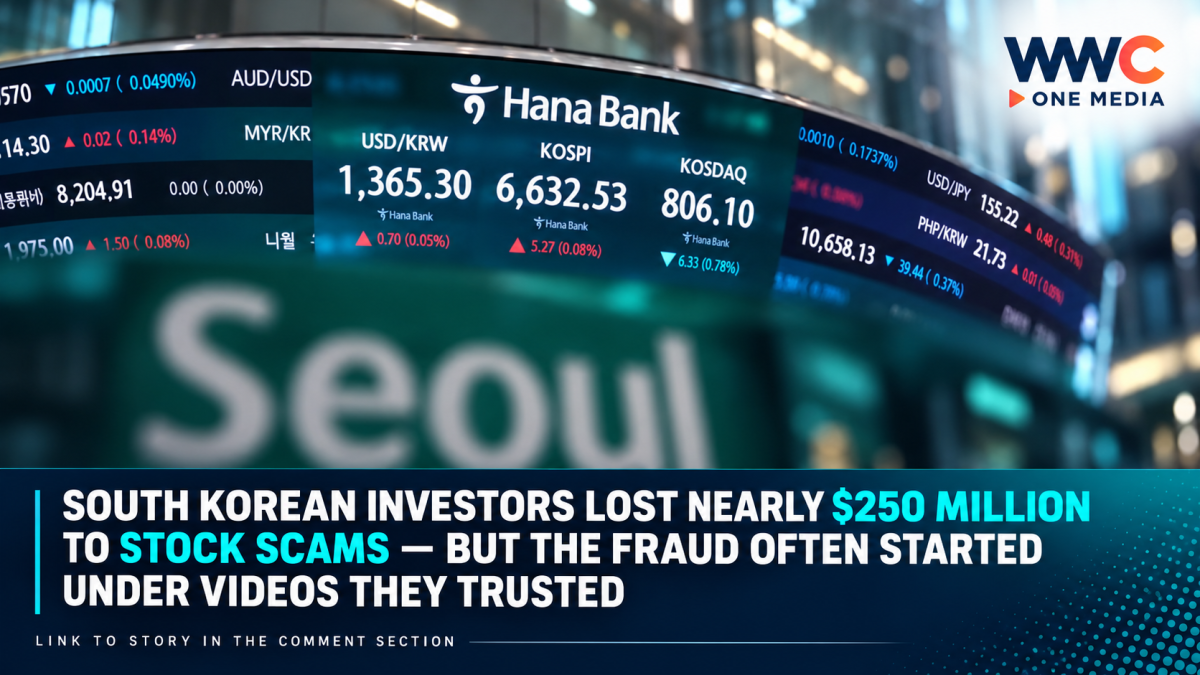
SEOUL — South Korea’s extraordinary stock-market boom created fortunes, FOMO and millions of new reasons to watch trading screens. It also created ideal conditions for fraudsters.
Police investigated 3,506 stock-tip chatroom cases involving 336 billion won, or roughly $247 million, during the first half of 2026, according to police data obtained by Reuters.
The number of cases increased only 4.1% from a year earlier.
But the amount of money involved jumped 19.8%.
That gap is one of the most revealing numbers in the story.
South Korea did not simply experience more stock scams.
The scams became financially more damaging.
Fraud rings took advantage of retail investors chasing gains during a historic equity rally, pulling targets from public social-media posts into private chatrooms where supposed experts, brokerage employees and investment advisers promised privileged information or extraordinary returns.
Then South Korea’s market reversed.
The KOSPI, which Reuters described as the world’s best-performing major stock benchmark during the first half of 2026, subsequently fell as much as 44% from its June 19 peak.
That violent move gave scammers two emotions to exploit.
Greed on the way up.
Fear on the way down.
The fraud often starts underneath a legitimate video
One of the most effective techniques does not begin with an obviously suspicious message.
Scammers reportedly post comments beneath videos or social-media content from real brokerage analysts, well-known investment personalities and financial influencers.
A viewer who already trusts the person in the video may assume the comment, account or invitation is connected to that legitimate expert.
The target is then moved away from the public platform and into a private chatroom on services such as Naver Band or other messaging applications.
Once inside, the victim sees what appears to be a community of successful investors.
Other members post supposed profits.
People congratulate one another.
A “manager” or “secretary” offers investment guidance.
A person claiming to represent a securities company may recommend installing a special trading application.
Much of that environment can be manufactured.
South Korean police have warned that posts showing supposed investment successes can come from bots, accomplices or automated accounts rather than genuine customers. Fraudsters also steal photographs and identities of legitimate investment professionals.
AI has made the impersonation game easier
Generative AI is adding another layer.
Yonhap documented fraudulent social-media campaigns in which scammers used AI-generated images of wealthy families, luxury homes and supposed insiders to create fictional personas offering exclusive stock information.
Police said impersonation of brokerage executives and investment experts has also become common.
The psychology is simple.
A person scrolling through social media sees somebody who appears rich, educated or professionally connected.
The account claims to possess information ordinary investors do not have.
The information is initially offered for free.
Only later does the victim encounter demands for subscription fees, large deposits or transfers to an investment account.
The visual sophistication of generative AI makes the first contact look more credible than the badly written spam messages investors may already know to avoid.
Some victims are shown fake profits before the money disappears
Perhaps the most dangerous version of the scam uses a counterfeit trading platform.
Fraudsters tell victims to download what appears to be an application operated by a legitimate securities company.
Deposited funds then appear inside the app.
Trading screens show winning positions.
The victim may see a balance rising rapidly.
But the numbers can be entirely fictional.
Police investigating a Cambodia-based operation said the ring used an application made to resemble a genuine securities firm’s mobile platform and displayed manipulated trading screens and fabricated investment returns.
That technique solves a fundamental problem for scammers.
People hesitate to send larger sums until they believe the first deposit actually worked.
A fake app can show them precisely what they want to see.
One Cambodia operation allegedly took 9.9 billion won from 59 people
In June, Seoul police announced the arrest of 10 members of a stock-tip-room fraud ring operating from Sihanoukville, Cambodia.
Police allege the organization stole approximately 9.9 billion won from 59 South Korean victims between February 2024 and February 2026. Nine of the 10 arrested suspects were detained.
The operation allegedly began by posting links beneath YouTube videos featuring genuine stock experts.
Victims were moved into Naver Band chatrooms.
Members of the group then posed as staff or secretaries connected with securities firms and promoted investments supposedly selected with artificial intelligence.
Police say the group promised returns of up to 600%.
It also used fake participants who claimed they were already making large profits, adding social proof designed to push hesitant victims toward sending money.
The alleged ringleader was a foreign national, while Korean call-center personnel filled roles including secretaries and fake customers, according to the investigation.
The case illustrates how sophisticated these operations have become.
They are not necessarily one person sitting behind a laptop.
They can resemble organized sales organizations with scripts, specialized employees, customer-management systems and overseas bases.
The $250-million figure does not mean every loss has been judicially proven
Police data require careful wording.
The 336 billion won represents money involved in the 3,506 stock-tip-chatroom cases investigated during January through June.
Each case can involve multiple victims.
Investigations may still be underway.
And individual defendants remain entitled to contest allegations in court.
So the safest description is that South Korean investors reported or were involved in roughly $250 million worth of suspected stock-tip-room fraud investigated by police, rather than saying courts have definitively established every dollar as criminal loss.
Even with that qualification, the scale is substantial.
And the increase from a year earlier indicates that the typical financial damage associated with these investigations is becoming more severe.
The stock rally gave scammers the perfect sales pitch
Fraud works best when the promised outcome already seems believable.
In a stagnant market, guaranteeing enormous gains sounds suspicious.
During a historic bull run, those same promises can feel less impossible.
South Korea’s 2026 market surge was heavily associated with technology and artificial-intelligence enthusiasm.
The KOSPI became the world’s best-performing benchmark during the first half, creating an environment in which stories about ordinary traders making sudden fortunes were easier to believe.
The Bank of Korea has separately warned about the destabilizing potential of increasingly aggressive AI-related trading and leveraged products, particularly those linked to major semiconductor companies such as Samsung Electronics and SK Hynix.
None of that legitimate market speculation is itself fraud.
But it creates useful raw material for fraudsters.
They can take a real theme—AI, semiconductors, reconstruction, technology exports—and attach fake privileged access to it.
Then the market fell 44%
The psychology changes when prices collapse.
Investors who missed the rally fear they will miss the rebound.
Those already holding losses may become desperate for a way to recover money quickly.
That can make extraordinary promises attractive precisely when caution should be highest.
Reuters reported that the KOSPI subsequently fell as much as 44% from its June 19 peak.
Financial-fraud specialists told Reuters that volatility increases uncertainty and creates better operating conditions for scam groups because retail investors become emotionally easier to pressure.
The fraudster’s message can therefore change with the market.
During a rally: You are missing out.
During a crash: We know how to recover your losses.
The destination can be the same private chatroom.
A victim borrowed money after watching other members boast about returns
Reuters interviewed a 47-year-old logistics worker identified by the English name Jay, who said he lost 60 million won in one such operation.
He entered a Naver group through a TikTok video he believed was associated with a well-known securities executive.
The room initially provided ordinary market commentary.
Later, participants began discussing large profits supposedly earned through staff connected to the investment firm.
Jay eventually borrowed money and invested 20 million won.
He then transferred another 40 million won after being presented with what he believed was an opportunity connected to a construction company that could benefit from Iranian post-war reconstruction.
The group later disappeared.
Jay filed criminal and civil complaints and told Reuters he had taken two additional jobs to repay his debts.
His account is one person’s allegation and experience, not proof that every investment room operates the same way.
But it demonstrates why the financial damage can continue long after the scam account disappears.
Victims may lose not only savings but borrowed money.
Other Korean cases show the same playbook
Separate 2026 investigations reveal recurring patterns.
In February, Busan police arrested a suspected money collector after one victim allegedly handed over 100 million won in cash and gold following false investment advice.
In June, Haenam police said a victim who had already transferred roughly 190 million won was pressured to provide another 60 million won in cash after being lured through investment content posted online.
In another case, police recovered more than 300 million won allegedly handed to a stock-tip scam whose operators claimed to possess a secret investment strategy capable of producing high returns.
And in August, Daejeon police arrested eight people accused of obtaining around 1.54 billion won in cash and gold bars from five victims by impersonating stock experts and promising returns of up to 100%. Six were detained.
The details vary.
The persuasion architecture is remarkably similar.
Why gold bars and cash are showing up
Modern scams are normally associated with bank transfers or cryptocurrency.
Several South Korean investment-fraud cases have involved victims being instructed to deliver cash or physical gold.
That can help criminal organizations avoid some of the bank-account controls designed to detect suspicious transfers.
It also creates another role inside the organization: the collector.
These people physically meet victims, collect the money or bullion and transfer the proceeds onward.
Police have used surveillance of suspected collectors to intercept funds and identify other members of fraud rings.
For victims, however, physical delivery can make recovery much harder once the assets leave their possession.
Police say some scam losses had started declining before the latest half-year total
The broader trend contains an apparent contradiction.
Reuters’ first-half figures show stock-tip-chatroom cases and money involved rising from a year earlier.
But South Korea’s National Police Agency separately said in June that more recent monthly data showed some categories of “new scam” crime beginning to decline.
Police reported 293.8 billion won in losses from stock-tip rooms, romance scams, task scams and similar schemes during the first quarter, down 11.7% from the previous quarter.
May investment-tip-room losses were reported at 41.3 billion won, about 26.1% lower than the first-quarter monthly average.
Both things can be true.
The first-half year-on-year total can rise while losses begin falling sequentially later in the period.
That distinction will matter when authorities assess whether enforcement campaigns are actually changing the trajectory.
The Financial Supervisory Service says these cases are primarily criminal investigations
South Korea’s Financial Supervisory Service told Reuters it does not maintain the police dataset on illegal stock-tipping chatrooms and said criminal investigation falls under law-enforcement responsibility.
The regulator did not provide Reuters with details of additional investor-protection rules specifically responding to the latest figures.
That highlights the cross-agency nature of the problem.
Financial regulators supervise licensed securities activity.
Police investigate fraud.
Banks control payment accounts.
Technology platforms host the social-media posts or chatrooms where initial contact can occur.
Telecommunications systems and overseas jurisdictions may also be involved.
A scam can move through all of those systems before a victim realizes anything is wrong.
Platforms are being pushed to catch the first contact earlier
Naver told Reuters that it removes fraudulent chatrooms when they are reported and is strengthening monitoring.
Jeonbuk Bank, which held the account involved in the victim case described by Reuters, said it was aware of fraud concerns and would continue improving scam-detection systems.
The difficult part is that scam accounts can look normal during the early stages.
A chatroom may initially provide genuine stock commentary.
A fake adviser may avoid asking for money for days or weeks.
A fraudulent platform may even permit small withdrawals initially to build confidence.
By the time suspicious behavior becomes obvious, substantial sums may already have been transferred.
“AI investment” is becoming the perfect fraud label
Artificial intelligence has become useful to scammers in two different ways.
First, it helps produce fake photographs, personas and marketing materials.
Second, the phrase “AI-powered investing” itself sounds technically sophisticated enough to explain supposedly extraordinary returns.
In the Cambodia case, investigators say victims were encouraged to buy stocks supposedly selected by AI through a fake trading platform.
The claim is difficult for an inexperienced investor to evaluate.
Algorithmic trading is real.
Machine learning is used throughout legitimate financial markets.
Securities firms genuinely build quantitative investment systems.
A criminal only needs to borrow that vocabulary and attach it to a fake app.
The existence of real AI trading therefore gives fake AI trading an aura of plausibility.
The most dangerous signal is often not the stock tip itself
Many fraud operations deliberately begin with advice that appears reasonable.
The purpose is trust, not immediate theft.
The bigger warning signs emerge when the relationship changes.
Victims are moved into closed groups.
The adviser claims exclusive or secret access.
Guaranteed or spectacular returns appear.
Users are told to install unfamiliar trading software.
Money is transferred to accounts that do not clearly belong to a regulated securities company.
Additional payments are demanded before withdrawals can be processed.
Or the supposed adviser discourages victims from discussing the investment with family and friends.
South Korean police have specifically warned that “exclusive” information and instructions not to tell others are common techniques used to isolate victims from people who might recognize the fraud.
Market volatility did not create the scammers — it gave them a better story
Stock-tip fraud existed long before the KOSPI’s 2026 rally.
What changed was the environment.
A soaring market made 100%, 300% or 600% returns seem less absurd to inexperienced investors.
Social media gave criminals direct access to people already consuming investment content.
Generative AI made impersonation cheaper.
Fake apps made fictional gains look real.
And closed chatrooms allowed coordinated accomplices to manufacture the appearance of a thriving investment community.
Then the market collapsed, creating a second pool of emotionally vulnerable investors searching for ways to recover.
That combination helps explain why the money involved climbed almost 20% while the number of investigated cases rose only about 4%.
South Korea’s next market rebound could bring another wave
The immediate market direction is unpredictable.
The fraud mechanism is easier to understand.
Whenever shares begin rising sharply again, scammers will have another believable narrative.
Whenever they collapse, scammers will have another pool of people desperate to recover.
The underlying defense therefore cannot depend on whether the KOSPI is up or down.
It depends on whether investors can distinguish a legitimate brokerage relationship from a carefully constructed imitation before money moves.
South Korea’s first-half statistics show the cost when that distinction fails:
3,506 investigated stock-tip-room cases.
336 billion won involved.
Nearly one-fifth more money than a year earlier.
The stock market created the excitement.
The scammers found a way to monetize it.




Leave a Reply