
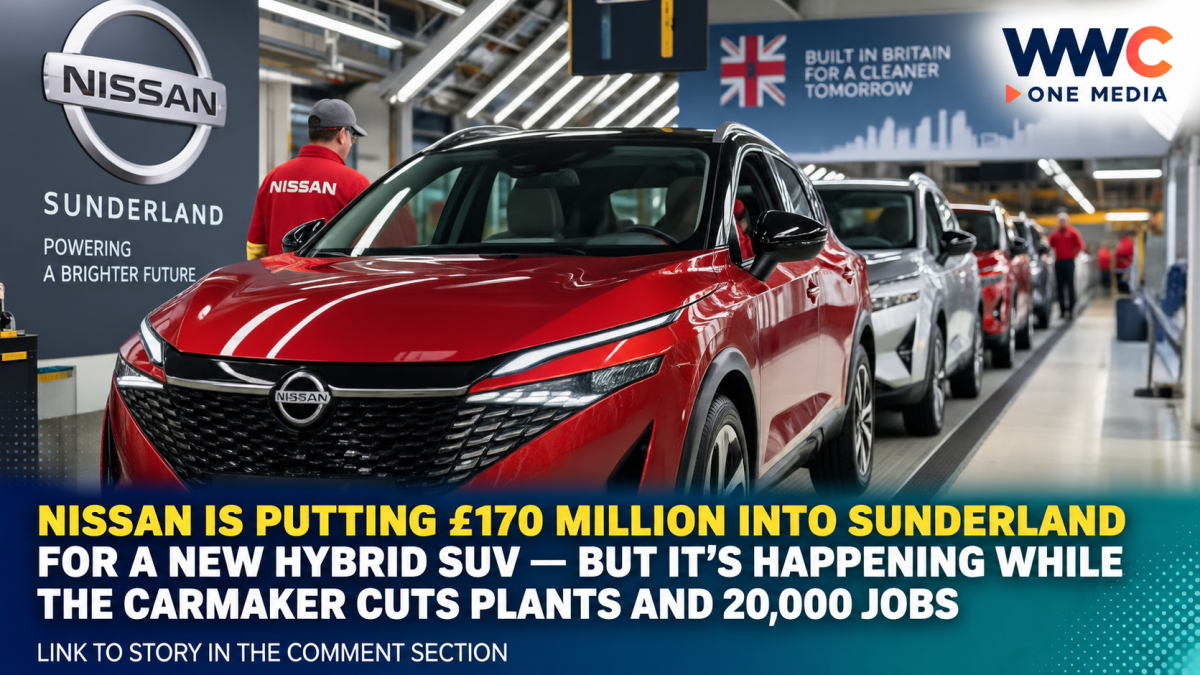
LONDON — Nissan is giving its giant Sunderland factory another model to build — and another reason to believe it has a future inside a carmaker that is aggressively cutting factories, jobs and costs around the world.
The Japanese automaker confirmed Wednesday that it will invest £170 million, or about $229 million, to manufacture the Kicks e-POWER small hybrid SUV in Sunderland for the European market.
The Kicks will be produced alongside the Qashqai, Juke and electric Leaf, although Nissan has not yet announced when European production of the new SUV will begin.
On the surface, it looks like another new-car announcement.
But inside Nissan, it carries considerably more weight.
The company is in the middle of a sweeping restructuring designed to slash its cost base, reduce its global manufacturing footprint and restore profitability.
That means every plant — and every future model assigned to one — matters.
For Sunderland, Britain’s biggest car plant, the Kicks could provide exactly what the factory has recently needed most:
more volume.
Kicks could add up to 50,000 vehicles to Sunderland
The Financial Times reported that Nissan’s new investment could increase Sunderland production by as many as 50,000 vehicles, helping lift utilization at a plant currently operating at roughly half its potential capacity.
That number helps explain why the decision matters beyond the £170 million headline.
Car factories are expensive assets.
When they operate well below capacity, every vehicle produced has to absorb a larger share of fixed costs — from equipment and buildings to energy and labor.
Adding another model can therefore improve the economics of the entire factory, not merely generate additional sales.
Sunderland currently employs around 6,000 people, according to Nissan, and the company says more than 11.9 million vehicles have been built at the site during roughly four decades of operation.
Nissan describes Sunderland as the UK’s largest car factory.
A new vehicle reportedly capable of adding tens of thousands of units annually could therefore become important insurance for one of Britain’s biggest automotive manufacturing operations.
But this isn’t a normal Nissan expansion
The announcement becomes more striking when viewed against what Nissan is doing elsewhere.
Under its Re recovery plan, the automaker is trying to return its automotive business to positive operating profit and free cash flow while radically reducing costs.
Nissan has said it plans to:
- reduce its global workforce by 20,000 employees between fiscal 2024 and fiscal 2027
- consolidate vehicle-production plants from 17 to 10
- cut fixed costs by ¥250 billion
- reduce variable costs by another ¥250 billion
- streamline research and development
- accelerate vehicle-development programs.
Five of the seven production sites targeted for consolidation had already been identified by Nissan in earlier restructuring updates.
The company has also launched voluntary separation programs in several markets, including the United Kingdom.
So Sunderland gaining another model while factories elsewhere are being reduced is not an insignificant development.
It means Nissan is choosing to put fresh capital into the British operation while simultaneously cutting capacity across its global network.
One Nissan EV planned for Sunderland has already been shelved
That distinction is particularly important because Nissan’s earlier UK product plans have not all survived its restructuring.
Reuters reported in June that Nissan had halted development of a battery-electric version of the Qashqai, its best-selling European model, as part of its broader effort to preserve cash and reduce development spending.
That electric Qashqai had previously been expected to be made in Britain.
The decision represented a notable retreat from plans Nissan announced in 2023, when the automaker outlined a much larger Sunderland electrification push.
The company has not abandoned electric vehicles at the factory altogether.
Production of the next-generation Nissan Leaf began in Sunderland in December 2025, following a £450 million transformation associated with the model. The UK government said the factory supported around 6,000 jobs at the time.
But adding the hybrid Kicks shows that Nissan’s European strategy is no longer simply about moving everything toward battery-electric vehicles as quickly as possible.
It is building a broader mix.
So what exactly is e-POWER?
The Kicks will use Nissan’s e-POWER system, which sits somewhere between the driving experience of an electric car and the refueling convenience of a conventional petrol vehicle.
It does not need to be plugged in.
Unlike many conventional hybrids, where both an internal-combustion engine and electric motor can propel the wheels, Nissan’s e-POWER system uses the petrol engine primarily to generate electricity.
The electric motor then drives the wheels.
Nissan describes the system as being “fuelled by petrol, driven by electric.”
The result is intended to provide some of the characteristics drivers associate with EVs — including electric-motor acceleration — without requiring them to find charging infrastructure.
That could make the Kicks particularly useful in European markets where consumers want lower-emission electrified vehicles but remain reluctant or unable to switch completely to battery-electric cars.
It also gives Nissan another product positioned between traditional petrol models and full EVs.
Nissan has been investing heavily in e-POWER
The technology is not new.
Nissan says cumulative global e-POWER production had already reached about 1.5 million vehicles by 2024, with versions offered in models including the Qashqai, X-Trail, Kicks and Sylphy across different markets.
The company launched its third-generation e-POWER system in Europe in 2025, initially through the Qashqai.
Nissan says the latest technology improves efficiency, reduces emissions and lowers noise compared with the previous generation.
The automaker has increasingly described e-POWER as a bridge that can accelerate electrification without requiring customers to jump immediately to a fully electric vehicle.
That strategy could become more important as automakers discover that Europe’s transition to electric vehicles is not happening at exactly the same speed in every country or customer segment.
Europe is still buying more electrified cars
The timing may appear contradictory because Europe’s electric-car market is actually strengthening.
Global EV sales rose for a sixth consecutive month in August 2026, with Europe providing much of the growth, according to Benchmark Mineral Intelligence data reported by Reuters.
Government incentives helped support battery-electric and plug-in-hybrid sales across European markets even as growth weakened elsewhere.
So Nissan’s embrace of another non-plug-in hybrid should not necessarily be interpreted as abandoning electric cars.
Instead, it reflects a wider industry trend toward offering several forms of electrification simultaneously.
Battery EVs may work for one customer.
Plug-in hybrids for another.
Non-plug-in hybrids such as e-POWER may suit customers who want electrified driving without installing or regularly using a charger.
The commercial challenge is deciding how much money to commit to each technology while regulations, consumer tastes and charging infrastructure continue to change.
Chinese automakers are adding another layer of pressure
Nissan’s restructuring is also taking place as Chinese automakers rapidly expand overseas.
Reuters reported earlier this year that Chinese brands had approximately doubled their UK market share to around 15%, while their share in the European Union had also been rising.
BYD, Chery and other Chinese groups are increasingly competing with established Japanese and European manufacturers on price, battery technology and model-launch speed.
BYD’s overseas vehicle sales, for example, rose 134.5% year on year in August 2026, according to company figures reported by Reuters.
That competitive pressure is affecting almost every traditional automaker.
Volkswagen is implementing one of the largest restructurings in its history.
Honda is seeking billions of dollars in cost reductions.
Toyota is reconsidering parts of its Chinese manufacturing structure.
And Nissan is cutting factories while attempting to launch competitive vehicles faster and at lower cost.
Against that backdrop, putting the Kicks into an existing, experienced Sunderland plant may be considerably cheaper and faster than creating entirely new European manufacturing infrastructure.
Nissan was even considering sharing Sunderland with China’s Chery
Perhaps the clearest sign that Sunderland’s utilization had become a strategic issue emerged earlier this year.
In June, Nissan confirmed that it was exploring whether Chinese automaker Chery could use one of Sunderland’s two production lines.
Reuters reported that the proposal was being examined as Nissan sought ways to use its manufacturing capacity more efficiently.
The Financial Times later reported that Nissan and Chery were discussing arrangements that could eventually involve several models, although the discussions had not become a binding production agreement.
The idea would have seemed extraordinary only a few years ago.
Nissan built Sunderland into one of Europe’s most prominent Japanese-owned automotive factories.
Now it is considering whether a rapidly expanding Chinese competitor could use some of the same production infrastructure.
That says a great deal about how quickly the global car industry has changed.
The UK government has been watching closely
Sunderland’s future has also become a political issue in Britain.
Reuters reported in June that the UK government was in advanced discussions with Nissan about potential financial support in exchange for long-term investment and commitment to Sunderland.
The latest announcement did not provide detailed terms of any government assistance connected specifically with the £170 million Kicks investment.
Business Secretary Jonathan Reynolds nevertheless welcomed Nissan’s decision, calling it a significant vote of confidence in Britain’s manufacturing capabilities and automotive future.
The UK has strong reasons to care.
Sunderland does not operate in isolation.
Major vehicle factories support networks of component manufacturers, logistics providers, engineers and service companies whose businesses can depend heavily on production volumes at the assembly plant.
That multiplier effect means an additional 50,000 vehicles could matter well beyond Nissan’s own workforce.
Sunderland has already survived several automotive turning points
Nissan’s Sunderland factory started vehicle production in the 1980s and has since become one of Britain’s most important car-manufacturing locations.
It built the original Leaf, one of the earliest mass-market battery EVs.
It became the production home of the Qashqai, one of Nissan’s most successful European models.
And Nissan says a new vehicle still rolls off its Sunderland production system roughly every two minutes.
The plant has repeatedly adapted as consumer tastes moved from traditional hatchbacks toward crossovers, and then toward hybrid and electric drivetrains.
The Kicks assignment represents another such transition.
But this one is happening while Nissan itself is undergoing perhaps the more important transformation.
The £170 million investment does not end the uncertainty
The new Kicks is clearly positive news for Sunderland.
It gives the factory another product.
It increases potential utilization.
It reinforces Nissan’s decision to continue manufacturing in Britain.
And it fits the company’s effort to sell more electrified vehicles without relying entirely on pure EVs.
But it does not make every question surrounding Sunderland disappear.
Nissan has not announced when Kicks production will begin.
The proposed arrangement with Chery remains another potential part of the plant’s future.
Nissan continues to restructure globally.
And European automakers face increasingly intense competition from Chinese manufacturers that are expanding at remarkable speed.
That makes the £170 million investment important — but also revealing.
Nissan is cutting manufacturing capacity around the world.
Yet at Sunderland, it is doing something different.
It is adding another car.
And the real test will be whether Kicks e-POWER can help turn Britain’s biggest car factory from an underused asset into one of the plants Nissan cannot afford to lose.


Leave a Reply