
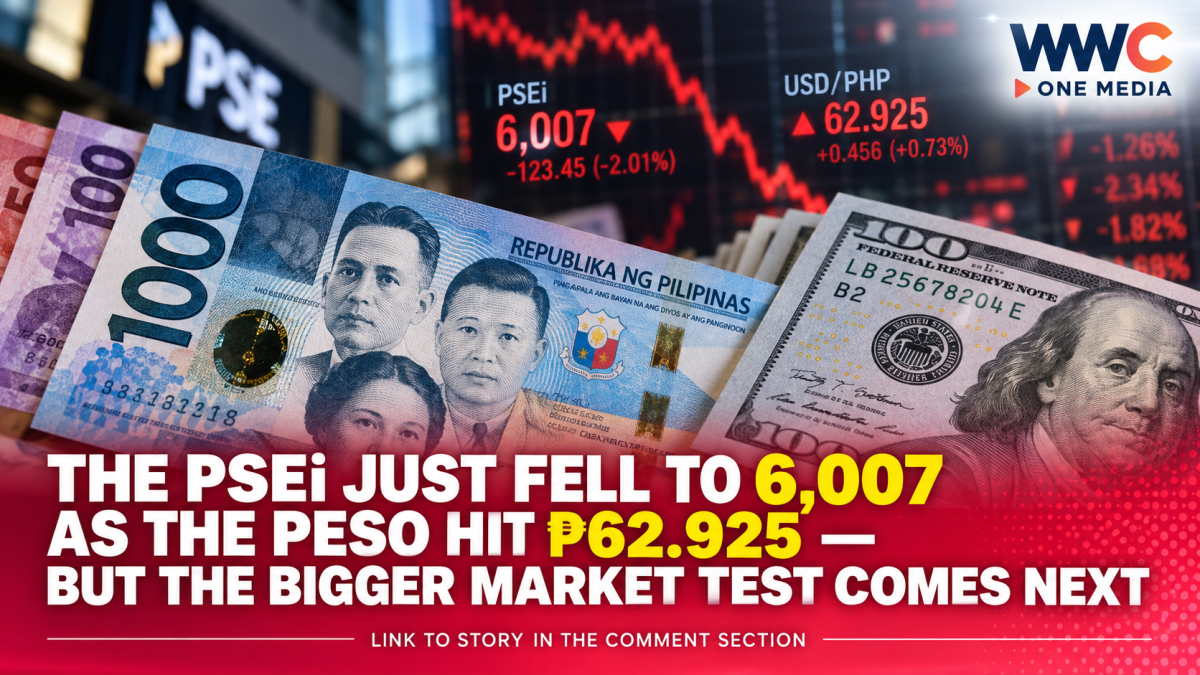
MANILA, Philippines — Philippine stocks are once again flirting with the psychologically important 6,000 level as a near-record-low peso, expensive oil and expectations of higher U.S. interest rates combine to make investors increasingly cautious about the country’s economic outlook.
The benchmark Philippine Stock Exchange index (PSEi) dropped 67.29 points, or 1.11%, to 6,007.78 on Tuesday, September 15, leaving it just 7.78 points above the 6,000 mark.
The broader All Shares index lost 21 points, or 0.62%, to finish at 3,342.52.
Official Philippine Stock Exchange data showed decliners outnumbering gainers, 96 to 90, with 53 stocks unchanged. Total value turnover reached about ₱5.35 billion.
But the index itself may only tell half the story.
Investors are confronting several pressures at once: a peso trading dangerously close to ₱63 against the dollar, oil prices above $100 a barrel, Philippine inflation still running above the central bank’s target and growing expectations that the U.S. Federal Reserve will raise interest rates.
Together, those forces could make imported goods more expensive, keep borrowing costs elevated and discourage investors from taking on additional risk.
The peso hit another record — even though it ended the day stronger
Tuesday’s currency trading produced what initially appears to be a contradiction.
The peso touched a new intraday record low of ₱62.925 to $1, after opening at ₱62.90.
But it later recovered and closed at ₱62.835, actually gaining 2.5 centavos from Monday’s record closing low of ₱62.86.
That distinction matters.
The peso did not set another record-low closing rate on September 15. Instead, it reached its weakest-ever level during intraday trading before recovering before the close.
The Philippine Star reported that traders believed the Bangko Sentral ng Pilipinas may have entered the market to smooth volatility, although that should be treated as market interpretation rather than a confirmed BSP announcement. Foreign-exchange trading volume jumped to around $1.9 billion, almost double the previous session’s $969.22 million.
The repeated testing of record lows nevertheless signals how much pressure remains on the currency.
Why oil is becoming a peso problem
One of the clearest sources of pressure is energy.
The Philippines is heavily dependent on imported petroleum, which generally has to be purchased using foreign currency. When global crude prices rise sharply, importers need more dollars to pay for essentially the same quantity of fuel.
That can increase demand for dollars and add pressure on the peso, although exchange rates are influenced by many factors beyond oil alone.
This week, those pressures intensified.
Philippine fuel companies implemented another large round of price increases on September 15. Major retailers raised gasoline by roughly ₱5.68 to ₱5.70 per liter, diesel by around ₱4.30 to ₱4.40, and kerosene by about ₱4.60.
Meanwhile, international crude remained exceptionally expensive amid continuing disruptions and geopolitical risks in the Middle East.
Brent crude was still trading at around $107.82 per barrel on September 16, while U.S. West Texas Intermediate was near $104.86, according to Reuters. Concerns have centered on disruptions involving Saudi infrastructure and other major oil-producing areas.
For the Philippines, the danger is a reinforcing cycle:
Higher oil prices can raise the country’s import bill.
A weaker peso can make each imported barrel even more expensive in local-currency terms.
And more expensive fuel can eventually filter through transportation, electricity, food distribution and other parts of the economy.
Inflation is already running at 6.1%
This is happening when Philippine inflation is already well above the Bangko Sentral ng Pilipinas’ preferred range.
The Philippine Statistics Authority reported that headline inflation stood at 6.1% in August, down only slightly from 6.2% in July.
Core inflation, which excludes selected volatile food and energy items, was 4.1%.
More concerning for the oil story, transport inflation accelerated to 13.5% in August from 11.9% in July, even before the latest round of major petroleum price increases.
The BSP’s inflation target is 2% to 4%, centered on 3%.
That means another prolonged surge in energy prices could complicate the central bank’s effort to bring inflation back toward target.
The BSP has already raised rates three times
The central bank is not standing still.
On August 27, the BSP raised its benchmark target reverse repurchase rate by another 25 basis points to 5%, its third consecutive increase.
That brought cumulative tightening since April to 75 basis points.
The BSP said persistent inflation risks, volatile oil prices and potential second-round effects required tighter monetary policy despite slower economic growth.
Higher interest rates can help contain inflation and make peso-denominated assets relatively more attractive.
But there is a trade-off.
More expensive borrowing can also discourage home purchases, business investment and corporate expansion — particularly when economic growth is already soft.
The Philippine economy expanded only 2.3% year on year in the second quarter of 2026, its weakest growth since 2021. Investment contracted and household-consumption growth slowed amid high inflation.
This leaves policymakers trying to solve two problems that pull monetary policy in opposite directions: inflation calls for tighter policy, while weak growth would normally argue for support.
Now the Federal Reserve is adding another complication
Philippine investors are also watching Washington.
Markets entered the September 16 Federal Reserve decision pricing roughly a 90% chance of a 25-basis-point U.S. rate increase, according to Reuters, following renewed American inflation pressures and rising energy costs.
Why does that matter in Manila?
Higher U.S. rates can make dollar-denominated investments and U.S. government securities more attractive relative to assets in emerging markets.
That does not automatically mean investors will abandon Philippine stocks, but wider interest-rate differentials can affect global capital flows and add support to the dollar.
The U.S. dollar was already trading near multiweek highs heading into the Fed decision.
For a peso already testing ₱63 to the dollar, that is another source of uncertainty.
The PSEi is now sitting on a psychological line
The PSEi’s close at 6,007.78 puts the benchmark almost exactly on the 6,000 level.
That figure has no magical economic power, but round numbers often become closely watched technical and psychological reference points for traders.
The index has struggled for momentum in recent weeks.
It closed at 6,264.70 on August 18 before experiencing repeated bouts of selling, eventually falling below 6,000 on August 28. It recovered above the threshold in September, only to return to 6,007.78 on September 15.
The latest selloff was also broad.
Among the PSE’s sector indexes, services dropped 2.55%, holding firms fell 0.65%, financials lost 0.48%, mining and oil slipped 0.37% and industrials edged down 0.02%.
Property was the lone sectoral gainer, advancing 0.17%.
This is bigger than one bad trading day
A 1.11% fall in the PSEi is significant, but by itself it is hardly an extraordinary market collapse.
What makes the latest decline more important is the environment surrounding it.
The Philippines currently faces an unusual mix of slow economic growth, above-target inflation, record currency weakness, triple-digit global oil prices and higher domestic interest rates.
At the same time, a potentially tighter U.S. Federal Reserve could strengthen the dollar and keep global financing conditions restrictive.
Those pressures do not guarantee that the PSEi will break below 6,000 or that the peso will cross ₱63 on a closing basis.
But they explain why investors are increasingly reluctant to make large bets.
The immediate question is whether the 6,000 level holds.
The bigger one is what happens if oil stays above $100, the Fed keeps tightening and the peso continues testing new lows.
Because Philippine stocks are no longer dealing with just one risk.
They are being squeezed by several of them at the same time.



Leave a Reply