
MANILA, Philippines — The Philippines is looking for a way to finance one of its biggest climate commitments without simply piling more debt onto the national balance sheet, as the government turns to grants, carbon markets, technology partnerships and private investment to help fund its transition to a lower-carbon economy.
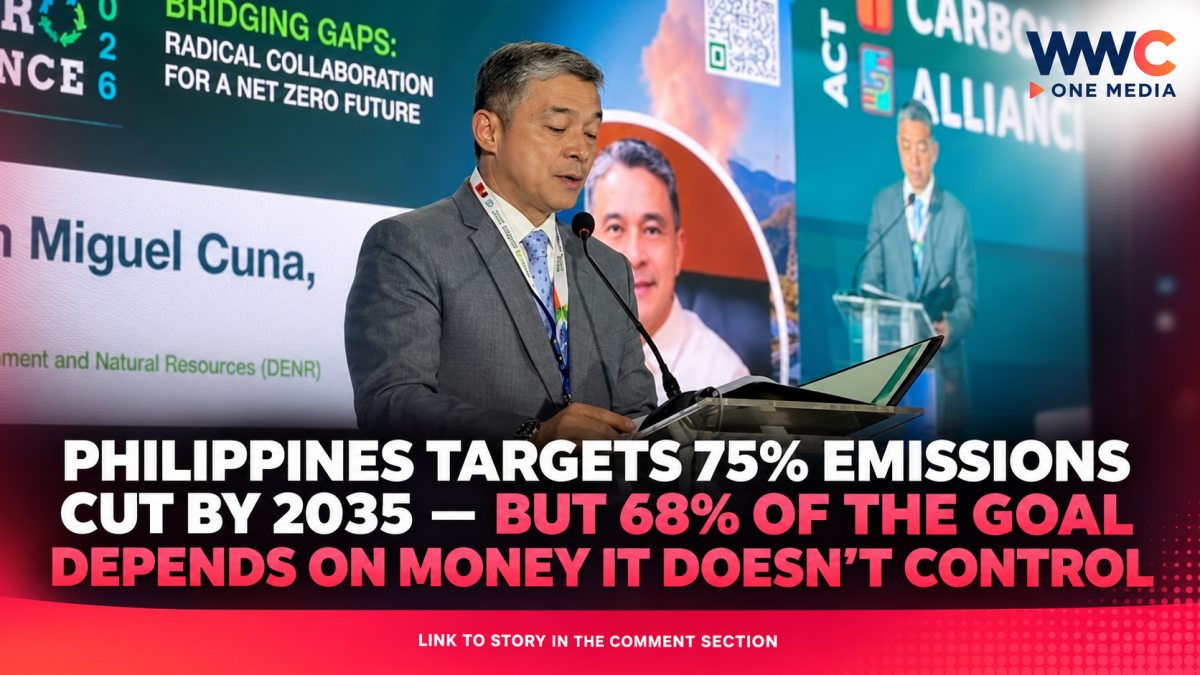
Environment Secretary Juan Miguel “Mitch” Cuna said the country needs climate financing that is accessible, scalable and “non-debt creating,” while urging international partners to help build investible projects under the mechanisms of the Paris Agreement. His remarks came at the Philippine Net Zero Conference 2026 in Pasay City, where government officials, business leaders and financiers gathered to discuss how climate pledges can be converted into actual projects.
The financing question has become even more important after the Philippines submitted its updated Nationally Determined Contribution, or NDC, to the United Nations Framework Convention on Climate Change on September 8, 2026.
Under that new pledge, the Philippines is targeting a 75% reduction and avoidance of projected cumulative greenhouse-gas emissions and removals over 2025 to 2035, compared with its business-as-usual scenario. The target includes forestry and other land use. Crucially, that does not mean emissions will simply be 75% lower than today’s level; it is measured against projected cumulative emissions under the NDC’s reference scenario.
The biggest number may be 68%, not 75%
Only 7 percentage points of the 75% target are unconditional, meaning the government says they can be delivered using domestic capabilities and resources.
The remaining 68 percentage points are conditional on international support, including financing, technology and capacity building.
That is an improvement in domestic ambition from the Philippines’ previous NDC. The 2021 commitment also carried a 75% headline target for 2020–2030, but only 2.71% was unconditional, while 72.29% depended on international assistance.
The updated pledge also expands and recalculates the emissions framework. It covers energy, transportation, industrial processes and product use, agriculture, waste, and forestry and other land use, while using 2015 as the base year for its updated accounting.
For Manila, however, raising the unconditional component does not remove the financing problem. Most of the headline target still depends on resources that have to come from outside normal domestic public spending.
DENR wants capital — but not another debt burden
Cuna is pushing development partners, financial institutions and investors to treat climate projects as investible assets rather than unusually risky projects.
He also called on developed economies to provide grant-based support, technology transfers and financing for loss and damage, particularly to unlock the conditional 68% of the Philippine target.
That distinction matters for a developing economy because climate projects financed primarily through borrowing can improve resilience or reduce emissions while also increasing future debt-servicing requirements.
The scale of the challenge was already substantial even before the latest NDC was filed. The OECD said Philippine authorities had estimated that about $72 billion in investment would be needed to achieve the conditional mitigation component of the previous 2020–2030 NDC, with much of that investment required in energy and transport. The same OECD review said the Philippines’ first Biennial Transparency Report identified about $637 million in loans and grants received for climate mitigation. Those figures relate to the earlier NDC period and should not be treated as the final financing requirement for the new 2025–2035 pledge.
Carbon markets could become part of the answer
One mechanism the DENR is pursuing is Article 6 of the Paris Agreement, which allows countries to cooperate on emissions reductions, including through internationally transferred mitigation outcomes and carbon-credit arrangements.
The Philippines has been building the rules needed for that market, including governance arrangements, authorization procedures, monitoring and verification systems and a national carbon registry.
A major step came on April 30, 2026, when the Philippines and Singapore signed an implementation agreement for carbon-credit cooperation under Article 6. The agreement establishes a framework for generating and transferring eligible carbon credits between the two countries and was the Philippines’ first implementation agreement of its kind.
Japan is another partner. Under the Philippines-Japan Joint Crediting Mechanism, projects and methodologies have included renewable energy, methane reductions from rice cultivation through Alternate Wetting and Drying, and carbon removals from afforestation and reforestation. A new afforestation/reforestation methodology was approved in July 2026.
The potential attraction is straightforward: well-designed carbon-market projects can bring foreign investment into renewable energy, agriculture, forests and other emissions-reduction activities without relying solely on sovereign borrowing.
But carbon trading also creates accounting risks. Cuna said the Philippines would not compromise the integrity of carbon accounting, safeguards against double counting or the country’s rights over its emissions reductions as it attracts international capital.
Grants are already arriving — but on a much smaller scale
The government is also trying to strengthen its ability to secure traditional international climate funding.
In June 2026, the Green Climate Fund approved a $6.78-million grant for a five-year Philippine readiness program aimed at improving the country’s ability to develop and implement climate investments aligned with its National Adaptation Plan and NDC implementation strategy.
The program is intended to strengthen inter-agency coordination, develop a pipeline of climate projects and improve monitoring and knowledge systems, according to the Department of Finance.
The grant is useful for preparing projects, but its size also illustrates the distance between climate-project readiness funding and the much larger sums eventually required for energy, transportation, agriculture, forests and resilient infrastructure.
The real test begins after the pledge
The government’s 75% figure is likely to attract the headlines, but the structure of the NDC shows why financing may determine how much of that ambition becomes reality.
The Philippines has increased the portion it intends to accomplish domestically from 2.71% under the old NDC to 7% under the new one. Yet 68% of the overall target remains conditional on international assistance.
That puts the focus increasingly on what happens after climate conferences: whether grants become available, whether carbon-market rules attract credible investment, whether technology partnerships produce projects at commercial scale and whether financing can reach Philippine communities and industries without creating an unsustainable debt burden.
The pledge is now on paper.
The harder question is whether the money required to deliver it will follow.

Leave a Reply