
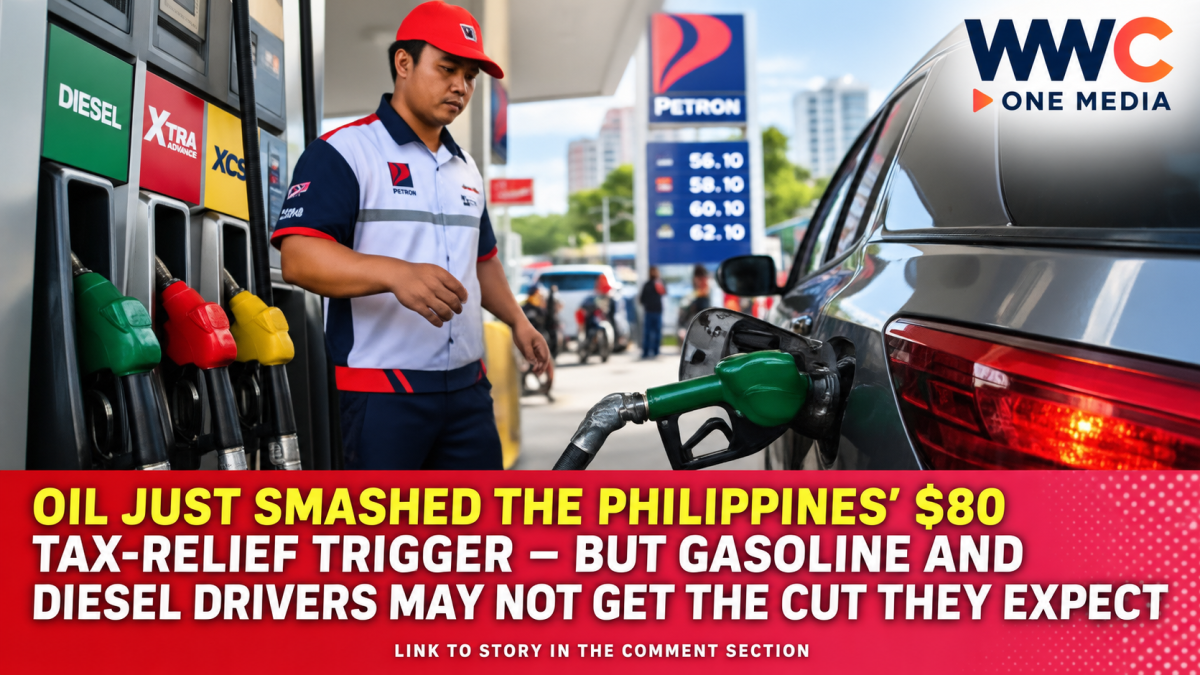
MANILA, Philippines — Global oil prices have climbed high enough to unlock the Philippine government’s emergency fuel-tax relief powers again, but motorists waiting for an immediate drop in gasoline and diesel prices may need to temper expectations.
The Department of Energy has formally certified that the 30-day average price of Dubai crude reached $99.41 per barrel from August 13 to September 11, far above the $80 threshold required under Republic Act No. 12316 before President Ferdinand Marcos Jr. can temporarily suspend or reduce excise taxes on petroleum products.
Energy Secretary Sharon Garin said the certification has been transmitted to the Development Budget Coordination Committee, or DBCC, which must evaluate whether to recommend tax relief to the President.
That means one major legal hurdle has been cleared.
It does not mean fuel taxes disappear automatically.
And the relief currently being considered may initially focus on liquefied petroleum gas and kerosene rather than the gasoline and diesel used by millions of motorists, jeepney drivers, truck operators and logistics companies.
That distinction could become increasingly important as the Philippines absorbs another sharp oil shock from escalating disruptions in the Middle East.
The trigger wasn’t just crossed — oil averaged almost $20 above it
Republic Act No. 12316, signed in March 2026, allows the President to suspend or reduce fuel excise taxes when the one-month average price of Dubai crude based on the Mean of Platts Singapore reaches or exceeds $80 per barrel.
The latest certified average was $99.41.
That is almost $20 above the statutory trigger.
The law gives the government flexibility.
Excise taxes can be fully suspended or only partially reduced, and the intervention can apply to selected petroleum products rather than every type of fuel.
Any single suspension or reduction can last for a maximum of three months, although the government’s total use of the authority cannot exceed one year in aggregate. The presidential authority itself is available only until December 31, 2028.
If the one-month Dubai crude average subsequently falls below $80, normal excise-tax rates automatically return one week after DOE certification, unless the three-month limit arrives first.
That is exactly what happened earlier this year.
The government already used this emergency button once in 2026
The current debate is not theoretical.
In April, the DOE certified that the preceding 30-day Dubai crude average had reached $93.71 per barrel.
The DBCC then recommended relief, and Marcos signed Executive Order No. 114 on April 16, fully suspending excise taxes on certain LPG and kerosene products.
At the time, the government did not extend the suspension to regular gasoline and diesel.
The relief was also designed to be temporary.
By June, the average Dubai crude price had fallen to $79.45 per barrel, below the statutory threshold. As required by the executive order, the Bureau of Internal Revenue restored the excise taxes effective July 8, 2026.
Barely two months later, international oil prices have surged again.
That rapid reversal shows why RA 12316 was designed as a temporary emergency mechanism rather than a permanent tax cut.
What could actually become cheaper?
For now, the Department of Finance has signaled a relatively targeted approach.
Finance Secretary Frederick Go said his department was prepared, once the DOE issued its certification, to immediately propose to the DBCC a 100% suspension of excise taxes on LPG and kerosene for presidential approval.
Under current tax rates:
LPG carries a ₱3 excise tax per kilogram, while kerosene carries ₱5 per liter.
If those excise taxes are fully suspended and the relief is passed through to consumers, the tax component of retail prices could fall by approximately those amounts, although actual shelf and pump prices can also be affected by inventories, import costs, foreign exchange rates, logistics and other pricing components.
The proposal would therefore directly benefit households and businesses that rely on LPG for cooking and kerosene for eligible uses.
But it would leave another question unanswered:
What about gasoline and diesel?
Gasoline carries ₱10 tax; diesel ₱6
The existing excise tax on unleaded premium gasoline is ₱10 per liter, while diesel carries ₱6 per liter.
RA 12316 gives the President legal authority to suspend or reduce those taxes as well if the required conditions are satisfied.
But as of the latest government statements, the DOF’s announced proposal is specifically focused on LPG and kerosene.
The LPG Marketers Association has called for broader relief covering gasoline and diesel amid the latest price surge, according to Philstar.
Whether economic managers ultimately broaden the package will depend on the DBCC’s recommendation and the President’s decision.
That creates a significant difference between saying “the $80 trigger has been breached” and saying “fuel taxes have been suspended.”
Only the first has happened so far.
Pump prices have already jumped by nearly ₱10 or more in two weeks
The renewed tax discussion comes after sharp increases at Philippine filling stations.
According to DOE figures reported by Philstar, oil companies raised prices on September 15 by approximately:
₱5.68 per liter for gasoline, ₱4.31 for diesel and ₱4.62 for kerosene.
Combined with the previous week’s adjustments, gasoline had risen by about ₱10.37 per liter in two weeks, diesel by ₱9.49, and kerosene by ₱10.20.
Some fuel products were already selling for more than ₱100 per liter at certain stations, underscoring how rapidly the international oil shock has reached Philippine consumers.
For a motorist buying 40 liters of gasoline, a ₱10-per-liter increase translates into roughly ₱400 more for a fill-up compared with two weeks earlier.
For transport businesses operating multiple vehicles, the additional cost can quickly multiply.
Why oil suddenly climbed above $100 globally
The Philippines imports most of its petroleum requirements, leaving domestic prices heavily exposed to international crude and refined-product markets.
The newest surge is being driven primarily by supply fears associated with escalating Middle East conflict and disruptions to some of the world’s most important oil transportation infrastructure.
Reuters reported on September 16 that Brent crude was trading around $107.82 per barrel, while U.S. West Texas Intermediate stood around $104.86.
Oil loadings at Saudi Arabia’s Yanbu port had been suspended after an attack forced the shutdown of the country’s East-West pipeline.
That pipeline has been used to move around 4 million barrels per day — roughly 4% of global oil supply — toward the Red Sea, providing an alternative route when Gulf shipping faces disruption.
Reuters reported that estimates for restoring the pipeline varied from days to several weeks.
The uncertainty is adding another risk premium to global oil prices even as U.S. inventory data temporarily pushed crude futures lower on September 16.
For the Philippines, the key issue is not merely whether crude moves up or down on a single trading day.
RA 12316 deliberately uses a one-month average, meaning sustained elevated prices — rather than a brief spike — determine whether the emergency tax authority becomes available.
The $99.41 certification shows that the latest increase has lasted long enough to meet that requirement.
The government says the country still has more than 50 days of fuel supply
Despite the price shock, the DOE has said the country’s overall fuel inventory remains sufficient for more than 50 days of national requirements.
That means the immediate Philippine issue is currently more about price affordability than an outright lack of physical supply.
The distinction matters.
A country can have sufficient fuel stocks while still suffering from steep price increases if the replacement cost of imported petroleum rises.
The government earlier said it can also source fuel from multiple exporting countries, although widespread disruptions in the Middle East can still raise the global market price paid even by buyers whose cargoes come from elsewhere.
Why not suspend every fuel tax?
A broad tax suspension sounds straightforward from a consumer perspective: remove the tax and reduce the retail price.
For government, the calculation is more complicated.
Excise taxes generate revenue used to fund public spending. Suspending them across large-volume products such as gasoline and diesel can therefore create substantially larger revenue losses than temporarily removing taxes from selected products.
RA 12316 explicitly requires the government to report to Congress on foregone revenue, the impact on different household groups, expected effects on inflation and fuel prices, possible market distortions and the overall cost-benefit calculation whenever the authority is exercised.
This explains why the law does not automatically eliminate every petroleum excise tax once oil hits $80.
Instead, it gives economic managers discretion to decide which products should receive relief, how large the reduction should be and how long it should last.
That tradeoff has been debated before.
Government economists have historically argued that universal gasoline and diesel tax cuts can deliver larger peso benefits to households consuming more fuel, while supporters of broad suspensions point to the indirect effect high diesel and gasoline prices have on public transport, freight, agriculture and consumer goods.
The current DBCC process will determine how those competing fiscal and consumer considerations are handled this time.
There’s another price effect hiding behind the pump
Higher oil prices do not stop with motorists.
Diesel is used to transport food and manufactured products.
Fuel is a major cost for logistics companies, delivery fleets, buses, jeepneys, fishing vessels and agricultural operations.
Airlines are exposed to jet-fuel costs.
Businesses that depend on generators or petroleum-based inputs can also face higher expenses.
That means a prolonged rise in energy costs can eventually affect food prices, transportation fares, manufacturing costs and inflation even for households that do not own cars.
This is one reason the government created an emergency tax mechanism in March instead of relying entirely on direct cash subsidies or waiting for world oil prices to normalize.
But the law also recognizes that excise-tax relief is only temporary.
It cannot control the underlying international price of crude.
Even after the trigger, there are still two decisions left
The latest DOE certification effectively completes the first step.
Dubai crude has remained above the legal threshold long enough for the government to act.
Now comes the DBCC.
The committee must determine whether to recommend a full suspension, partial reduction or no change — and which petroleum products should be covered.
Then the President must decide whether to approve the recommendation and issue the necessary order.
Based on the DOF’s latest public position, LPG and kerosene currently appear to be the products under immediate consideration.
Gasoline and diesel have not yet been included in that announced proposal.
So while headlines saying the $80 fuel-tax trigger has been breached are accurate, Filipino motorists should not interpret that as an automatic ₱10 cut in gasoline or ₱6 reduction in diesel.
Those taxes remain in force unless the administration specifically decides otherwise.
The next move now belongs to the DBCC and Malacañang
The Philippine government created RA 12316 precisely for moments like this.
In March, Congress gave the executive branch a way to react faster when international oil markets became exceptionally volatile.
In April, that power was used.
In July, the relief automatically ended when oil fell below the threshold.
Now, in September, the trigger has been breached again — this time with the certified Dubai crude average at $99.41 per barrel, substantially higher than during normal market conditions.
The question is no longer whether the government can cut petroleum excise taxes.
Legally, it can.
The question is which fuels it will choose, how much relief it will approve, and whether any reduction will be large enough to offset an oil market that remains above $100 a barrel globally.




Leave a Reply