
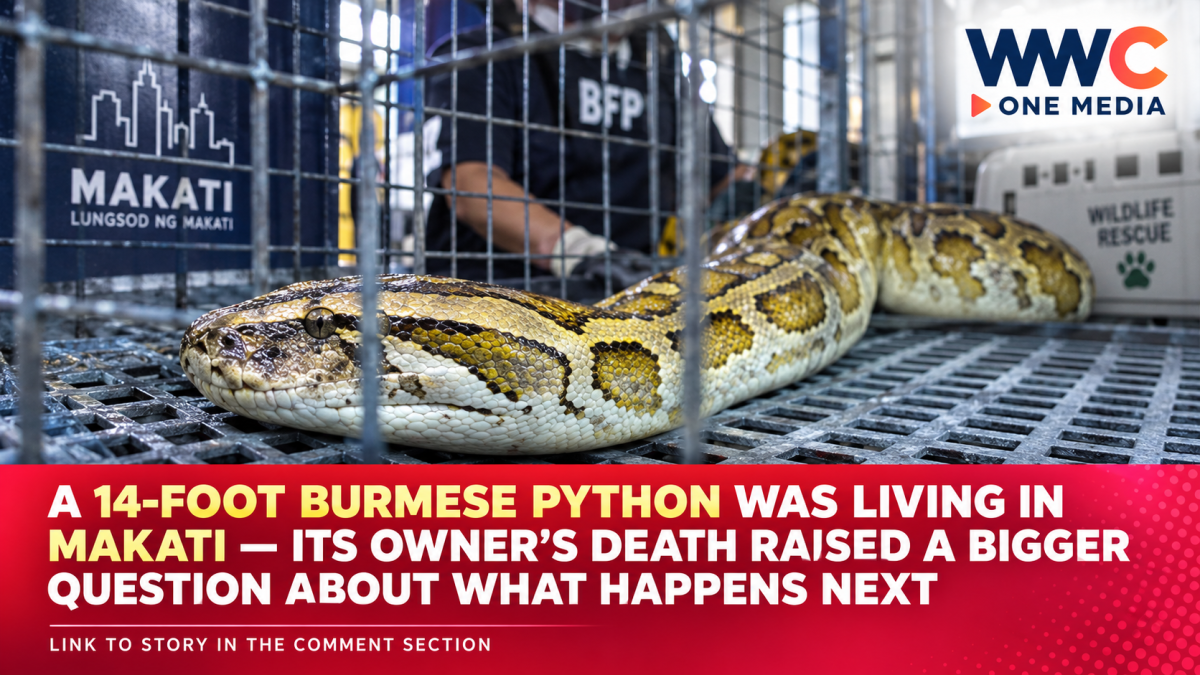
MANILA, Philippines — A 14-foot Burmese python weighing about 50 kilograms has been turned over to environmental authorities in Makati after the death of the person who had been caring for it, raising a wider question about what happens to large exotic pets when their owners can no longer keep them.
The Department of Environment and Natural Resources said relatives of the python’s former keeper contacted authorities and surrendered the massive snake in Barangay Pio del Pilar, Makati City.
Personnel from the DENR Metropolitan Environmental Office-West responded and arranged the safe transfer of the reptile. An initial examination found the python in good physical condition, with no visible wounds or signs of physical abuse.
The snake was subsequently brought to the Wildlife Rescue Center at Manila Zoo, where it will undergo further examination and care while authorities determine its proper disposition.
And that final decision is more complicated than simply releasing it into a forest.
This is not a native Philippine python
The rescued animal is a Burmese python, or Python bivittatus, one of the world’s largest snake species.
Burmese pythons are non-venomous constrictors native to parts of South and Southeast Asia, but DENR has previously classified the species as exotic wildlife in the Philippines — meaning it does not naturally occur in the country.
That distinction matters.
The Philippines has its own native large constrictor, the reticulated python, which is naturally found in the archipelago. Burmese pythons encountered in Philippine homes, pet collections or wildlife facilities instead generally originate from the exotic-animal trade or captive breeding.
DENR says Burmese pythons commonly kept as exotic pets may appear relatively calm under controlled conditions, but they remain wild animals whose behavior and physical requirements differ fundamentally from domesticated pets.
At 14 feet and roughly 50 kilograms, the Makati python is already within the large-adult range described by authorities. DENR said Burmese pythons can commonly reach around 10 to 16 feet and require specialized housing, handling and husbandry.
That makes finding a suitable long-term home considerably more difficult than rehoming a dog or cat after an owner’s death.
Why DENR cannot simply release it
Because the Burmese python is exotic to the Philippines, releasing one into local forests would create a separate environmental concern.
Republic Act No. 9147, or the Wildlife Resources Conservation and Protection Act, regulates the possession, transport, collection and trade of wildlife — and explicitly applies to exotic species maintained or bred in captivity in the Philippines. The law also regulates the introduction of wildlife outside its natural habitat.
For that reason, the snake’s transfer to a rescue facility is an important step.
Authorities can assess its health, origin and documentation before determining where it can legally and safely remain.
Possible outcomes were not announced by DENR in the current case, so reports should avoid claiming that the snake will eventually be released, permanently housed at Manila Zoo or transferred elsewhere until officials make that determination.
Owning a Burmese python legally requires paperwork
Keeping exotic wildlife in the Philippines is not automatically illegal.
But it is regulated.
DENR has previously explained that a Burmese python legally imported into the Philippines requires the appropriate wildlife import documentation, while legal private possession requires the applicable Certificate of Wildlife Registration or other authorization.
Republic Act No. 9147 says private persons possessing threatened or exotic wildlife must meet legal requirements, including demonstrating the capacity and facilities needed to maintain the animals. The law also regulates transportation, sale and other wildlife-related activities.
Importantly, DENR’s public statement about the Makati python did not say whether its deceased keeper possessed the necessary permits or registration.
There is therefore no basis at this stage to describe the animal as illegally owned.
That is a distinction worth making because earlier Burmese-python cases in Metro Manila have involved very different circumstances.
DENR has handled Burmese pythons in Metro Manila before
In February 2023, DENR officers responded to a complaint concerning a Burmese python being kept in San Andres Bukid, Manila.
In that case, DENR said the owner could not produce a Certificate of Wildlife Registration and ultimately voluntarily surrendered the animal. It was transferred to a government wildlife rescue facility.
Several months later, the Las Piñas City Veterinary Office turned over a 7.5-foot albino Burmese python to DENR after its owner reportedly said he could no longer afford or manage its care. Officials said the animal was in good condition.
DENR has also retrieved a Burmese python from a residential area in Navotas, after residents reported the animal and expressed concern about safety. Officials stressed after that case that large exotic snakes require experienced handling and should not be treated like conventional domestic pets.
Those cases illustrate a recurring challenge: exotic reptiles can live for years and eventually grow far beyond the size many buyers encounter when they first acquire them.
The issue becomes particularly complicated when an owner dies, relocates, experiences financial problems or simply becomes incapable of providing appropriate housing and veterinary care.
The international trade in Burmese pythons is also regulated
The Burmese python is listed in Appendix II of the Convention on International Trade in Endangered Species of Wild Fauna and Flora, or CITES.
CITES records also identify Python bivittatus as Vulnerable under the global conservation assessment referenced by the convention. Appendix II does not prohibit international trade outright, but it subjects trade to controls designed to prevent exploitation incompatible with the species’ survival.
That creates an unusual contrast.
In places where Burmese pythons naturally occur, conservation authorities are concerned about pressures on wild populations.
In other countries, most famously the United States, escaped or released Burmese pythons have become invasive predators in areas such as southern Florida.
The Philippine situation is different, but the underlying lesson is similar: exotic wildlife cannot simply be treated as disposable pets and released when ownership becomes difficult.
A 50-kilogram snake requires a long-term plan
The Makati case is therefore about more than the spectacle of a giant snake living in one of Metro Manila’s most densely developed cities.
It highlights a practical question that often receives less attention in exotic-pet ownership:
Who takes responsibility for the animal when the original owner no longer can?
A Burmese python can eventually require a secure enclosure, specialized feeding, veterinary expertise and handlers capable of safely managing an animal weighing tens of kilograms.
Unlike a domesticated pet, transferring that responsibility can also trigger wildlife-registration and transport requirements.
The family in the Makati case chose to surrender the python to authorities after the keeper died — a decision that allowed specialists to assess both the animal’s welfare and its future placement rather than leaving relatives to handle a huge constrictor themselves.
DENR’s warning: don’t try to catch large wildlife yourself
DENR-NCR is again reminding residents not to approach or attempt to handle large pythons found in residential or public areas.
Instead, sightings or animals needing surrender should be reported to the barangay, local veterinary authorities or DENR so trained personnel can conduct a controlled retrieval.
That advice is relevant even though Burmese pythons are non-venomous.
A large constrictor has considerable muscular strength and can bite defensively when frightened, restrained or improperly handled. Non-venomous does not mean harmless.
For the 14-foot python surrendered in Makati, however, the immediate danger appears to have passed.
The animal is now in professional care.
The unanswered question is what kind of permanent home authorities can find for an exotic snake that has already grown longer than many family cars — and could remain dependent on human care for years to come.




Leave a Reply