
MANILA, Philippines — Hanabishi built its name selling appliances for Filipino homes. Forty years later, some of the products that may say the most about the company are not sitting in kitchens or living rooms at all — they are hanging from classroom ceilings, helping small businesses and serving communities rebuilt after disasters.
As the homegrown appliance brand celebrates its 40th anniversary in 2026, Hanabishi is renewing a long-running partnership with GMA Kapuso Foundation, extending a relationship that has supported disaster rehabilitation, schools, housing projects and other community programs across the Philippines.
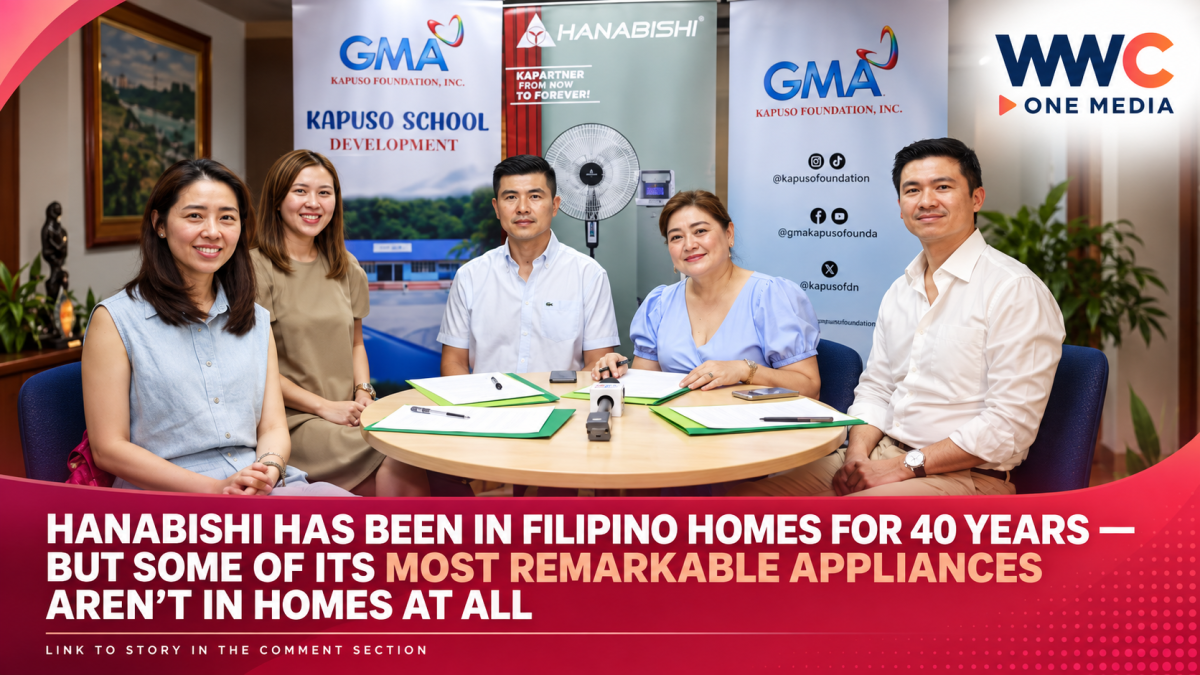
Hanabishi President Jasper Ong and GMA Kapuso Foundation Executive Vice President and COO Rikki Escudero-Catibog signed a new memorandum of agreement at the Kapuso Center in Quezon City, continuing a partnership that the two organizations say has lasted about 14 years.
But the anniversary is also revealing something bigger about Hanabishi’s evolution.
The company that began in 1986 with electric fans is increasingly using its products — and its partnerships — as tools for rebuilding homes, improving classrooms and supporting Filipino livelihoods.
Hanabishi started with one product Filipinos badly needed
Hanabishi is operated by Fortune Buddies Corp., a Philippine company founded in 1986.
Its origins were remarkably straightforward.
Company founder Jose Ong saw an opportunity in the Philippine appliance market after traveling to Thailand and Taiwan, which were major manufacturing centers at the time. In a tropical country where air-conditioning remained beyond the reach of many households, affordable electric fans had mass-market potential.
That became Hanabishi’s entry point.
Manila Standard reported during the company’s 30th anniversary that the business began by concentrating on affordable electric fans before moving into rice cookers, kitchen equipment and eventually larger appliances.
By 2023, company executives were still describing electric fans as one of Hanabishi’s defining products. Philstar.com reported that the category had remained a bestseller since the brand’s early years.
Today, Hanabishi says its lineup includes cooking appliances, refrigerators, washing machines, chest freezers, air conditioners and other household and commercial products, with distribution through more than 3,000 outlets nationwide. That distribution figure comes from the company itself.
The wider product portfolio gave Hanabishi a bigger commercial footprint.
It also gave the company something it could deploy outside the retail market.
A disaster partnership became a 14-year relationship
Hanabishi’s relationship with GMA Kapuso Foundation developed around disaster recovery.
Official GMA Kapuso Foundation records show Hanabishi participating in its Kapuso Village project in Iligan City in 2012, where families displaced by Tropical Storm Sendong were being given permanent homes.
When the foundation inaugurated the first houses in Barangay Mandulog that year, Hanabishi representatives were there to provide appliance packages to beneficiary families.
The wider Iligan project eventually produced 180 permanent housing units for Sendong survivors.
When the final 60 homes were turned over in 2014, GMA News reported that the houses were also supplied with appliances donated by Hanabishi.
The partnership then extended into the massive rehabilitation effort that followed Super Typhoon Yolanda.
GMA Kapuso Foundation completed 403 permanent homes in Tacloban for Yolanda survivors and later developed another 169-unit Kapuso Village in Palo, Leyte. Hanabishi was among the partners represented in the Palo project.
Hanabishi’s own corporate history says its support contributed to housing projects in Iligan and Leyte, while GMA Foundation records independently confirm the company’s participation and appliance donations in several of those developments.
What began as post-disaster assistance eventually moved into another area where something as ordinary as an electric fan can make a practical difference: public schools.
Some Hanabishi fans have reportedly been running in schools for more than a decade
As part of the renewed partnership, Escudero-Catibog highlighted an unusual measure of longevity.
She said that when GMA Kapuso Foundation returns to renovate some schools more than a decade after construction, it still finds original Hanabishi ceiling fans operating in the classrooms.
That observation comes from GMA Kapuso Foundation rather than from an independent product-testing organization, but it helps explain why appliances became a recurring component of the foundation’s school projects.
The partnership can be traced through years of GMA Foundation records.
In 2016, the foundation inaugurated its first Kapuso Village Integrated School, designed for around 700 elementary and high school students. Hanabishi supplied the school’s appliances, including classroom fans and water dispensers.
A year later, Hanabishi renewed its partnership to support Kulayan ang Kinabukasan, a program that repaired and repainted older Kapuso schools while installing new ceiling fans, wall fans and water dispensers.
GMA Foundation’s 2019 annual report also lists Hanabishi appliances among the items provided during rehabilitation work at schools in Oriental Mindoro.
Then came one of the partnership’s most significant projects.
After the Marawi siege, Hanabishi helped equip 18 rebuilt classrooms
Following the 2017 Marawi siege, GMA Kapuso Foundation launched its Rebuild Marawi Project to restore educational infrastructure damaged or disrupted by the conflict.
Hanabishi joined the initiative covering 18 classrooms in three schools:
Camp Bagong Amai Pakpak Elementary School, Pendolonan Elementary School and Datu Saber Elementary School.
Contemporary reporting from Balita said Hanabishi committed approximately ₱500,000 worth of electric fans, water dispensers and other appliances to the three beneficiary schools.
GMA Kapuso Foundation opened the first rebuilt school building at Camp Bagong Amai Pakpak Elementary School in October 2018. The four-classroom building, which also contained eight restrooms, was intended for nearly 300 pupils from kindergarten through Grade 6.
Hanabishi was among the material donors supporting the Marawi rebuilding program, alongside government agencies, private companies and other organizations.
The partnership continued at Datu Saber Elementary School, where GMA Foundation later completed a three-story, seven-classroom building.
Foundation records show that the structure included classroom ceiling fans and water dispensers supplied by Hanabishi. GMA News reported in January 2021 that the new facility also contained a faculty room, canteen, library, hand-washing facilities, restrooms and other learning amenities.
It is an important distinction: Hanabishi did not single-handedly rebuild the schools.
The projects involved GMA Kapuso Foundation, government institutions, military engineering units, donors, corporations and international partners. Hanabishi’s specific contribution centered largely on appliances and other support.
That context makes the impact clearer without overstating the company’s role.
The CSR strategy is now moving from disaster relief to livelihoods
Hanabishi’s community activities are also expanding beyond housing and school projects.
Through its Kapartner sa Kabuhayan advocacy, the company has partnered with K-COOP on Project Karinderya, an initiative designed to support small community eateries while helping provide meals to vulnerable residents.
Under the program, participating karinderya operators can receive equipment and livelihood support while designated beneficiaries — including senior citizens, persons with disabilities, pregnant or breastfeeding mothers and low-income families — receive subsidized meals.
Hanabishi participated by supplying Karinderya Starter Kits containing appliances that small food-business owners could use in their operations.
The company describes many of the beneficiaries as “nanaypreneurs” — mothers operating small food businesses to generate household income.
This is a different kind of corporate social responsibility from one-time disaster donations.
Instead of simply distributing goods after a crisis, livelihood programs attempt to provide assets that can continue producing income.
Whether those businesses remain sustainable over the long term would require independent follow-up data, but the model points to how Hanabishi is broadening its community strategy.
Hanabishi’s 40th anniversary also turned attention inward
The company has also used its 40-year milestone to recognize employees.
Earlier in 2026, Hanabishi sent approximately 90 employees who had served the company for at least five years on a four-day, all-expenses-paid trip to Hong Kong.
Eligibility was based on tenure rather than corporate rank, according to the company.
For a privately held company whose history spans two generations of the Ong family, employee retention has become part of the brand’s anniversary message alongside community work.
Hanabishi executives have described the business as having evolved from a relatively narrow line of small appliances into a much wider product portfolio serving homes and businesses across the country.
That growth also reflects how dramatically the Philippine appliance market has changed.
Consumers who once considered owning several electric fans a sign of improving household prosperity now shop for inverter air conditioners, induction cookers, ice makers and connected devices.
Yet Hanabishi has largely kept its positioning around affordability and mass-market practicality rather than pushing exclusively into premium smart-home technology. Philstar.com reported company executives saying in 2023 that the high cost of some smart features did not always fit Hanabishi’s core market.
From appliances in homes to appliances that help rebuild communities
Corporate anniversary campaigns can easily become exercises in nostalgia.
Hanabishi’s 40th year offers a more tangible record to examine.
There are permanent homes built for families displaced by Sendong and Yolanda.
There are classrooms in Marawi rebuilt after conflict.
There are fans and water dispensers installed in schools.
There are small karinderya owners receiving equipment intended to help them earn an income.
And according to GMA Kapuso Foundation, some appliances installed through earlier projects are still being used more than 10 years later.
None of these projects belongs to Hanabishi alone. They were collaborative efforts involving foundations, government agencies, communities, donors and numerous private-sector partners.
But that may be precisely the lesson behind the company’s renewed partnership as it begins its fifth decade.
For a brand built around appliances designed to make everyday life more comfortable, the bigger legacy may be what happens when those products leave the showroom — and end up in a home rebuilt after a typhoon, a classroom recovering from conflict or a tiny neighborhood business trying to survive.




Leave a Reply