
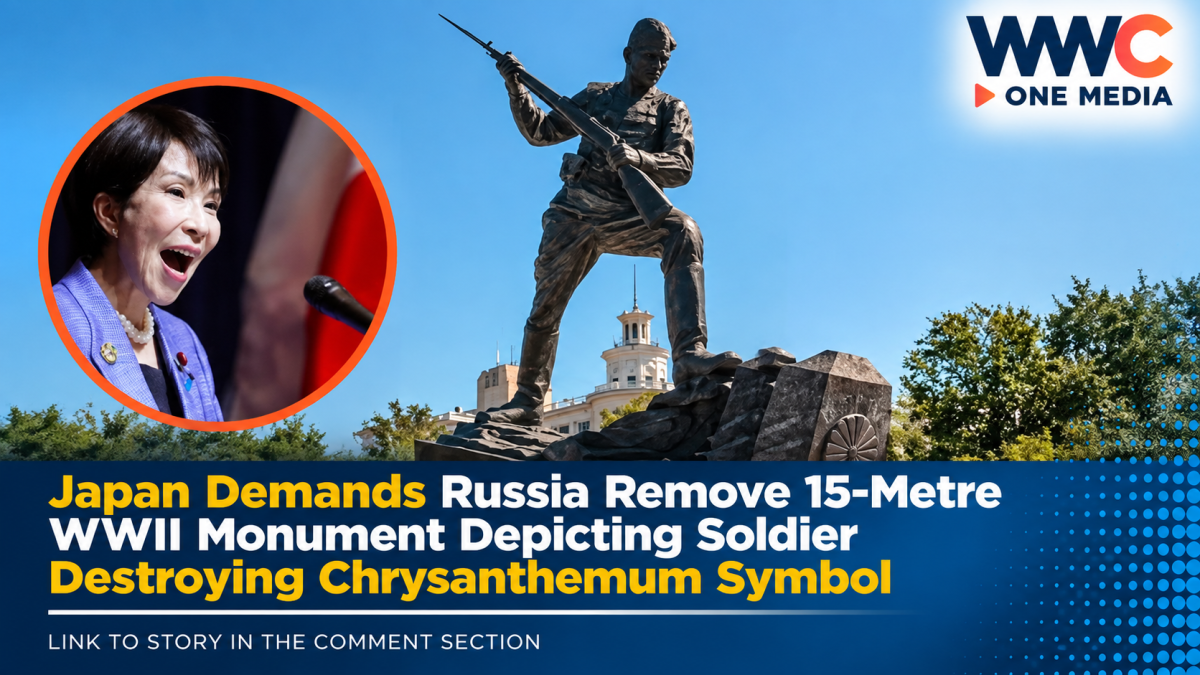
TOKYO — Japan has demanded that Russia remove a towering new World War II monument in the far eastern city of Khabarovsk, escalating a fresh diplomatic dispute over a sculpture depicting a Soviet soldier destroying a stone marker bearing a chrysanthemum crest — a symbol closely associated with Japan and its Imperial family.
The Japanese government says the monument is unacceptable and damaging to Japanese public sentiment.
Russia, however, has shown no sign of backing down.
The dispute has now become the latest flashpoint in already strained relations between Tokyo and Moscow.
Monument Marks Soviet Victory Over Japan
The controversy centres on a 15-metre bronze monument unveiled in Khabarovsk on Sept. 4.
The monument commemorates the Soviet Union’s victory over Japan at the end of World War II and depicts a Soviet soldier smashing a boundary stone with the butt of his rifle.
The stone bears a chrysanthemum crest.
According to Japan’s Foreign Ministry, the monument depicts a Soviet soldier destroying a boundary stone containing chrysanthemum crests moulded into it.
Japan says the chrysanthemum crest is widely recognised as a symbol of the country and is closely associated with the Imperial family.
Japan Calls the Monument ‘Unacceptable’
Japanese Foreign Minister Toshimitsu Motegi said Tokyo had strongly protested through diplomatic channels and demanded that Russia halt the installation and remove the monument.
In an official statement released on Sept. 5, Japan’s Foreign Ministry said the monument was not constructive for relations between the two countries.
The ministry said depicting the destruction of the chrysanthemum crest was unacceptable from the perspective of Japanese public sentiment and described the situation as extremely regrettable.
Japan said Russia had not responded positively to its request and that Tokyo would continue pressing Moscow to remove the monument.
Prime Minister Also Demands Its Removal
Japan’s Prime Minister Sanae Takaichi also publicly called for the monument to be dismantled.
She said the chrysanthemum crest is widely recognised as a symbol of Japan and argued that a monument depicting its destruction was completely unacceptable.
The intervention from Japan’s prime minister elevated the dispute beyond a routine diplomatic protest.
What began as an objection to one element of a new memorial has now developed into a high-profile dispute involving the governments of both countries.
Why Is the Chrysanthemum Symbol So Sensitive?
The chrysanthemum is deeply connected to Japan’s national identity and Imperial tradition.
The chrysanthemum crest is associated with Japan’s Imperial family and is widely recognised as a symbol of the country.
Japan’s Foreign Ministry said the destruction of the symbol in the monument was particularly offensive because of its significance to Japanese public sentiment.
But Russian officials have presented a sharply different interpretation.
For Russia, the symbol on the boundary marker is connected to the historical context of Imperial Japan and Japanese militarism during the war.
That difference in interpretation is now at the heart of the diplomatic dispute.
Russia Says the Chrysanthemum Will Stay
The Russian Military Historical Society has publicly rejected calls to remove the chrysanthemum symbol.
Russian officials involved with the memorial said the boundary marker was based on a historical marker associated with Imperial Japan’s presence on Sakhalin.
A senior representative of the Russian Military Historical Society said the chrysanthemum would remain part of the monument.
The organisation’s position is that the symbol represents the defeat of Japanese militarism and is part of the monument’s historical narrative.
Russian officials have argued that removing it would change the meaning of the memorial.
Moscow Fires Back at Tokyo
The dispute became even more heated after Russian Foreign Ministry spokeswoman Maria Zakharova responded to Japan’s demand.
Russian media reported that Zakharova dismissed Tokyo’s call for the monument to be removed and defended Russia’s right to commemorate its wartime history.
Her response signalled that Moscow is unlikely to accept Japan’s request.
The Russian position remains that the monument represents historical events connected to the Soviet campaign against Imperial Japan and the end of World War II.
Monument Unveiled at WWII Victory Commemoration
The unveiling ceremony was linked to Russia’s commemoration of its victory over Japan and the end of World War II.
The monument was installed in Khabarovsk, one of Russia’s major cities in the Far East.
The Russian Military Historical Society was involved in the project.
The ceremony also drew attention because Chinese and North Korean representatives were reported to have attended.
The monument’s unveiling comes as Russia continues to place strong emphasis on commemorating its military history and World War II victories.
A Symbol of History — But Whose History?
The controversy highlights how the same historical symbol can carry completely different meanings.
For Japan, the chrysanthemum crest is associated with:
- Japan’s national identity
- The Imperial family
- Long-standing cultural and historical traditions
For Russian officials defending the monument, the symbol is linked to:
- Imperial Japan
- Japanese militarism
- The Soviet Union’s wartime victory
That clash of historical interpretations has transformed a monument into a diplomatic dispute.
Neither side appears ready to change its position.
Japan-Russia Relations Already Under Strain
The monument dispute comes at a difficult time for relations between Tokyo and Moscow.
Japan and Russia have long-standing disputes over territory and historical issues.
Tokyo also maintains its position over the Northern Territories, while relations between the two countries have deteriorated significantly in recent years.
The new monument dispute adds another sensitive historical issue to an already tense relationship.
Japan argues that the memorial’s imagery damages national sentiment.
Russia argues that the monument reflects its interpretation of historical events.
For now, there appears to be little room for compromise.
Tokyo Says It Will Keep Pressing Russia
Japan has made clear that its demand will not end with one diplomatic protest.
Foreign Minister Motegi said Tokyo would continue to strongly urge Russia to remove the monument.
But Moscow’s response so far suggests the request will be rejected.
Russian officials have publicly defended the monument’s design, while the Russian Military Historical Society has specifically stated that the chrysanthemum symbol will remain.
That leaves the two governments facing an increasingly public disagreement over a monument designed to commemorate events from more than eight decades ago.
A 15-Metre Monument Now at the Centre of a Diplomatic Storm
The towering sculpture in Khabarovsk was intended to commemorate the Soviet Union’s victory over Japan during World War II.
Instead, it has triggered a new confrontation between Moscow and Tokyo.
Japan wants it removed.
Russia says the controversial symbol will stay.
And the dispute has exposed how deeply historical memory continues to influence modern diplomacy.
For Tokyo, the destruction of the chrysanthemum crest is an unacceptable insult to a symbol associated with Japan.
For Moscow, the monument represents the defeat of Japanese militarism and a defining Soviet victory.
One monument. Two radically different interpretations.
And now, a new diplomatic battle between Japan and Russia.
WWC ONE MEDIA J.M.D




Leave a Reply