
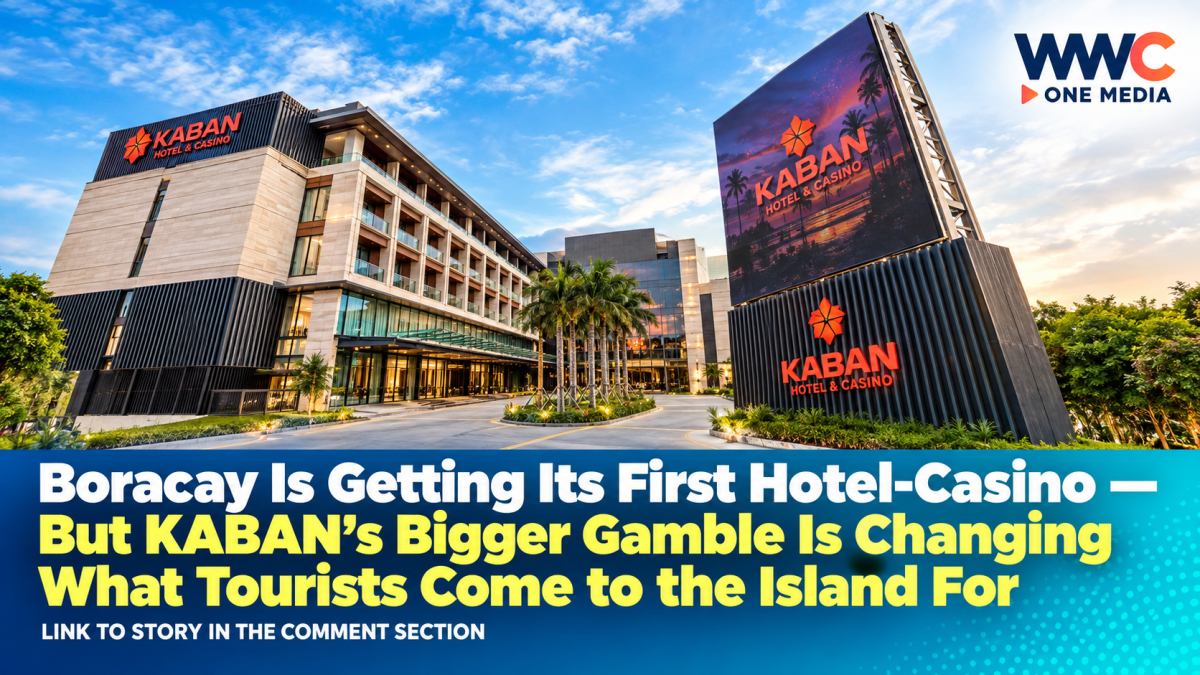
BORACAY, Philippines — Boracay has spent decades selling one thing better than almost anywhere else in the Philippines: the beach. Now, a new development at the island’s northern end is betting visitors will also come for gaming, dining and late-night entertainment.
KABAN Hotel and Casino Boracay is set to begin welcoming guests on September 16, introducing an 88-room hotel and a PAGCOR-licensed casino at the newly promoted Station 0 in Barangay Yapak, Malay, Aklan.
Its arrival is notable not simply because another luxury property is opening on one of the Philippines’ most famous tourist islands.
KABAN is being promoted as Boracay’s first hotel-casino, combining accommodation, gambling, restaurants, nightlife and wellness under one roof in an island whose international reputation has traditionally revolved around white sand, water activities and beachfront nightlife.
And it arrives after years in which casino development on Boracay was politically controversial—and at times explicitly blocked.
Inside Boracay’s new casino-hotel
The six-story KABAN development contains 88 hotel rooms and suites, including premium accommodations and a presidential suite.
Its casino occupies approximately 2,000 square meters and is expected to offer table games, slot machines and electronic gaming under Philippine Amusement and Gaming Corp. regulation.
KABAN’s official materials say access to gaming areas is restricted to people 21 years old and above, with identification and Know Your Customer checks forming part of its responsible-gaming controls.
The property also includes multiple restaurants and bars, a spa, swimming pool, VIP facilities, a children’s play area, lobby café and rooftop entertainment space.
Its dining lineup is led by Lamii All-Day Dining, while the company is separately pitching its sports bar as another entertainment draw.
The September 16 opening is technically the property’s soft launch.
KABAN says its formal grand launch will take place on October 11, 2026, following several weeks of promotional activities around Boracay.
Station 0 is being built as Boracay’s next commercial district
KABAN is also part of a much bigger real estate play.
Developer Golden TW Realty and Development Corp. is building out a roughly 23-hectare master-planned development in northern Boracay, where Station 0 is being positioned as a new tourism, lifestyle and entertainment district.
Unlike Stations 1, 2 and 3—which have long defined how tourists navigate White Beach—Station 0 is a newer branding initiative centered in Barangay Yapak.
A Station 0 landmark was unveiled in May with officials from Malay and representatives of Golden TW promoting the area as Boracay’s newest tourism zone.
KABAN is intended to act as one of its anchors.
Golden TW is also developing Boracay Central, a lifestyle mall scheduled to open in the fourth quarter of 2026, expanding the district beyond accommodation and casino gaming.
That makes Station 0 a different proposition from the beachfront commercial density of Station 2.
The developer is essentially trying to create an additional reason for visitors to travel north—not necessarily for sand and swimming, but for restaurants, entertainment, shopping and gaming.
The casino is significant because Boracay once said no to casinos
That history cannot be separated from KABAN’s opening.
In 2018, then-President Rodrigo Duterte opposed new casino developments on Boracay while the island was undergoing a major environmental rehabilitation.
One of the highest-profile proposals involved Macau’s Galaxy Entertainment Group, which had planned a roughly $500-million integrated casino resort with Philippine partner Leisure and Resorts World Corp.
Duterte rejected the project.
His administration also imposed a broader moratorium on new casinos on the island.
But in August 2021, amid the government’s need for additional revenue after the economic damage caused by the COVID-19 pandemic, Duterte reversed course and authorized casino operations on Boracay.
At that time, PAGCOR said projects linked to Galaxy and the Andrew Tan-controlled group could proceed subject to requirements.
The reversal was controversial because Malay’s municipal government had previously adopted its own casino moratorium.
Local officials argued at the time that national approval would not by itself eliminate the need for local permits and compliance.
KABAN’s 2026 opening therefore represents more than a new hotel launch.
It is the first concrete expression of Boracay’s shift from an island where casino resorts were publicly rejected to one where a licensed hotel-casino is preparing to receive guests.
A smaller casino than Manila’s integrated resorts
There is also an important question of scale.
KABAN should not be confused with the giant integrated resorts operating in Metro Manila’s Entertainment City.
Those properties contain thousands of hotel rooms, enormous casino floors, shopping malls, arenas, convention facilities and large-scale entertainment complexes.
KABAN has just 88 rooms and a 2,000-square-meter gaming floor.
It is closer to a boutique casino-hotel embedded within a resort destination than to a Manila-style integrated resort.
That could actually work to its advantage on Boracay.
A massive casino complex might clash with an island still closely associated with beaches, low-rise tourism and environmental carrying-capacity concerns.
A smaller property allows the operator to test demand for gaming without attempting to remake Boracay into another Entertainment City.
The Philippine casino market is already enormous
KABAN is entering a gaming industry that continues to generate substantial revenue.
PAGCOR data show that the Philippine gaming industry recorded roughly ₱88.14 billion in gross gaming revenue during the second quarter of 2026 alone.
Licensed casinos generated approximately ₱45.38 billion of that total, while electronic gaming and other licensees contributed another substantial share.
But most large casino revenue remains concentrated in established gaming centers such as Metro Manila and Clark.
Boracay offers a different opportunity.
Rather than attracting gamblers primarily to a casino destination, operators can potentially capture spending from millions of tourists already visiting the island.
That distinction is important.
KABAN does not necessarily need to convince someone to fly to Boracay solely to gamble.
It can also try to convince an existing resort visitor to spend an evening at the casino, restaurant, sports bar or entertainment venue.
Boracay already has more than two million potential customers a year
The size of the tourism market explains the attraction.
Boracay welcomed 2,155,217 visitors in 2025, according to Aklan Provincial Tourism Office data reported by the Philippine Information Agency.
Domestic tourists accounted for about 1.77 million, while foreign arrivals reached approximately 357,500.
Tourism-related revenues on the island reached roughly ₱47 billion for the year.
South Korea remained the largest source of international visitors, followed by markets including the United States, Australia, Taiwan, Russia and China.
Malay’s government set a target of 2.6 million tourist arrivals for 2026.
Even capturing a relatively small percentage of that traffic could produce meaningful business for a property with only 88 rooms.
That may explain why KABAN is emphasizing entertainment beyond traditional casino gambling.
KABAN wants tourists even when they don’t gamble
The company’s strategy appears deliberately broader than the gaming floor.
It has seven dining concepts, wellness facilities, a rooftop venue and live-entertainment ambitions.
The company has also partnered with entertainment organizer Insignia Presents Productions to bring concerts and events to the property. Its marketing describes Station 0 as a potential 24/7 entertainment hub rather than simply a casino district.
That diversification matters.
Casino revenue can be volatile, and the majority of Boracay visitors may have little interest in gambling.
Restaurants, nightlife, events and accommodations give the property alternative ways to monetize island traffic.
It also makes KABAN more comparable to a lifestyle resort with gaming attached rather than a pure gambling destination.
It is also creating local jobs
The operator says approximately 40% of KABAN’s employees are from Aklan, giving the development a direct local-employment component.
That figure is significant for the project’s political positioning.
Casino development can generate opposition over social costs, but developers typically emphasize employment, tourism spending and local tax revenues when seeking community support.
KABAN is making the same argument indirectly: the resort is being presented not merely as an entertainment venue but as part of a wider investment cycle around Station 0.
Technology is another part of the pitch
The property is also building infrastructure intended to support a modern hotel and casino operation.
Earlier this year, operator GTW Hotel and Leisure Inc. signed an agreement with PLDT Enterprise to supply connectivity and digital infrastructure for KABAN.
The partners said the systems would support guest services and hotel operations as the property prepared for its third-quarter opening.
That may seem like a minor operational detail, but casinos are particularly technology-intensive businesses.
Gaming systems, surveillance, transaction monitoring, customer databases, hotel systems, digital rewards platforms and security all depend heavily on reliable connectivity.
But Boracay’s environmental history cannot be ignored
There is another side to the expansion story.
Boracay was completely closed to tourists for six months in 2018 after the national government declared a state of calamity and ordered an extensive rehabilitation effort addressing sewage, infrastructure and environmental violations.
That episode fundamentally changed how development on the island is scrutinized.
Every substantial new tourism project now operates against the memory of what happened when visitor volumes and commercial growth outpaced infrastructure.
That makes Station 0’s development a balancing act.
New hotels, restaurants, malls and entertainment facilities can create jobs and increase visitor spending.
But they also add demand for water, electricity, waste management, sewage treatment, transport and public services.
The long-term test will therefore be whether Boracay can increase the value generated per tourist without simply returning to uncontrolled development.
A casino-hotel may fit that strategy if it persuades existing visitors to spend more without requiring dramatically larger tourism volumes.
But that outcome depends on how responsibly the broader Station 0 district grows.
Responsible gaming will be another test
Casinos carry social risks that ordinary hotels do not.
PAGCOR says its regulatory framework requires licensed gaming operators to promote responsible gambling, restrict access by minors and financially vulnerable individuals, and prevent gaming facilities from being used for illegal activities.
KABAN says its own responsible-gaming policy includes an age threshold of 21, identity verification and controlled access.
It also explicitly tells customers that gambling should be treated as entertainment rather than a way to make money.
Those rules will matter because KABAN is opening inside one of the country’s most mainstream family and leisure destinations.
A casino in Boracay has a very different social setting from one located inside an established metropolitan gaming district.
The bigger story
For years, the question surrounding casinos in Boracay was whether they should exist at all.
Now, that debate is moving into a new phase.
KABAN begins operations on September 16.
Its casino is licensed.
Its hotel rooms are taking reservations.
A lifestyle mall is following nearby.
And Golden TW is actively building Station 0 into a new commercial and entertainment district.
What happens next could shape the type of tourism development Boracay attracts.
If KABAN succeeds, other developers may see evidence that visitors want more than beachfront resorts and restaurants—and that gaming and entertainment can become another layer of the island’s tourism economy.
If it struggles, the lesson may be just as important: Boracay’s global attraction may still depend overwhelmingly on the beach rather than casino-style entertainment.
Either way, KABAN represents a symbolic break with the island’s recent past.
Boracay spent years fighting over whether casinos belonged on the island. Starting September 16, the question is no longer whether one will open—but whether visitors will embrace it enough to change what Boracay becomes next.




Leave a Reply