
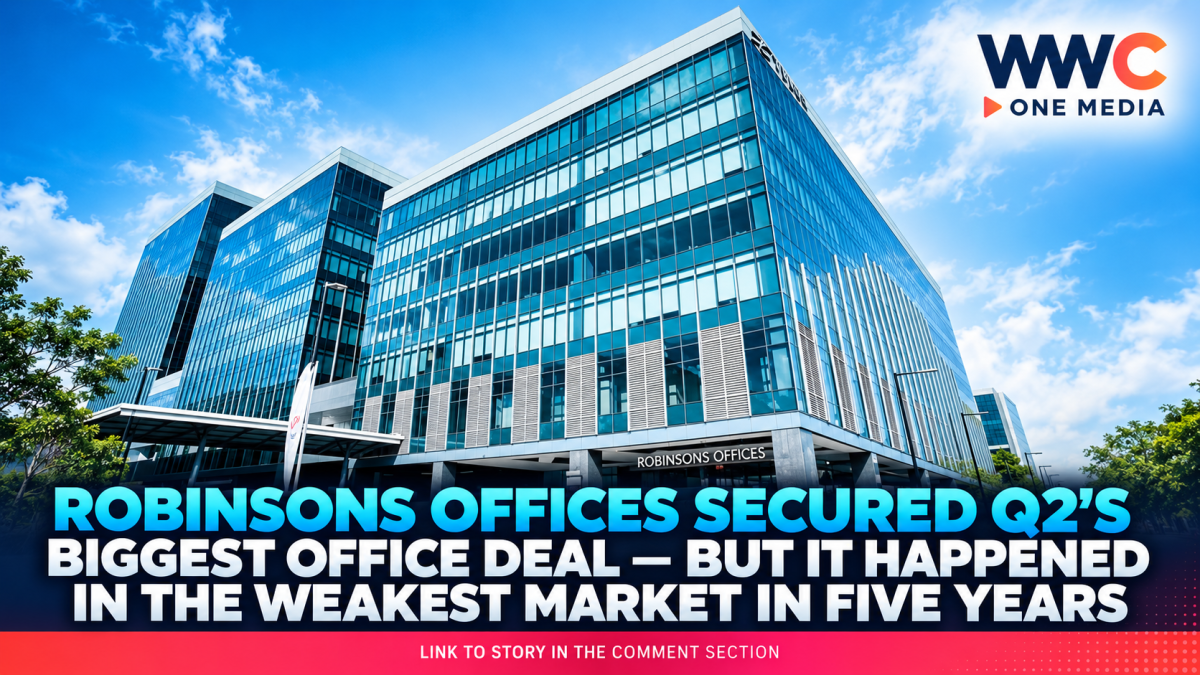
MANILA, Philippines — Robinsons Offices has emerged as the Philippines’ leading property developer by office transaction volume in the second quarter of 2026, powered by a massive 33,400-square-meter pre-leasing commitment at The Jewel in Mandaluyong City—a deal that stands out even more because it landed during one of the weakest quarters for Philippine office demand in years.
The office arm of Robinsons Land Corp. recorded approximately 38,000 square meters of transactions during the quarter, according to CBRE Philippines’ Q2 2026 Market Monitor.
The biggest contributor was Asscher, the first of four planned office towers at The Jewel.
Its 33,400-square-meter pre-leasing transaction was the largest individual Philippine office deal recorded by CBRE during the second quarter.
That single commitment made The Jewel one of the clearest examples of a trend reshaping Metro Manila’s office sector: companies may be more cautious about taking space, but they are still willing to make large commitments when the building, location and amenities meet increasingly demanding requirements.
And that matters because the wider market is far from booming.
The Biggest Deal Came During the Weakest Quarter in Five Years
CBRE recorded 161,160 square meters of headline office transactions nationwide during Q2 2026.
But there is an important catch.
When pre-leasing transactions and space taken by developers within their own buildings are excluded, CBRE said underlying—or “real”—office demand was only about 111,100 square meters, making it the thinnest quarter in five years.
The number of office transactions also fell sharply to 116 deals, a 35% decline, according to CBRE.
Colliers Philippines painted a similarly cautious picture.
It said Metro Manila office leasing activity fell 24% quarter-on-quarter during Q2 as geopolitical uncertainty prompted businesses to postpone relocation and expansion decisions.
Overall Metro Manila vacancy remained at around 19%.
Leechiu Property Consultants also reported that Metro Manila office transactions fell 32% year-on-year during the first half of 2026, reaching 488,000 square meters compared with 721,000 square meters a year earlier.
Q2 alone dropped 23% from the previous quarter in Leechiu’s dataset.
The firms use different methodologies and coverage universes, so their transaction totals should not be compared directly. But they point to the same underlying trend:
Companies are still leasing offices—but they are making decisions more cautiously.
Against that backdrop, a 33,400-square-meter commitment becomes significantly more notable.
Robinsons Offices Has Now Led Q2 Leasing Two Years in a Row
The result was not a one-off.
Robinsons Offices also topped CBRE’s developer rankings in the second quarter of 2025, when it recorded close to 50,000 square meters of new transactions.
Its GBF Center 2 project in Bridgetowne accounted for 27,100 square meters and ranked as the country’s top-performing individual office building during that period.
That means Robinsons Offices has now produced major leasing wins in back-to-back second quarters, first at Bridgetowne and now at The Jewel.
For Robinsons Land Senior Vice President and Robinsons Offices General Manager Jericho Go, the latest transaction indicates that tenants remain willing to commit to premium developments despite softer overall demand.
He said the Asscher deal showed that large requirements could still be secured by buildings combining strong locations, technology, sustainability and thoughtful design.
The data from other property consultants support that argument.
Colliers found that green-certified buildings accounted for 68% of office transactions during the first half of 2026, while sustainability and accessibility are increasingly influencing where corporations locate their operations.
Why The Jewel Could Be a Big Bet on Mandaluyong
The Jewel is rising on a 2.5-hectare property at EDSA and Pioneer Street in Mandaluyong, on the former site of Forum Robinsons.
Robinsons Land originally unveiled the project as an approximately ₱25-billion development combining premium offices with a new retail complex.
Its four towers are named after diamond cuts:
Asscher, Trilliant, Marquise and Peruzzi—collectively known as the ATMP Towers.
The strategy behind the site is straightforward.
Unlike developments tied to only one traditional central business district, The Jewel sits along EDSA between several of Metro Manila’s biggest employment centers.
It provides relatively direct access toward Ortigas, Makati and Bonifacio Global City, while remaining close to Quezon City, San Juan and Manila.
Robinsons is also proposing a link to MRT-3 Boni Station, which could become particularly important as corporations put more weight on employee commuting times and return-to-office accessibility.
That connectivity could become one of The Jewel’s strongest advantages.
Offices Are Becoming Part of the Battle for Talent
Office landlords are no longer competing solely on rental prices.
Hybrid work has changed what companies expect from physical workplaces.
Businesses increasingly want office buildings that make employees willing—or at least less reluctant—to commute again.
That means transport accessibility, sustainability certifications, food and retail options, collaborative areas, natural light and modern building systems are becoming more important.
The Jewel is being designed with smart elevators using destination-control technology, 4.2-meter floor-to-floor heights and 12-meter-high office lobbies.
Environmental features include rainwater collection, energy-efficient air-conditioning, double-glazed curtain walls and charging facilities for electric vehicles.
Flexible common spaces for meetings and collaboration are also part of the plan.
This strategy aligns closely with broader market trends.
Colliers says companies increasingly favor transit-oriented, sustainable and flexible workplaces, while JLL expects the continuing “flight to quality” to support demand for premium buildings even as the broader market remains competitive.
Robinsons Land’s Existing Office Portfolio Is Holding Up
The leasing win also comes as Robinsons Land’s office business continues to deliver growing recurring income.
For the first half of 2026, RLC reported ₱4.37 billion in office revenue, up 6% year-on-year.
Office EBITDA climbed 5% to ₱3.42 billion, while portfolio occupancy improved to 87% from 86% in the first quarter.
Second-quarter office revenue alone reached ₱2.20 billion, up 5%.
That performance is notable because office landlords across Metro Manila are still dealing with elevated vacancy and significant competition for tenants.
RLC’s overall first-half revenue reached ₱25.4 billion, up 10%, while consolidated net income rose 12% to ₱9 billion.
In other words, office properties remain an important recurring-income engine inside Robinsons Land even as the sector adjusts to post-pandemic workplace patterns.
There Is Still Plenty of Empty Office Space
The 33,400-square-meter Asscher deal should therefore not be mistaken for evidence that Metro Manila’s office-market problems have disappeared.
Colliers estimates vacancy at around 19%, while its Q2 research highlighted businesses delaying decisions and favoring renewals over costly expansions or relocations.
JLL, whose Manila Grade A dataset focuses primarily on Makati and Taguig, reported a lower 13.8% vacancy rate in Q2, down from the previous quarter.
It also recorded 40,400 square meters of positive net absorption and said technology, financial services, IT-BPM and flexible-workspace firms continued to support demand.
Meanwhile, CBRE warned that once pre-leasing and developer-related transactions were stripped out, Q2 produced the weakest underlying demand in five years.
So the market is increasingly divided.
Older or poorly located buildings may have to compete aggressively for tenants.
Newer Grade A developments with transportation access, green credentials and modern technology could capture a disproportionate share of whatever demand remains.
The Jewel is designed to fall firmly into the second category.
The Jewel Still Has Years to Prove the Bet
The project will not arrive all at once.
According to the latest development timetable reported by InsiderPH, the mall and first two office towers are targeted for completion by 2028, with the remaining two towers scheduled by 2030, subject to market conditions.
Earlier Robinsons plans had envisioned individual tower completions stretching from 2027 through 2030, underscoring that construction pacing has always depended partly on demand.
That gives Robinsons flexibility.
If office demand accelerates, the developer can push ahead more aggressively.
If demand remains weak, later phases can be calibrated to avoid flooding the market with unnecessary supply.
The 33,400-square-meter Asscher commitment provides an important early validation for that strategy.
But the real test will come when the rest of The Jewel’s office inventory enters a Metro Manila market where companies have more choices—and far less tolerance for mediocre buildings.
For now, Robinsons Offices has delivered something competitors want badly:
a very large tenant commitment in a very cautious market.
That is why the biggest story behind its Q2 leasing lead may not simply be the 38,000 square meters it transacted.
It is that almost all of the momentum was anchored by one enormous bet on a building that has not even opened yet.



Leave a Reply