
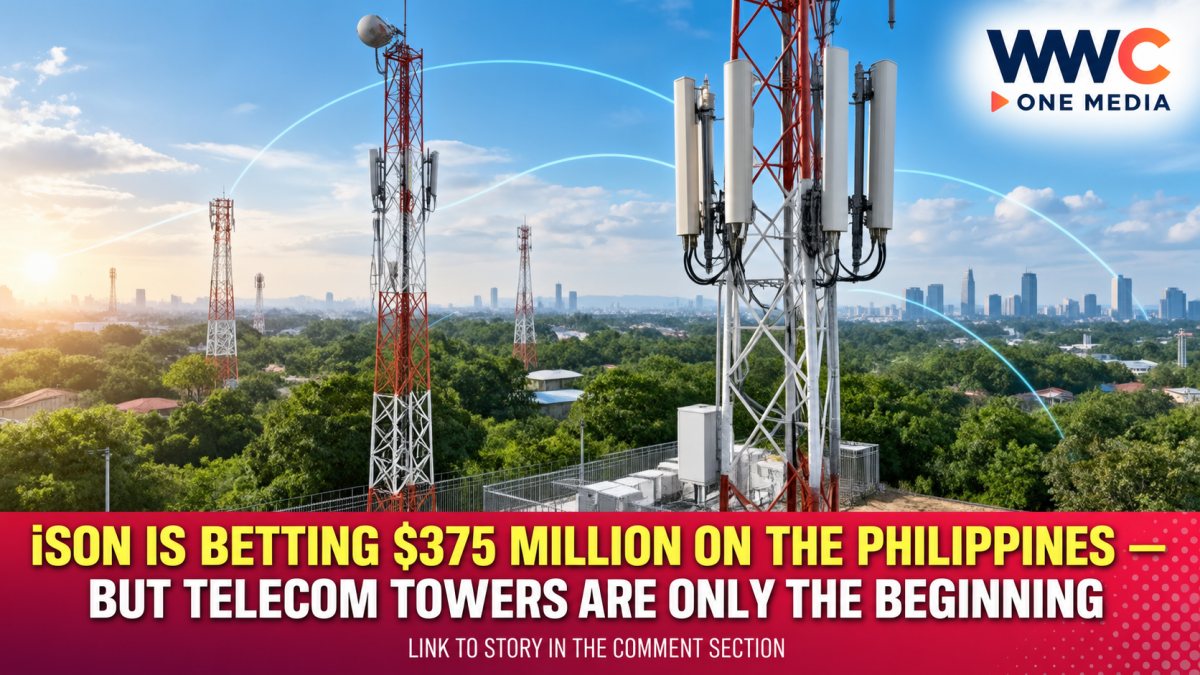
MANILA, Philippines — Global technology and infrastructure group iSON is preparing to pour as much as $375 million in additional investment into the Philippines, dramatically expanding a local business that began with telecommunications towers but is now reaching into agriculture, renewable energy, digital healthcare and business process outsourcing.
The largest piece of the investment package is a planned $300-million expansion of iSON Tower Ltd. Inc., which aims to grow its Philippine telecommunications network to around 3,000 towers over the next decade.
Another $75 million is earmarked for new or expanded investments in agrotechnology, healthcare and BPO, according to plans presented by iSON executives during a September 12 meeting with President Ferdinand Marcos Jr. and senior Philippine economic officials in New Delhi.
That makes iSON’s latest commitment much more than another telecommunications infrastructure project.
The company is effectively building a four-pronged Philippine strategy around connectivity, food production and renewable power, digital healthcare, and outsourced services.
And the scale could become significantly larger if all the projects move from commitments to actual construction and operations.
$300 Million Will Go Mainly Into Telecom Towers
Telecommunications remains the centerpiece.
iSON Tower plans to invest up to $300 million over 10 years to expand its network to roughly 3,000 sites, with the company targeting construction of around 300 to 400 towers annually.
It is not starting from zero.
iSON says it has already invested approximately $65 million in 450 telecommunications towers serving around 600 tenants across Metro Manila, Luzon, the Visayas and Mindanao.
That $65 million is separate from—and is not included in—the new $375-million investment package.
The tower expansion is expected to add more than 100 direct employees, on top of the company’s existing workforce of more than 120, while expanding its contractor network to about 1,000 workers.
Those numbers make telecom infrastructure by far iSON’s biggest Philippine bet.
But the strategy behind it matters just as much as the amount.
iSON Is Betting on Shared Towers
iSON operates under the Philippines’ Common Tower Policy, which encourages telecommunications companies to share infrastructure instead of every mobile operator building its own tower at the same location.
The model is designed to lower duplication, reduce deployment costs and accelerate network expansion.
iSON already has relationships with the country’s two dominant mobile network operators.
When the Asian Development Bank announced financing for iSON in 2024, it said both Globe Telecom and Smart Communications had master lease agreements with the tower company.
Under that arrangement, iSON acquires or leases sites, builds towers and handles their operation, security and maintenance, while telecommunications providers rent capacity on the infrastructure.
ADB and Security Bank provided a combined ₱4.8-billion financing package in 2024 to support the development and operation of up to 800 iSON telecommunications towers. Each lender supplied ₱2.4 billion.
That earlier financing helps explain why iSON is already a meaningful player rather than a newcomer making its first promise to enter the Philippine market.
The Tower Target Has Changed
There is one important detail in the company’s expansion story.
When iSON’s $300-million telecommunications investment was publicized in August 2025, the Department of Trade and Industry said the company planned to construct 3,000 to 4,000 new telecommunications towers over the following decade.
The latest September 2026 announcement uses a different formulation: iSON now plans to expand its Philippine network to 3,000 towers.
That appears to be a refinement of the earlier plan rather than an entirely new $300-million commitment.
For accuracy, the latest 3,000-tower target should therefore take precedence when describing iSON’s current roadmap.
It also means the headline $375-million figure should not be interpreted as $375 million suddenly committed on top of every investment figure previously announced by the group.
Much of the telecom component builds on an expansion strategy iSON has been discussing with the Philippine government for more than a year.
But Telecom Is Only $300 Million of the Story
The more interesting change is what iSON is doing with the other $75 million.
Its largest non-telecom proposal is a $50-million agro-solar development in New Clark City, planned in partnership with the Bases Conversion and Development Authority.
The project would combine approximately 50 hectares of protected agriculture using greenhouses and polyhouses with a 40-megawatt-peak solar photovoltaic facility.
Initial crops are expected to include capsicum, cherry tomatoes and cucumbers.
Eventually, iSON plans to cultivate around 20 to 25 varieties.
The idea is unusual because the project combines two sectors normally considered separately.
One part is designed to produce higher-value crops in controlled agricultural environments.
The other creates renewable electricity.
If executed as announced, it could turn a portion of New Clark City into a demonstration site for combining food production and clean-energy infrastructure.
Earlier Plans Were Even Bigger
There is another accuracy point worth separating from the latest announcement.
In August 2026, the Department of Finance discussed a broader iSON pipeline that included a $50-million modern agriculture project as well as a much larger proposed 400-megawatt agro-solar development worth about $200 million, in addition to a separate 40-MW solar initiative in New Clark City.
Those earlier proposals should not automatically be added to the new $375-million figure.
The latest DTI-backed package specifically identifies $50 million for the New Clark City agro-solar project with a 40-MWp solar component.
In other words, iSON has discussed a wider pipeline with Philippine officials, but the September package is narrower and more clearly defined.
That distinction is important because investment announcements often contain projects at very different stages—from exploratory discussions to detailed commitments.
$15 Million Bet on Digital Healthcare
iSON is also allocating $15 million to expand digital healthcare services in the Philippines.
Its plans include 24-hour teleconsultations in English and Tagalog, international second medical opinions and medical-tourism services for patients requiring more complex treatment.
Philippine government reporting said the proposed teleconsultation offering could cost around ₱65 per month, although that pricing remains subject to iSON’s final implementation plan.
The potential market is obvious.
For Filipinos living in areas where access to doctors or major hospitals remains limited, low-cost remote consultations could reduce the need to travel simply for basic medical advice.
iSON Health already markets round-the-clock virtual consultations and digital medical services internationally.
The Philippine expansion could therefore give the group a way to apply an existing digital-health model to a country with large geographic barriers to healthcare access.
But execution will matter.
Telemedicine still depends on licensed medical professionals, reliable connectivity, regulatory compliance and mechanisms for referring patients who require physical examination or emergency treatment.
Another $10 Million Goes Into BPO
The final $10 million of the announced non-telecommunications package will fund expansion of iSON’s contact-center operations.
The company’s Philippine BPO business already serves Globe Telecom and Smart Communications.
Its longer-term plan is more ambitious: iSON wants to shift some international work currently handled from South Africa, Egypt and India into Philippine operations.
That would turn the country from a market served by iSON into a delivery location serving overseas customers.
The Philippines already has one of the world’s largest IT-BPM industries, giving iSON access to a deep pool of English-speaking customer-service and technology workers.
For the company, relocating international workloads could also allow the various parts of its Philippine business to reinforce one another.
Its towers support digital connectivity.
Its contact centers rely on that connectivity.
And its digital-health services depend on reliable communications infrastructure as well.
Why the Philippines Fits iSON’s Strategy
iSON’s businesses are concentrated in emerging markets.
The group has operations in around 35 countries and more than 25,000 employees globally, according to Philippine government reporting.
That makes the Philippines a logical market for several reasons.
It has a large and young population, growing mobile-data consumption, an established BPO industry and significant demand for better rural connectivity.
At the same time, infrastructure gaps remain.
The government has been trying for years to accelerate tower construction and simplify permitting because slow approvals, rights-of-way problems and inconsistent local procedures have historically delayed broadband infrastructure projects.
Shared infrastructure is one of the government’s responses to that problem.
If iSON can add hundreds of towers each year, it could give Globe, Smart and potentially other operators additional sites without forcing every telecommunications company to independently acquire land and construct duplicate facilities.
Government Incentives Could Sweeten the Deal
The Philippine government has also signaled that qualifying iSON investments could receive support under the country’s current investment framework.
Projects may potentially qualify for incentives under the CREATE MORE Act and the Strategic Investment Priority Plan.
Strategic projects may also seek expedited government processing through the Green Lane for Strategic Investments.
Trade Secretary Cristina Roque said the company’s expansion reflects growing confidence among international investors and could bring new capital, technology and employment into the country.
Finance Secretary Frederick Go similarly described the proposed investments as an opportunity to strengthen strategic industries and create jobs.
Those are government assessments, however.
The real economic impact will depend on how much of the announced capital is eventually deployed and how quickly the proposed projects move through financing, permitting and construction.
The Bigger Story: One Investor, Four Industries
The most significant part of iSON’s announcement may therefore not be the $375-million headline by itself.
It is the breadth of the bet.
A company that entered the Philippine market primarily as an independent telecommunications-tower operator now wants a much bigger role in the economy.
Its current investment map looks like this:
- Up to $300 million: telecom infrastructure and expansion toward a 3,000-tower network
- $50 million: protected agriculture and a 40-MWp agro-solar project in New Clark City
- $15 million: digital healthcare and teleconsultation
- $10 million: BPO and contact-center expansion
Together, those planned investments total $375 million, excluding the roughly $65 million iSON says it has already deployed in its existing tower network.
That distinction matters.
The Philippine investment is not yet a completed $375-million transaction.
It is a roadmap.
But iSON already has hundreds of towers in operation, established relationships with Globe and Smart, financing support from institutions including ADB and Security Bank, and an existing local operating platform.
That gives the commitment more substance than an investment announcement from a company with no local footprint.
The next question is execution.
If iSON succeeds in building hundreds of towers each year while simultaneously rolling out agricultural, healthcare and BPO businesses, its Philippine operation could look dramatically different by the end of the decade.
What began as a telecommunications infrastructure play could become a much broader bet on how the Philippines connects, works, produces food—and even accesses healthcare.




Leave a Reply