
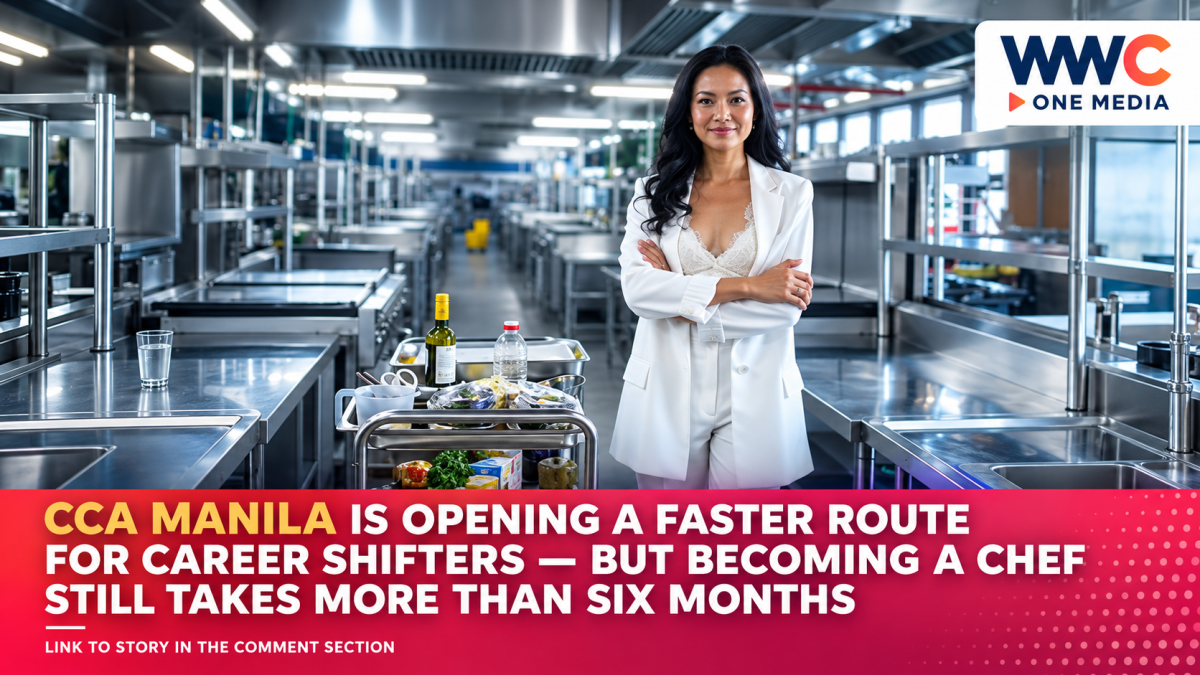
MANILA, Philippines — For Filipinos who have dreamed of trading the office desk for a professional kitchen—but cannot afford to put work and family responsibilities on hold—CCA Manila is betting that culinary school no longer has to mean years of full-time study.
The Center for Culinary Arts Manila is widening its pitch to career shifters, entrepreneurs, working professionals and serious home cooks through flexible professional programs that combine online learning with face-to-face kitchen training.
At the center of that push are CCA Manila’s six-month Professional Chef Program, or ProChef, and its new seven-month Professional Baking Program, or ProBaking.
The approach reflects a growing market for adults who want formal culinary credentials and professional techniques without enrolling in a traditional two-year diploma program.
And the timing may be significant: employment in the Philippine accommodation and food-service sector has been expanding sharply.
This isn’t just about people who want to become chefs
CCA Manila’s strategy appears designed around a broader reality in culinary education: not everyone who studies professional cooking intends to start at the bottom of a restaurant kitchen.
Some students already own food businesses.
Others have spent years cooking at home but want professional certification.
Still others are executives or employees considering a second career.
CCA’s own program structure now reflects those different paths. Its full-time Diploma in Culinary Arts and Technology Management runs for two years, while its professional certificate track is designed to fit around the schedules of working adults.
That makes the shorter programs a potentially more practical entry point for people who want to test—or accelerate—a move into the food industry.
ProChef compresses professional training into six months
The six-month Professional Chef Program combines digital coursework through Rouxbe Online Culinary School with hands-on instruction.
Students start with fundamentals such as food safety, sanitation, culinary math, ingredient identification and nutrition before progressing into knife skills, meat and poultry fabrication, seafood preparation, stocks, soups, sauces and different cooking techniques.
The curriculum also includes garde manger, egg cookery, bread baking and pastry fundamentals.
CCA currently describes the program as requiring one face-to-face training and assessment session each Saturday from 2 p.m. to 8 p.m., supplemented by four hours of online consultation per week.
That schedule helps explain the target market.
Instead of requiring students to leave their jobs and attend culinary school five days a week, ProChef gives working adults a pathway to formal training while retaining much of their existing routine.
The format also isn’t entirely new.
CCA Manila has offered versions of its professional chef track for years, and in July 2026 it was already advertising another ProChef intake. The school has also used its partnership with online culinary education provider Rouxbe since 2020.
The new bet is baking—and business
Where CCA Manila is adding a distinctly new offering is ProBaking, its seven-month Professional Baking Program launched for the September 2026 intake.
The course does more than teach students how to produce bread, cakes and pastries.
Students move through ingredients, food safety and baking techniques before tackling artisan breads, viennoiserie, cakes, pastries and plated desserts.
But the later stages introduce something particularly relevant to aspiring entrepreneurs: production workflow, costing, yield management, quality control, branding, packaging and pricing.
The program culminates in the development and presentation of a bakery business plan.
In other words, CCA is not positioning ProBaking solely as a route toward employment in another company’s pastry kitchen.
It is also pitching it as preparation for students who eventually want to build their own food business.
CCA’s current calendar lists the next ProBaking intake at its UP BGC campus on September 26, 2026. The school lists a ₱50,000 reservation fee, although prospective students should confirm the complete tuition and payment structure directly with CCA before enrolling.
Why business skills matter as much as recipes
Knowing how to bake a croissant or execute a sauce is only one part of surviving commercially in the food industry.
A restaurant or bakery must also know how much every serving costs, what price the customer will accept, how much product is wasted, how production should be scheduled and whether sales can cover labor, rent, ingredients and other expenses.
That business angle is increasingly visible in CCA Manila’s broader training philosophy.
Daily Tribune previously profiled entrepreneur Raymund Aaron of Villa Socorro Farm, who enrolled in CCA’s Professional Chef Program and used culinary training to help develop new ideas for his family’s banana-chip business.
Rather than becoming a restaurant chef, Aaron applied what he learned to an existing food-manufacturing enterprise—illustrating the kind of student CCA’s shorter professional programs increasingly seek to serve.
Similarly, the latest InsiderPH report highlights ProChef graduates who used their training to strengthen their food businesses and professional cooking skills rather than simply using the certification to look for their first kitchen job.
Career shifters are entering a food sector that has been adding workers
There is also a larger economic backdrop to CCA’s move.
Latest Philippine Statistics Authority data show that accommodation and food-service activities recorded an increase of 729,000 employed people in July 2026 compared with July 2025, making it one of the sectors with the biggest year-on-year employment gains.
Earlier structural data tell a similar story.
The PSA counted 37,500 formal accommodation and food-service establishments in 2024, up 21.5% from 30,861 in 2022.
Those businesses employed 520,642 people, a jump of 43% over the same period.
Restaurants and mobile food-service businesses alone accounted for 349,629 workers, or more than two-thirds of employment in the sector.
Those numbers do not mean every culinary graduate is guaranteed a job, nor do they measure chef vacancies specifically.
But they do show that CCA is courting career changers at a time when the broader hospitality and food-service ecosystem is considerably larger than it was just a few years ago.
Culinary careers no longer end at the restaurant kitchen
The career possibilities are also broader than the traditional chef ladder.
BusinessMirror has previously highlighted CCA graduates working as restaurant owners, culinary consultants, recipe developers and educators, while others have pursued international hospitality careers.
CCA itself says its alumni work across restaurants, hotels, airlines, cruise lines and food businesses, and the institution increasingly incorporates entrepreneurship into its curriculum.
For students who do want conventional restaurant careers, however, practical exposure remains important.
A Manila Bulletin report in April highlighted the structured internships built into CCA’s full diploma program, placing students inside working professional kitchens where speed, consistency and operational discipline become part of their education.
The shorter ProChef program likewise lists optional local internship opportunities.
But six months does not automatically make someone a chef
There is an important distinction that prospective career shifters should understand.
A six- or seven-month professional certificate can build fundamentals, introduce industry standards and give students structured practice.
It cannot replace years of experience in a high-pressure commercial kitchen.
CCA alumnus and chef JP Anglo, in promoting a 2026 scholarship program with the school, emphasized that professional kitchen work requires long hours, discipline and persistence beyond what can be learned in the classroom.
That is arguably the biggest reality check for anyone imagining culinary school as an instant route out of an unsatisfying corporate career.
Professional kitchens can mean demanding schedules, repetitive work, physical strain and starting positions far removed from the glamorous version of the profession seen on television or social media.
Formal education provides a foundation.
Experience still has to be earned.
CCA is betting on the second-career student
CCA Manila has been teaching culinary arts since 1996, but the profile of the student it is trying to attract is changing.
The conventional model—finish high school, enroll in culinary school, graduate and find a restaurant job—is now only one route.
Its newer pitch includes the banker who wants to open a café, the entrepreneur trying to professionalize a family food business, the returning overseas worker considering another career, and the home baker who wants to turn weekend orders into a commercial operation.
That is why the combination of part-time schedules, online theory, hands-on kitchen work and business training matters.
It lowers one of the biggest barriers to changing careers: having to stop everything else before beginning again.
The Philippine food-service industry is expanding, but competition is expanding with it. Knowing how to cook well remains essential. Knowing how to cost, manage, standardize and sell may determine who actually turns that skill into a sustainable livelihood.
CCA Manila’s bigger bet, therefore, isn’t simply that more Filipinos want to become chefs or bakers. It’s that a growing number are willing to reinvent their careers—and want a way to do it without starting their lives over from zero.




Leave a Reply