
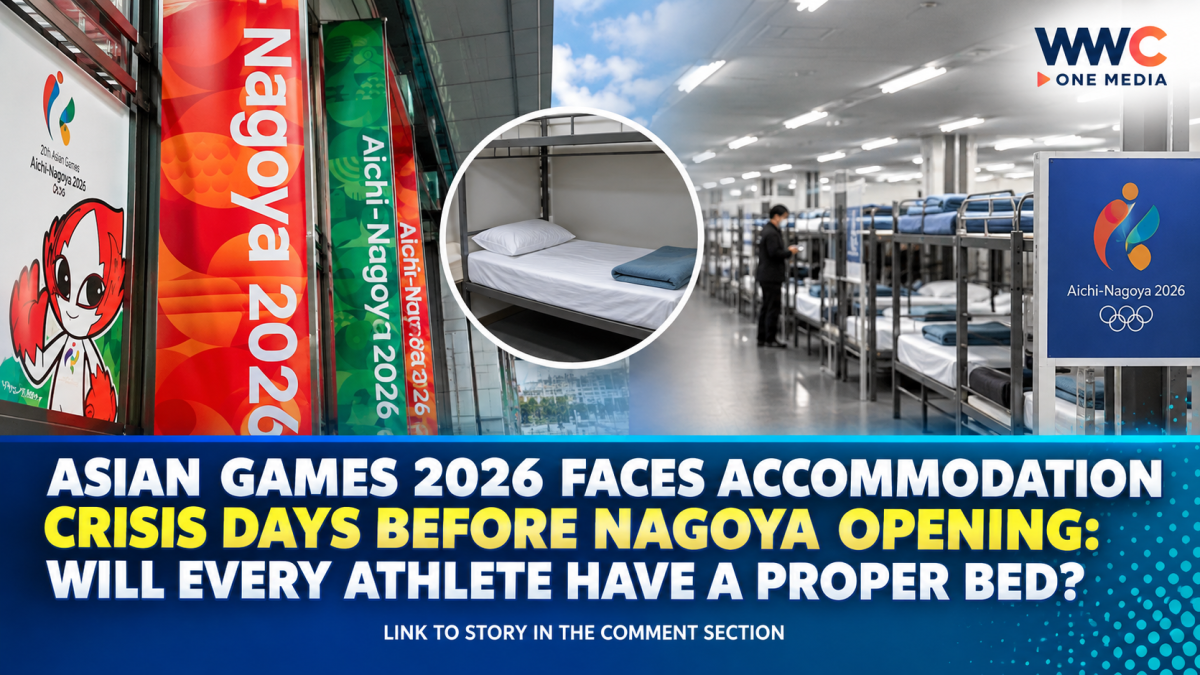
NAGOYA, Japan — The 2026 Asian Games are about to begin in Aichi-Nagoya, but a growing accommodation controversy is threatening to overshadow the sporting spectacle.
The Games officially open on September 19, with competition already underway in some sports. More than 11,000 athletes from across Asia are expected to participate, but several delegations have raised concerns about whether the host region has enough suitable accommodation for the huge influx of athletes and officials.
The most striking complaint has come from South Korean officials, who described the accommodation situation as the “worst ever” and warned of a serious shortage of rooms.
The controversy has put an uncomfortable question in the spotlight just days before the opening ceremony:
Will every athlete have a proper place to sleep?
No traditional athletes’ village
Unlike many previous editions of the Asian Games, Aichi-Nagoya does not have a conventional purpose-built athletes’ village.
Instead, organizers have arranged accommodation through a combination of hotels, temporary wooden cabin-style units and a cruise ship.
The cruise ship is being used as a floating accommodation facility, while temporary structures near Nagoya Port are designed to house additional participants.
The unusual setup was partly driven by the cost of constructing a permanent athletes’ village.
But with the number of participants increasing, the available accommodation has come under intense pressure.
South Korea raises concerns over beds and facilities
South Korean officials have been among the most vocal critics.
According to AFP-based reporting, South Korean basketball officials complained that some beds in the temporary accommodation were too short for players to fully stretch out.
Other complaints have involved leaking plumbing and the overall condition of some temporary housing facilities.
The concerns became especially visible after South Korean basketball player Byun Jun-hyung posted a video showing a bathroom leak at his team’s accommodation, accompanied by an appeal for help.
The reports have triggered criticism of the organizers’ preparations so close to the opening of one of Asia’s biggest sporting events.
A shortage does not mean everyone will be left without accommodation
Despite the headlines surrounding the bed shortage, it is important to distinguish between a shortage of suitable rooms and a complete lack of accommodation.
Organizers previously said they would provide accommodation for participants, even as the number of athletes and officials increased.
The current controversy concerns the quality, availability and suitability of some of those arrangements—not evidence that thousands of athletes will simply have nowhere to sleep.
Different delegations have also reported different experiences.
India’s cricket officials, for example, said their athletes were satisfied with their designated hotel accommodation. Players are expected to have individual rooms rather than share rooms, although the accommodation is not comparable to a luxury hotel.
That contrast highlights how accommodation conditions can vary significantly between delegations.
Why Nagoya’s housing crunch became so serious
The Aichi-Nagoya Games are expected to bring a huge number of athletes, officials and support personnel into the region.
With no traditional athletes’ village, organizers have had to spread participants across multiple accommodation facilities.
The arrangement includes hotels as well as temporary structures and the cruise ship, creating a logistical challenge involving transportation, room allocation and athlete comfort.
The shortage has become particularly sensitive because athletes competing at the highest level need adequate rest and recovery.
For sports such as basketball, volleyball, swimming and athletics, even basic accommodation conditions can have an impact on preparation.
The Games have already faced another major test
The accommodation controversy comes after heavy rainfall and flooding hit Nagoya in the days leading up to the Games.
Around 400 athletes and staff staying in temporary accommodation were temporarily evacuated to higher ground during the severe weather.
Nagoya Mayor Ichiro Hirosawa subsequently said the flooding would not disrupt the Games, which remain scheduled for September 19 through October 4.
The weather problems added another layer of pressure to preparations already facing scrutiny over accommodation.
Organizers now face a race against the clock
The immediate challenge is to ensure that all delegations have accommodation that is safe, functional and suitable for elite athletes.
The controversy also raises broader questions about the decision not to construct a traditional athletes’ village.
A permanent village would have provided centralized housing, but it would also have required substantial investment and long-term planning.
Instead, Aichi-Nagoya is relying on a more unconventional model designed to reduce costs and make use of existing infrastructure.
The approach may eventually prove practical, but the final days before the opening ceremony have exposed some of its weaknesses.
The Asian Games are still set to go
Despite the complaints, there is no indication that the 2026 Asian Games will be canceled or postponed because of the accommodation problems.
The opening ceremony remains scheduled for September 19, and organizers continue preparing for thousands of athletes competing across dozens of sports.
The spotlight, however, is now firmly on the organizers.
The Asian Games are supposed to showcase sporting excellence and bring the continent together. But before athletes can chase medals, they need something much more basic:
a safe place to rest.
And with the opening ceremony only days away, Nagoya faces a final test of its organizational readiness—one that could determine whether the unusual accommodation strategy becomes a successful innovation or one of the most talked-about problems of the Games.




Leave a Reply