
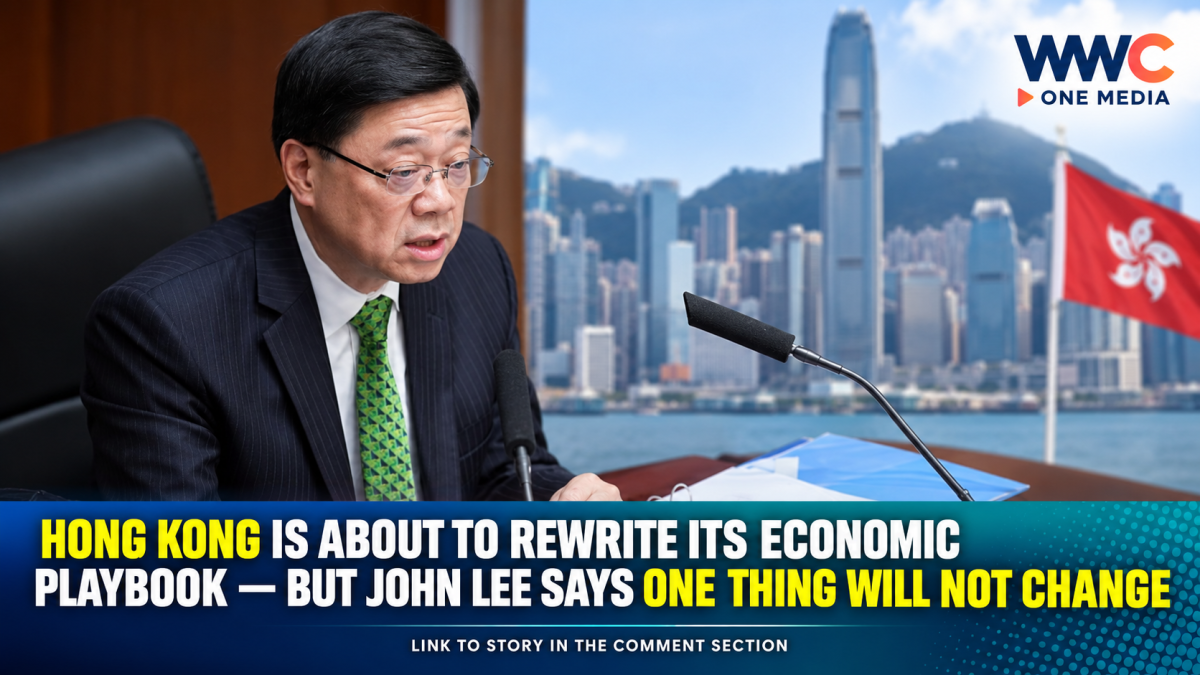
HONG KONG — Hong Kong is preparing to enter a new era of long-term economic planning, but Chief Executive John Lee Ka-chiu insists the city is not abandoning the capitalist system that has long defined its economy.
Lee is set to unveil Hong Kong’s first-ever Five-Year Plan for Economic and Social Development on September 16, together with his annual Policy Address. The blueprint will set the strategic direction for the city from 2026 to 2030, while the Policy Address is expected to translate those broader priorities into specific policies and measures.
The move is significant because Hong Kong has historically relied on annual policy addresses and budgets rather than the type of comprehensive, long-term development planning used by mainland China.
In a recent opinion article, Lee sought to address concerns that adopting a five-year plan could signal a fundamental change in Hong Kong’s economic model.
His answer was emphatic: the system will remain capitalist.
Lee said the plan would uphold Hong Kong’s rule of law and capitalist system, implement the Basic Law and maintain the principle of “one country, two systems.” He argued that long-term planning is intended to make better use of Hong Kong’s existing advantages rather than replace the city’s economic model.
China alignment at the heart of the strategy
While Hong Kong will retain its capitalist framework, the new blueprint is expected to bring the city’s economic strategy into much closer alignment with China’s 15th Five-Year Plan, which covers the same 2026-2030 period.
That means Hong Kong’s future development is likely to place greater emphasis on its role as an international gateway for China, particularly in finance, trade, technology and regional cooperation.
The Hong Kong government has identified several major areas of focus, including the development of the Northern Metropolis, innovation and technology, financial services, regional cooperation and improvements to people’s livelihoods.
The Northern Metropolis is particularly important. The massive development project along Hong Kong’s northern border with mainland China is designed to become a major economic and residential hub, with plans involving technology, industry, housing and higher education.
Business groups have also identified the Northern Metropolis and artificial intelligence as crucial components of Hong Kong’s next phase of growth. The South China Morning Post reported that major chambers, including the American Chamber of Commerce in Hong Kong and the Federation of Hong Kong Industries, urged the government to make the project a major economic driver while strengthening Hong Kong’s position as an international financial centre.
From laissez-faire to strategic planning
The biggest change may not be the policies themselves, but the way Hong Kong’s government intends to manage economic development.
For decades, Hong Kong was closely associated with a relatively hands-off, market-led approach. The city became one of the world’s major financial centres without relying on a traditional centrally planned economic model.
That philosophy is now being supplemented by more deliberate long-term planning.
The South China Morning Post has noted that Hong Kong’s first five-year plan represents a major shift because the city previously depended largely on annual policy addresses and budgets for government-wide planning. Supporters argue that longer-term coordination could help address structural problems such as housing shortages, inequality and limited upward mobility.
Lee, however, argues that strategic planning and capitalism are not mutually exclusive.
The objective, he says, is to create the conditions for businesses and residents to benefit from new growth opportunities while ensuring Hong Kong remains competitive internationally.
Technology and the Northern Metropolis emerge as major bets
Innovation and technology are expected to feature prominently in the new development blueprint.
The government has previously identified the transformation of traditional industries, development of emerging sectors and investment in future industries as major priorities. It also wants Hong Kong to strengthen its position as an international innovation and technology centre and a hub for high-skilled talent.
The Northern Metropolis could provide much of the physical infrastructure for that ambition.
The project is planned to transform a huge area along the mainland border into a combination of residential, industrial, educational and innovation zones. Business groups have argued that its success should ultimately be measured not only by construction but by whether it attracts companies, creates jobs and generates new industries.
Finance remains a critical advantage
Despite the emphasis on technology and new industries, Hong Kong’s financial sector remains central to the city’s economic strategy.
That comes as Hong Kong’s capital markets have shown strong signs of recovery.
Reuters reported that funds raised through IPOs and secondary share placements in Hong Kong reached approximately US$83.5 billion in the first eight months of 2026, up 76 percent from the same period a year earlier. More than 400 companies had also established or expanded operations in the city during the first half of the year, according to InvestHK.
The figures strengthen the government’s argument that Hong Kong can continue functioning as an international financial centre while simultaneously becoming more deeply integrated with mainland China’s economy.
The city is also expanding financial connections beyond China. On September 10, Hong Kong and Dubai announced a working group aimed at strengthening cooperation between their financial markets and increasing cross-border investment and financial connectivity.
National security will also have an economic dimension
Another potentially important feature of the coming blueprint is the connection between economic development and national security.
The South China Morning Post reported on September 14 that the five-year plan is expected to include a dedicated national-security component, with institutional safeguards potentially extending into sensitive areas such as finance and technology. The issue is increasingly being treated not simply as a law-enforcement matter but as part of protecting Hong Kong’s economic infrastructure and managing geopolitical risks.
That could become one of the most closely watched aspects of the final plan, particularly by international investors and multinational companies operating in the city.
A pivotal moment for Hong Kong
Hong Kong’s first five-year plan therefore represents more than another government policy document.
It signals an attempt to combine capitalism, long-term state planning, technological development and deeper integration with mainland China while preserving Hong Kong’s role as an international financial and commercial centre.
The government conducted an extensive public consultation before finalising the blueprint, receiving more than 16,000 submissions, according to reports.
John Lee has stressed that the five-year plan will provide the long-term direction, while the annual Policy Address will focus on implementation.
That distinction could prove important.
The real test will not be whether Hong Kong can produce a five-year blueprint. It will be whether the city can turn ambitious plans for technology, housing, infrastructure, finance and regional integration into measurable economic gains — without undermining the market-driven advantages that made Hong Kong a global financial centre in the first place.
And that is why September 16 could mark one of the most consequential policy moments for Hong Kong in years.

Leave a Reply