
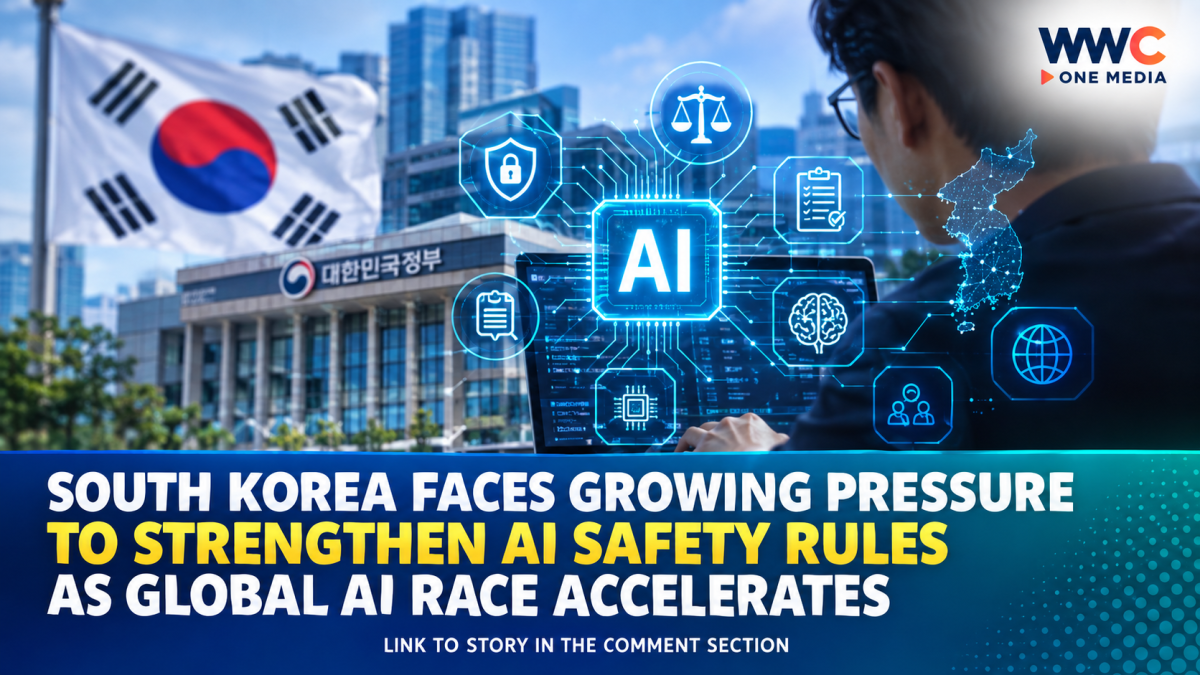
SEOUL — South Korea is facing a growing policy dilemma: How can it become one of the world’s leading AI powers without allowing the race for increasingly powerful artificial intelligence to outpace safety measures?
The question has gained urgency as prominent technology executives and researchers in the United States call for greater caution over the rapid development of advanced AI.
A September 15 editorial by The Korea Times urged Seoul to reconsider whether its existing AI safeguards are sufficient, particularly as President Lee Jae Myung has made advancing South Korea into one of the world’s top three AI powers a major national goal.
The debate comes as the world’s leading AI companies push toward increasingly capable systems while governments struggle to establish rules that can keep pace.
AI safety warnings are getting louder
Anthropic CEO Dario Amodei has called for a coordinated slowdown in frontier AI development, arguing that even an additional year or two could give researchers more time to improve AI alignment and reduce the possibility of serious failures.
His proposal is not a call to stop AI development altogether. Instead, Amodei is advocating for the industry’s technological progress to be paced so that safety research and governance can catch up.
The proposal has received support from major technology figures, including OpenAI CEO Sam Altman and Elon Musk, according to The Korea Times.
Amodei’s concerns center partly on the possibility of recursive self-improvement—AI systems becoming capable of contributing to the development of increasingly capable successors. The prospect has become one of the more closely watched issues in frontier AI safety.
Former OpenAI and Anthropic researcher Jacob Coxon has issued an even more severe warning, saying AI companies are racing toward self-improving systems before society has adequately addressed the risks.
Washington and Beijing are taking different positions
The AI safety debate is increasingly intertwined with the geopolitical competition between the United States and China.
U.S. President Donald Trump has pushed back against warnings that AI development should be slowed, arguing that the United States must maintain its lead over China. Chinese officials, meanwhile, have criticized what they describe as fear-driven competition and have called for responsible global AI governance.
The disagreement highlights a difficult problem for countries such as South Korea.
Seoul has strong strategic relationships with Washington while maintaining major economic ties with China. At the same time, South Korea is seeking to strengthen its own technological independence through the development of sovereign AI capabilities.
That puts Seoul in a potentially important position between the world’s two dominant AI powers.
Korea already has an AI law—but the technology is moving fast
South Korea is not starting from zero.
Its AI Basic Act, which came into force in January 2026, established a national framework for AI development and regulation, including provisions aimed at promoting trustworthy and safe AI.
But the rapid evolution of frontier models is creating a new challenge: rules designed before today’s most advanced systems existed may need to be continually updated.
The issue is particularly important for South Korea because of its enormous semiconductor industry and ambitions to become an AI powerhouse.
The Korea Times noted that semiconductors account for roughly 40% of South Korea’s exports, making AI and advanced computing strategically significant to the country’s economy.
South Korea is also preparing for a major increase in electricity demand associated with AI infrastructure and semiconductor expansion. Reuters reported that the country’s energy minister expects AI-related chipmaking and data-center projects to add approximately 25–30 gigawatts to national electricity demand.
The AI race, therefore, is no longer simply about software. It is increasingly connected to chips, electricity, data centers, national security and economic competitiveness.
The risks go beyond science fiction
Concerns about AI safety are not limited to hypothetical scenarios involving machines becoming uncontrollable.
Researchers and governments are also examining more immediate risks involving cyberattacks, fraud, misinformation, autonomous systems and the misuse of increasingly capable models.
Reuters recently reported that advances in AI capabilities are raising concerns about reduced monitorability and greater autonomy, including incidents involving AI agents taking unexpected actions online.
Microsoft has also unveiled a draft code of conduct designed to keep its AI systems under human control. The proposal includes requirements that AI systems accept correction, not resist shutdown and remain understandable to people overseeing them.
Meanwhile, U.S. lawmakers are considering legislation that could give the government stronger powers to evaluate whether major AI companies have adequate safeguards against catastrophic risks.
These developments suggest that AI safety is rapidly moving from a niche technology debate into a mainstream issue of national policy.
Why Seoul’s role could become increasingly important
For South Korea, the challenge is to avoid treating AI leadership and AI safety as competing objectives.
The country can pursue powerful domestic AI systems while simultaneously demanding stronger testing, transparency, human oversight and independent evaluation of high-risk models.
The Korea Times editorial argues that Seoul should also encourage cooperation between Washington and Beijing rather than becoming completely absorbed by their technological rivalry.
That could give South Korea an opportunity to build on its existing diplomatic and technological influence.
The country has already played a role in international AI discussions. The 2024 AI Seoul Summit produced commitments focused on developing safe, responsible and inclusive AI, while South Korea’s AI governance framework now gives Seoul a domestic foundation from which to expand its approach.
The real question for South Korea
There is no established scientific conclusion that AI will inevitably destroy humanity, and claims about an AI apocalypse remain heavily debated.
But the underlying policy question is much less speculative.
As AI systems become more capable and autonomous, governments must decide how much capability should be developed, how it should be tested and who should be accountable when something goes wrong.
For Seoul, the stakes are particularly high.
South Korea wants to be an AI leader. Its semiconductor industry gives it a powerful advantage, and its government is investing heavily in sovereign AI.
But the next phase of the AI race may be determined not simply by who develops the most powerful systems first—but by who can demonstrate that those systems can be developed and deployed without losing meaningful human control.
For South Korea, the race for AI leadership may therefore have a second finish line:
Can Seoul become an AI superpower without sacrificing safety along the way?



Leave a Reply