
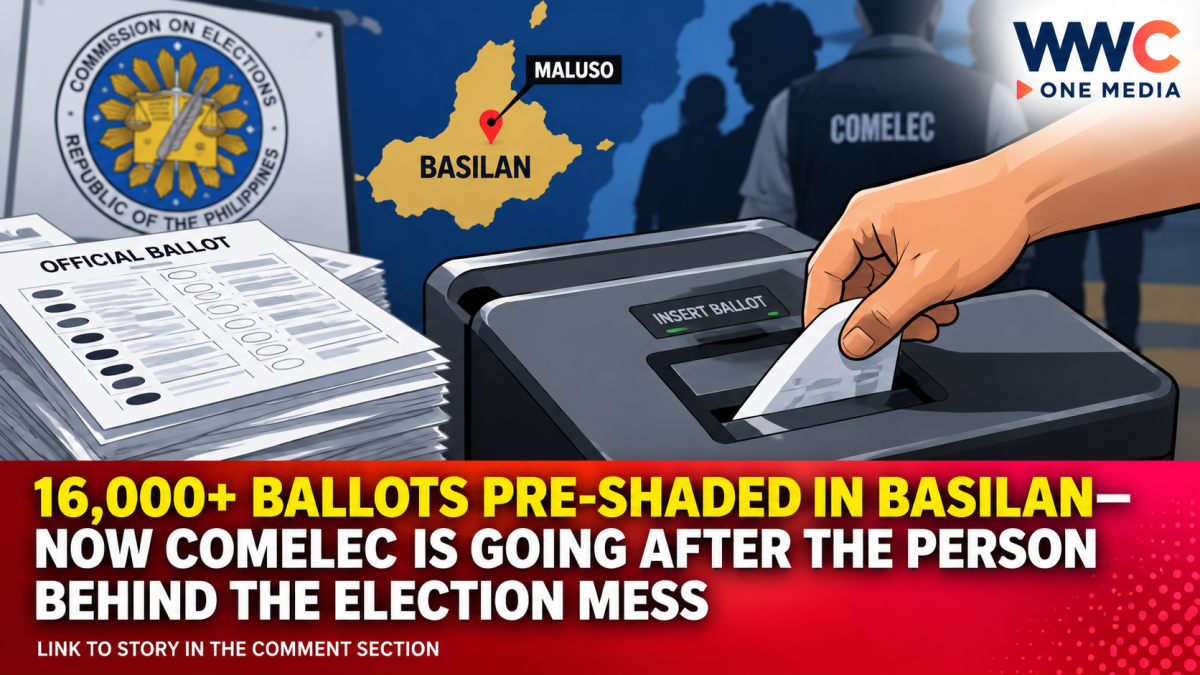
MANILA, Philippines — The discovery of thousands of pre-shaded ballots in Maluso, Basilan has escalated into a potential major election offense, with the Commission on Elections (Comelec) saying the person behind the incident has been identified and could face electoral sabotage charges.
The incident disrupted voting during the historic first Bangsamoro Autonomous Region in Muslim Mindanao (BARMM) parliamentary elections and forced authorities to reprint ballots for affected voters.
Comelec Chairman George Erwin Garcia said authorities already had information on the person responsible for the pre-shading and that cases would be filed.
“Cases will definitely come,” Garcia said, stressing that those responsible would be held accountable regardless of their position.
More Than 16,000 Ballots Compromised
The problem centered on 36 polling precincts in Maluso, where official ballots had allegedly been pre-shaded before voters could use them.
Reports from the Comelec and other news organizations put the number of affected ballots at more than 16,000, with PNA reporting 16,653 official ballots involved.
The discovery prompted the Comelec to place Maluso under its direct control.
The affected ballots were immediately withdrawn from use, while the National Printing Office was ordered to produce replacements. The replacement ballots were transported from Quezon City to Zamboanga City before being sent onward to Basilan.
The move was designed to prevent the questionable ballots from affecting the outcome of the election.
Voting Had to Continue on a Different Schedule
Because the replacement ballots could not be immediately delivered on election day, voting in the affected Maluso precincts did not proceed with the rest of the BARMM.
Comelec subsequently announced that voting in the affected areas would continue on September 15, with polling scheduled from 7 a.m. to 7 p.m.
Garcia emphasized that this was a continuation of the election rather than a complete reset or postponement of the Maluso vote.
The replacement ballots arrived Monday evening and were scheduled for distribution directly to electoral board members early Tuesday morning.
The development meant voters in the affected precincts had to return to the polls while the rest of the region proceeded with the first parliamentary election.
Why Electoral Sabotage Is a Serious Charge
Comelec officials said the incident could go beyond an ordinary election offense.
Under Philippine election law, electoral sabotage is a special election offense involving certain forms of vote tampering when the number of votes involved exceeds the statutory threshold.
Because the Maluso incident involved more than 10,000 affected ballots, Comelec said it was examining the possibility of filing an electoral sabotage case. Such an offense carries a severe penalty, including life imprisonment upon conviction.
An ordinary election offense carries considerably different penalties, including imprisonment, disqualification from public office and loss of the right to vote, depending on the specific violation.
Importantly, the filing or possible filing of charges does not mean that the suspected individual has already been found guilty. The person would still be entitled to due process and the presumption of innocence.
Comelec Took Control of Maluso
The ballot controversy was serious enough for the Comelec en banc to place Maluso under Comelec control.
According to earlier reports, the poll body determined that ballots in 36 of the municipality’s precincts had been compromised after officials discovered they had already been shaded. Garcia said the poll body had information about the suspected culprit and immediately ordered the reprinting of the affected ballots.
Comelec control gives the poll body greater direct authority over election-related operations in the affected locality.
The decision came as the historic BARMM elections were already facing other security problems.
The Ballot Incident Was Not the Only Election Crisis
The Maluso controversy unfolded alongside deadly violence in Cotabato City, where three people were killed and 15 others were wounded in a shooting involving supporters of rival political groups.
Authorities also reported an explosion involving a person allegedly carrying an improvised explosive device.
Because of the violence and other security concerns, the Comelec placed both Cotabato City and Maluso, Basilan under Comelec control.
Despite the problems, the Comelec reported that 5,113 of 5,212 clustered precincts, or 98.10%, had opened across BARMM as of 7:49 a.m. on September 14.
Historic Election Under Pressure
The incident is particularly significant because the BARMM parliamentary elections represent a major milestone in the region’s transition toward self-government.
Voters are electing an 80-member Bangsamoro Parliament, composed of regional parliamentary party representatives, district representatives and sectoral representatives.
The election follows years of political transition under the Bangsamoro peace process, making the credibility of the first parliamentary vote especially important.
The Associated Press reported that more than 20,000 soldiers and police officers were deployed for election security, while voting was extended in Maluso because of the suspected ballot-tampering attempt.
Officials Warned Against Undermining the Vote
The ballot incident also drew criticism from local officials and election-monitoring groups.
Basilan Vice Gov. Hadjiman “Jim” Hataman-Salliman described the pre-shading as a possible attempt to undermine the Bangsamoro people’s democratic aspirations and discredit political participants in the election. However, he did not identify a specific person or group as responsible.
That distinction is important.
While Comelec officials have said they have identified the suspected individual behind the pre-shaded ballots, authorities have not publicly established a final judicial finding of guilt or publicly proven a broader political motive behind the incident.
Election Watchdogs Also Reported Other Irregularities
The ballot controversy was not the only election irregularity reported during the first BARMM parliamentary polls.
The Legal Network for Truthful Elections (LENTE), which deployed election observers across the region, reported concerns involving delayed voting, ballot handling and alleged improper assistance to voters.
LENTE also reminded voters that they have the right to receive a clean ballot without pre-existing marks and may refuse a pre-shaded ballot.
The group said its monitors recorded a range of election-day safety and process concerns while calling for transparency and de-escalation.
What Happens Next?
The immediate priority is to complete voting in the affected Maluso precincts using newly printed ballots and ensure that the replacement ballots are properly accounted for.
But the legal consequences could last much longer.
With Comelec officials saying the person behind the pre-shading has been identified, investigators are expected to determine exactly how the ballots were accessed, who authorized or carried out the pre-shading, and whether the incident meets the legal requirements for electoral sabotage.
The scale of the incident makes the case particularly consequential: more than 16,000 voters’ ballots were reportedly affected in the first parliamentary elections of the Bangsamoro region.
For a region whose historic vote is intended to demonstrate a transition from conflict toward democratic self-governance, the investigation will be closely watched.
The ballots may have been replaced—but the bigger question now is whether the person behind the unprecedented Maluso ballot incident will face the maximum consequences under Philippine election law.




Leave a Reply