
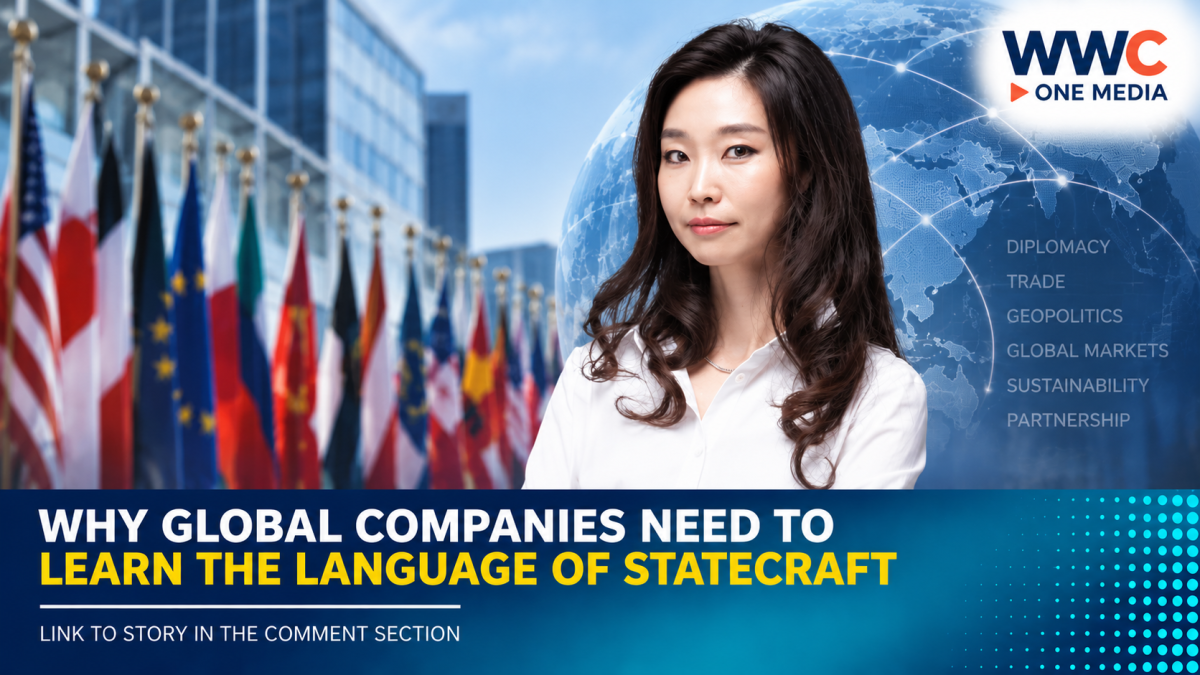
The rules of global business are changing — and for corporate boardrooms, understanding markets and finance may no longer be enough.
As geopolitical tensions rise, governments are playing a larger role in determining where companies can invest, which technologies can cross borders and which industries are considered strategically important. National-security reviews, export controls and industrial policies are increasingly becoming part of the corporate decision-making landscape.
That is the central argument of a new analysis by Soo Kim, a former CIA analyst and strategic-risk consultant, published by The Korea Times on September 15. Kim argues that companies expanding internationally need something beyond traditional government relations: the ability to translate commercial ambitions into the strategic language of governments.
The new language of global business
For corporate executives, the vocabulary of expansion typically revolves around investment returns, efficiency, market share, capital and growth.
Governments have a different set of priorities.
National leaders and policymakers are increasingly focused on issues such as industrial resilience, supply-chain security, national defense, technological sovereignty and geopolitical leverage.
That gap can become a major obstacle when companies attempt major cross-border deals.
Kim argues that companies cannot simply approach governments with a conventional commercial pitch and expect regulatory or political concerns to disappear. Instead, businesses need to understand what the host government considers strategically important and structure their investments accordingly.
In other words, companies increasingly need to speak the language of statecraft.
Hanwha and HD Hyundai offer a glimpse of the strategy
The evolving U.S.-Korea maritime relationship provides a useful example.
According to Kim’s analysis, Korean industrial groups such as Hanwha Group and HD Hyundai are positioning their U.S. investments not simply as commercial opportunities, but as contributions to America’s broader industrial and defense capacity.
Hanwha’s acquisition of Philly Shipyard and subsequent investment in its modernization is highlighted as an example. Rather than presenting the investment purely around commercial efficiency, the strategy can also be understood in the context of U.S. concerns over shipbuilding and naval maintenance capacity.
HD Hyundai’s strategic partnership with Cerberus Capital Management is another example cited in the analysis, with the cooperation framed around strengthening U.S. industrial capabilities.
The significance goes beyond shipbuilding.
For foreign companies entering strategically sensitive industries, investment can intersect with national-security reviews, export-control requirements, domestic-industry protections and labor considerations. Those factors can make a conventional merger-and-acquisition strategy far more complicated.
From regulatory obstacle to competitive advantage
The bigger idea is that government involvement does not necessarily have to be viewed solely as a barrier.
If a company can demonstrate that its investment helps address a country’s strategic problem, regulatory complexity can potentially become part of its competitive advantage.
That approach is particularly relevant in industries where governments are actively trying to strengthen domestic capabilities.
The sectors include semiconductors, artificial intelligence, clean energy, defense and critical minerals — areas where economic competitiveness increasingly overlaps with national security.
For companies, that means geopolitical analysis may need to move much earlier in the decision-making process.
Instead of asking only, “Is this investment commercially attractive?”, boardrooms increasingly need to ask:
“How will the government where we are investing see this deal?”
Why lobbying alone may no longer be enough
Traditional government-relations teams can help companies communicate with policymakers, but Kim argues that reactive lobbying is insufficient for today’s environment.
The more important capability may be strategic translation — understanding a government’s priorities early and incorporating those priorities into the structure and narrative of a transaction before the deal reaches the regulatory stage.
That could change everything from where a company invests to how it builds local partnerships, develops supply chains and presents its economic contribution.
The shift is especially important as governments seek greater control over strategically sensitive technologies and supply chains.
The boardroom is becoming geopolitical
The message for corporate leaders is increasingly clear: geopolitics can no longer be treated as a background issue reserved for diplomats, lawyers or government-affairs specialists.
A company’s ability to expand internationally may depend on whether its strategy fits the strategic priorities of the country it is entering.
That does not mean companies should abandon commercial discipline. Rather, financial, legal and geopolitical considerations increasingly need to be evaluated together.
As Kim concludes, companies that succeed in the next phase of globalization may be those capable of turning sovereign alignment into boardroom strategy.
The era when corporations could treat geopolitics as someone else’s problem may be fading. In the new global economy, understanding what governments want could become just as important as understanding what customers want.




Leave a Reply