
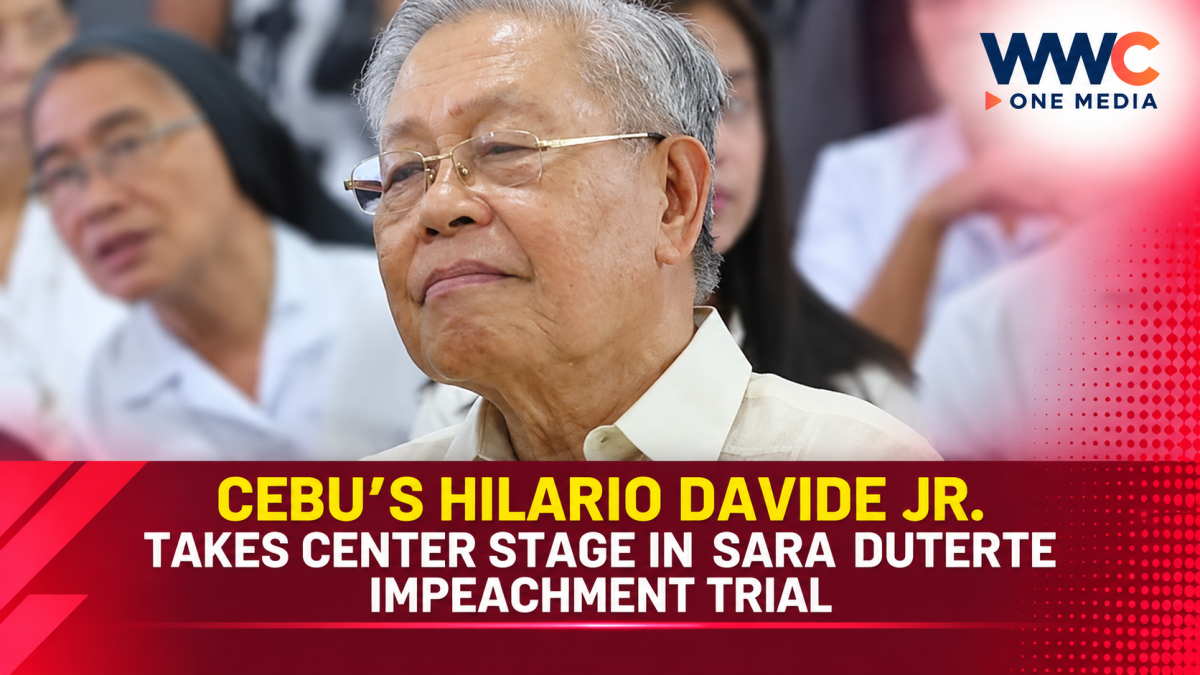
Former Chief Justice Hilario G. Davide Jr. is once again at the centre of a Philippine impeachment case — this time as a legal adviser to the Senate impeachment court hearing the trial of Vice President Sara Duterte.
The Cebuano jurist has an unusual connection to the country’s impeachment history. He presided over the Philippines’ first impeachment trial, was himself the subject of two failed impeachment complaints and was among the framers of the 1987 Constitution, which established the country’s current impeachment system.
Now, at 90, Davide has been asked to help the Senate resolve one of the most closely watched legal questions in Duterte’s impeachment trial: how many senators are required to convict a sitting vice president.
From impeachment judge to adviser
Davide served as the presiding officer during the 2000-2001 impeachment trial of President Joseph Estrada.
More than two decades later, he has returned to the impeachment process in a completely different role.
The Senate impeachment court appointed Davide, together with retired Supreme Court chief justices Artemio Panganiban, Reynato Puno and Adolfo Azcuna, as amici curiae, or “friends of the court.”
Their task is to provide legal guidance on the disputed voting threshold for conviction.
The other three retired magistrates are expected to personally appear before the Senate on September 16. Davide, however, will submit a legal memorandum to the impeachment court.
The 16-vote question
The central issue is whether conviction requires two-thirds of the entire 24-member Senate.
Two-thirds of 24 senators is 16 votes.
Davide has previously expressed the view that the Constitution’s requirement that conviction be supported by “two-thirds of all the Members” means the full Senate membership, rather than only senators who are present or participate in the trial.
Under that interpretation, 16 votes would be required to convict Duterte.
It would also mean that seven senators voting against conviction would be enough to prevent a guilty verdict if all 24 Senate seats are counted in determining the threshold.
The Senate impeachment court’s final interpretation could have major consequences for the outcome of Duterte’s trial.
Why Davide’s constitutional role matters
Davide’s involvement carries particular weight because he was one of the 48 members of the 1986 Constitutional Commission that drafted the 1987 Constitution.
He was one of three commissioners from Cebu, alongside journalist and constitutional commission floor leader Napoleon Rama and jurist Regalado Maambong.
The Constitution was approved by voters in a nationwide plebiscite on February 2, 1987.
The document established the impeachment framework now being applied to Duterte’s case.
That makes Davide’s participation more than simply the opinion of a retired Supreme Court justice. He was involved in drafting the constitutional system whose provisions are now being debated.
A long career in Philippine law
Davide’s career has included some of the country’s most important legal and constitutional positions.
A graduate of the University of the Philippines College of Law, he taught law and practised privately before entering public service.
He served as a delegate to the 1971 Constitutional Convention and was later appointed chairman of the Commission on Elections by President Corazon Aquino.
He also led a presidential fact-finding commission investigating the failed military coup attempts of 1989.
Davide joined the Supreme Court as an associate justice in 1991 and became the country’s 29th chief justice in 1998.
His tenure included the impeachment trial of Estrada, where he presided over proceedings that became a defining moment in Philippine political history.
After retiring from the Supreme Court, Davide served as the Philippines’ permanent representative to the United Nations and later became vice president of the UN General Assembly.
He was also awarded the Ramon Magsaysay Award for Government Service in 2002.
Davide was once an impeachment target himself
Davide’s connection to impeachment is not limited to presiding over Estrada’s trial.
In 2003, two separate impeachment complaints were filed against him while he was chief justice of the Supreme Court.
Both attempts failed.
The experience gives him a rare perspective on impeachment from both sides of the constitutional process: as the judge overseeing a presidential impeachment trial, as a chief justice facing impeachment complaints and now as a legal adviser to the Senate impeachment court.
Duterte trial enters a crucial phase
The dispute over the required number of votes comes as Duterte’s impeachment trial moves through another critical stage.
The vice president faces three grave threats charges arising from remarks she made in November 2024 involving President Ferdinand Marcos Jr., First Lady Liza Araneta-Marcos and House Speaker Martin Romualdez.
Duterte previously said she had arranged for someone to kill the three officials if she herself were killed.
She was arrested after an arrest warrant was issued on September 4 and posted bail the following day.
Her lawyers have also challenged proceedings in a separate grave-threats case before a Quezon City court.
The Senate impeachment trial, however, remains focused on the constitutional and factual questions surrounding the impeachment complaint.
Why Davide’s memorandum could matter
The Senate’s decision on the voting threshold could ultimately determine how difficult it is to convict the vice president.
If the court adopts the interpretation that 16 votes are strictly required, Duterte would need to lose the support of at least 16 senators for a conviction to succeed.
That makes every senator’s position potentially significant.
Davide’s memorandum is therefore expected to receive close attention from both Duterte’s supporters and opponents, particularly because of his experience with impeachment and his role in drafting the Constitution.
For Cebu, his involvement is also a notable reminder of the province’s place in Philippine constitutional history.
The man who once presided over the country’s first impeachment trial and helped write the rules governing the process is now offering his legal interpretation as another impeachment case unfolds.
What Davide ultimately tells the Senate could become an important part of the constitutional debate over Vice President Sara Duterte’s political fate.



Leave a Reply