
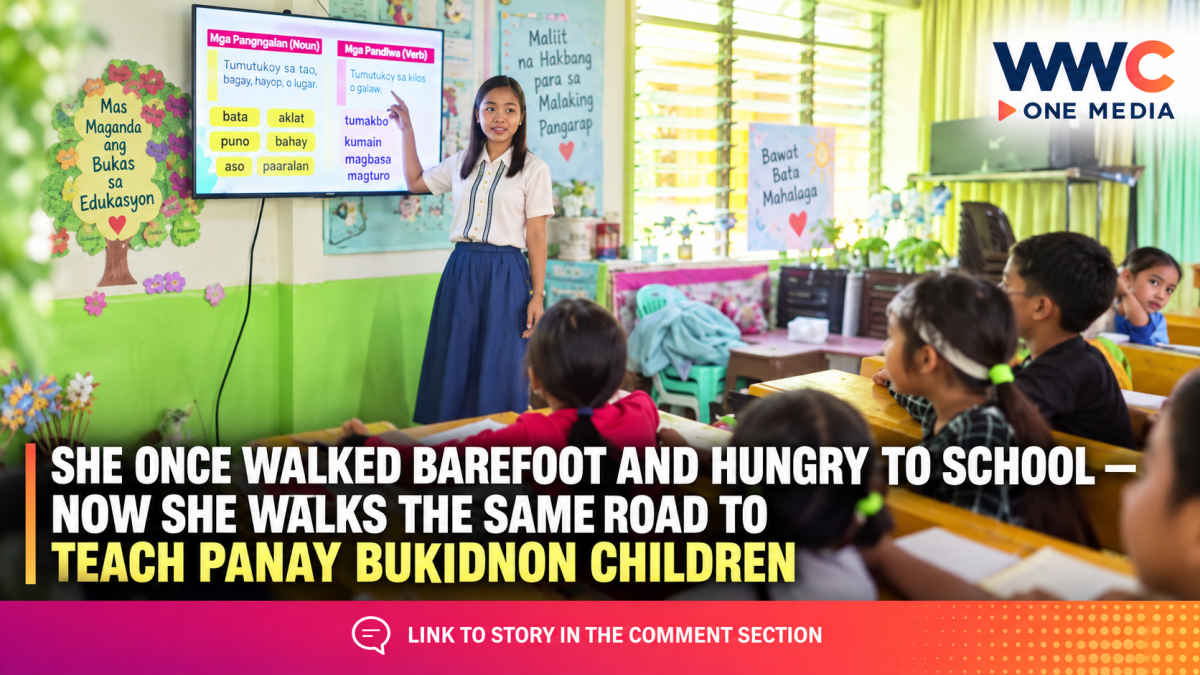
ILOILO, Philippines — Every school day, Lowie Ann Lavilla Castor makes an hour-long journey into the uplands of Calinog.
At the end of it is Aglonok Primary School, where she teaches Grade 4 Indigenous Peoples learners.
The trip is difficult.
But for Castor, the road is also painfully familiar.
Long before she became the teacher standing in front of the classroom, she was the child walking roughly the same distance to school — sometimes barefoot, sometimes hungry, and carrying the hope that education could eventually pull her family out of poverty.
Today, the 27-year-old Panay Bukidnon educator is doing something more powerful than simply returning home.
She is showing children living through hardships she understands firsthand that the road out of poverty can begin in the very classroom they struggled to reach.
Born into the same struggle her pupils now face
Castor comes from Barangay Cahigon in Calinog, Iloilo, and is the eldest of five children in a Panay Bukidnon family.
Her parents, Nina Analie and Rowie, depended on upland farming and manual work to support their children.
Money was often desperately short.
Castor recalled going to school without slippers and sometimes with little or no food. Before classes, she would sell native delicacies from her aunt’s store so she could earn money for her daily school expenses.
She graduated with honors from Binolusan Pequeño Elementary School and later attended Binolusan Pequeño National High School, but academic success did not make her family’s financial problems disappear.
That experience is not unique to one household.
DSWD Western Visayas has documented that children from Ati and Panay Bukidnon communities in remote parts of Iloilo can face extraordinarily long journeys to education, with some walking two to four hours — sometimes barefoot — to reach the nearest primary school.
The distance is more than an inconvenience.
For a poor household, every hour spent walking, every transportation expense and every missing meal can become another reason for a child to leave school.
College nearly became the breaking point
Castor eventually entered West Visayas State University–Lambunao Campus, pursuing a Bachelor of Elementary Education.
Getting there was already an achievement.
Staying there was harder.
By her second year, the family’s finances had become so strained that she considered quitting and finding work instead.
Her mother resisted that idea and kept borrowing money to cover her daughter’s basic needs.
Then came the intervention that changed the trajectory of Castor’s life: she qualified for Iloilo Province’s Provincial Educational Assistance Program for Indigenous Peoples, administered through the Provincial Social Welfare and Development Office.
She finished her degree.
And she eventually became a licensed professional teacher.
Published records from the January 2022 Licensure Examination for Professional Teachers list Castor, Lowie Ann Lavilla among the successful elementary-level examinees.
For Castor, the scholarship did more than pay bills.
It changed who was standing at the front of an Indigenous classroom a few years later.
Iloilo’s IP scholarship program was built for stories like hers
The assistance Castor received is part of a wider provincial strategy that has been operating since School Year 2016-2017.
DSWD says the program was established under Iloilo Provincial Ordinance No. 2016-128 and is intended for economically disadvantaged Indigenous residents who want to pursue tertiary education.
The province now accepts 50 new IP grantees annually.
Current beneficiaries receive up to ₱41,000 per school year, including monthly, book and communication allowances, with additional assistance available for thesis or research work. Applicants must meet residency, income and educational requirements.
The program remains highly competitive.
In 2024 alone, 273 applicants competed for 50 available IP scholarship slots, according to the Iloilo Provincial Government.
Those numbers help explain why Castor’s experience is bigger than an individual success story.
A scholarship did not merely enable one young woman to graduate.
It helped create a teacher who has returned to serve the very community the program was designed to empower.
Aglonok remains geographically isolated
The community where Castor now teaches continues to face access challenges.
The Iloilo Provincial Government identifies Barangay Aglonok as a geographically isolated and disadvantaged area, or GIDA.
In August 2025, provincial library personnel traveled there with government and military personnel to conduct storytelling activities, literacy games and distribute books and school supplies to children who had limited access to educational resources.
That context makes Castor’s daily commute more meaningful.
She is not choosing a comfortable posting close to a major town center.
She is entering a place where delivering basic education can itself require overcoming geography.
And because she grew up under similar circumstances, she can recognize things that may be invisible to an outsider.
A student arriving exhausted may have walked a long distance.
A missing notebook may reflect poverty, not indifference.
A child who seems distracted may not have eaten enough that morning.
Those realities can change how a teacher interprets a student’s behavior — and how quickly a struggling child receives understanding instead of punishment.
Representation inside the classroom matters
Castor also represents something increasingly important in Indigenous education: children seeing educators who come from their own communities.
The Department of Education’s Indigenous Peoples Education, or IPEd, framework says education for Indigenous learners should be culturally rooted and responsive, with Indigenous communities taking part in shaping learning programs and incorporating their knowledge systems, practices and social contexts into education.
That approach is fundamentally different from asking Indigenous children to leave their identity at the classroom door.
A Panay Bukidnon teacher can understand the community’s language, family structure, customs and practical realities in ways that may strengthen trust between school and home.
There is already evidence in Iloilo that provincial educational support is producing more Indigenous professionals.
In 2023, the Iloilo Provincial Government reported that 23 beneficiaries of its IP educational assistance program passed the Licensure Examination for Teachers in one examination cycle.
Castor’s story therefore sits within a larger transformation.
Scholarship recipients can become teachers.
Teachers can become role models.
And children who once assumed higher education was beyond their reach can begin seeing someone from their own community who already made the journey.
Panay Bukidnon educators have shown what culture-based teaching can do
Iloilo has another well-known example of what can happen when Indigenous identity becomes an educational strength rather than an obstacle.
Panay Bukidnon educator Jesus Insilada, who became a finalist for the Global Teacher Prize in 2018, developed culture-based teaching approaches incorporating traditional songs, dances, epics, games and crafts into academic lessons.
The Philippine News Agency reported that his approach was designed partly to reduce dropout rates and improve Indigenous learners’ confidence and academic engagement.
Castor’s role is different, and there is no basis to claim she uses exactly the same methods.
But both stories point toward the same broader principle:
Indigenous children do not necessarily need education that separates them from their culture. They need education that equips them for the wider world without telling them their own world has no value.
That is the philosophy behind DepEd’s national IPEd framework.
Her next challenge is job security
There is, however, an important unfinished part of Castor’s story.
She currently serves as a local school board teacher, rather than holding the permanent public-school position she hopes to secure.
Castor told Panay News she wants a permanent appointment so she can continue serving Indigenous learners while providing more stability for her family and helping her younger siblings finish their education.
That creates an irony difficult to miss.
The education system helped a poor Indigenous student become a licensed teacher.
She has returned to teach in a geographically isolated Indigenous community.
Yet her own path toward long-term security inside that system remains incomplete.
For policymakers, that raises a broader question about whether producing Indigenous teachers is enough if qualified educators serving remote communities still face uncertain employment.
Education can change more than one generation
The most compelling part of Castor’s journey is not that poverty vanished once she received a diploma.
It did not.
Nor is it that every child who walks an hour to school will automatically become a professional.
The lesson is more practical.
At several points, Castor’s education could have ended.
Distance could have stopped her.
Hunger could have stopped her.
Her family’s inability to pay could have stopped her.
College expenses nearly did.
What changed the outcome was a combination of determination, family sacrifice and public assistance.
That combination is exactly why educational-access programs matter.
Government support cannot manufacture ambition.
But it can prevent poverty from extinguishing it.
One scholarship can return to the community as a teacher
That may be the strongest argument for Iloilo’s Indigenous education assistance program.
A scholarship recipient does not necessarily benefit alone.
When the recipient becomes a teacher, nurse, engineer, social worker or other professional and remains connected to the community, the investment can return in a very different form.
Iloilo officials themselves have made that argument, saying the success of an IP scholar can represent not just progress for one family but a victory for the wider Indigenous community.
Castor is now living that multiplier effect.
Years ago, she walked toward school because she believed education could change her family’s future.
Now she makes another long journey into Aglonok because children waiting in a Grade 4 classroom are beginning that same journey.
She knows what it feels like to arrive with tired feet.
She knows what it means to study while hungry.
And she knows that the difference between dropping out and graduating can sometimes be one person — or one program — deciding that a child’s poverty should not determine how the story ends.
Lowie Ann Castor once walked those mountain roads hoping education would rescue her future. Today, she walks them again carrying something she did not have as a child: proof for the next generation that the journey can lead somewhere.


Leave a Reply