
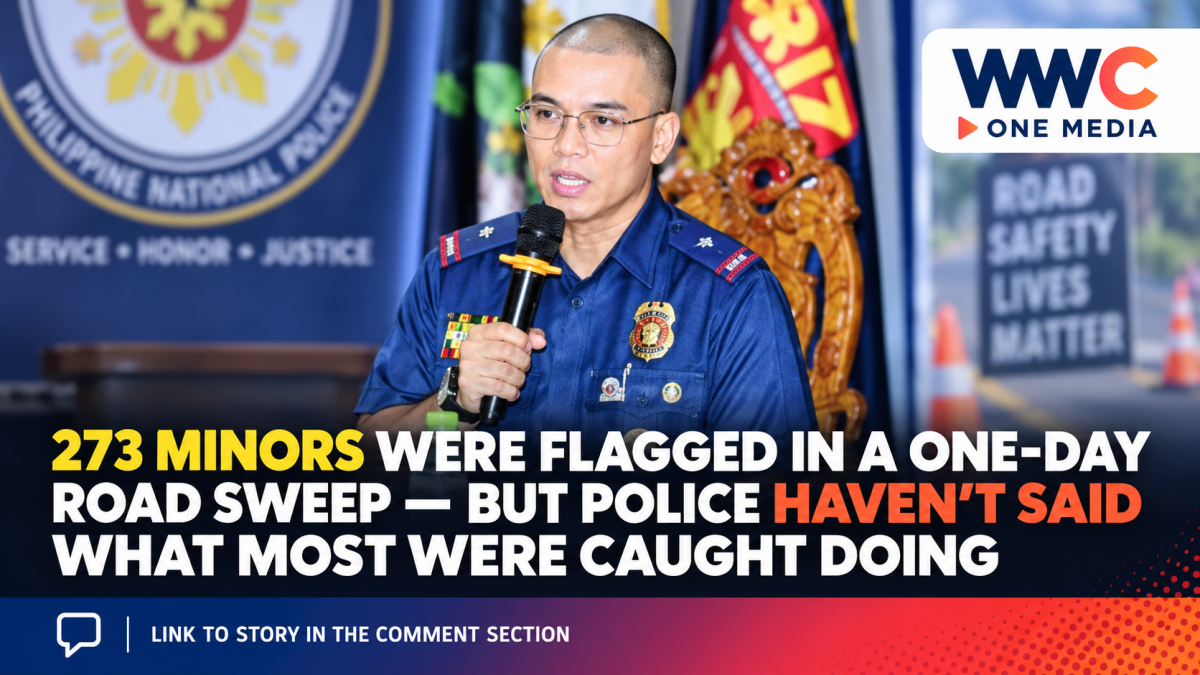
ILOILO CITY, Philippines — In the space of a single day, police across Western Visayas encountered 273 minors in situations serious enough to trigger warnings or traffic fines, putting a fresh spotlight on how frequently children and teenagers are being exposed to risks on the region’s roads.
The Police Regional Office 6 said officers carried out 276 operations on September 13 under Oplan Sagip Bata, a campaign designed to identify and prevent road-safety risks involving minors before they result in injuries or deaths.
Of the 273 minors flagged, 195 were given warnings while 78 cases resulted in corresponding traffic fines.
But one detail stands out immediately.
Iloilo province alone accounted for 102 cases — more than 37% of the entire regional total.
Aklan followed with 42 minors, Capiz with 38, Antique with 36, Iloilo City with 32, the Regional Mobile Force Battalion 6 with 15 and Guimaras with eight.
For Western Visayas police chief Brig. Gen. Randulf Tuaño, however, the operation is not supposed to be about filling citation books.
The goal, he said, is to intervene before unsafe behavior turns into something irreversible.
Police say prevention — not punishment — is the point
Tuaño said authorities are treating the campaign as both an enforcement operation and an early-intervention program.
“When we see minors exposed to traffic risks, we have to act early,” he said, stressing that police also want parents and other responsible adults to understand their role in keeping children safe.
He said guidance and prevention are just as important as enforcement.
That distinction matters because Oplan Sagip Bata is broader than a conventional traffic crackdown.
When PRO-6 discussed the initiative in August, police said it was created after officials noticed a high incidence of vehicular incidents involving minors. The campaign covers road safety, compliance with local ordinances and early intervention in situations that could endanger children.
By August 25 — less than two months after the campaign began in July — PRO-6 said police had already intervened in cases involving 1,312 minors through 1,096 weekend operations across Western Visayas.
Roughly 70% of those earlier cases resulted in warnings rather than penalties.
The September 13 figures therefore suggest the issue has not disappeared.
If anything, one day producing another 273 interventions indicates that risky road behavior involving young people remains common enough to keep police repeatedly returning to the streets.
But what exactly were the 273 minors doing?
This is the biggest unanswered question in the latest police report.
PRO-6 did not specify the individual traffic violations or circumstances involving the 273 minors.
It also did not clarify whether the 78 fines were imposed directly on minors, on drivers transporting them, on parents or guardians, or on other legally responsible adults.
That means it would be inaccurate to describe all 273 children as underage motorcycle drivers.
Some may have been passengers.
Some may have been connected to other traffic violations or local ordinances.
Earlier reporting on Oplan Sagip Bata shows that the program has addressed a range of issues, including unsafe motorcycle use, reckless behavior and curfew violations.
Police have also emphasized that motorcycles are commonly used by students because they can be one of the cheapest and most practical forms of transportation in many communities.
That is particularly relevant in rural provinces where public transport can be infrequent and schools may be several kilometers from students’ homes.
The convenience, however, comes with considerable risk.
Motorcycles are at the center of the Philippines’ road-safety problem
Motorcycles have become indispensable transportation for millions of Filipino families.
They are relatively inexpensive to purchase and operate, can travel through congested streets and provide mobility in areas poorly served by buses or jeepneys.
But when crashes occur, riders and passengers have little physical protection.
Recent Department of Health surveillance illustrates that vulnerability.
During the 2025-2026 holiday monitoring period, DOH sentinel hospitals recorded 1,384 road-crash injuries. Motorcycle-related incidents accounted for 989 cases — roughly seven out of every 10.
Almost half of all patients, 647 or 47%, were between 15 and 29 years old. Seven out of every 10 recorded fatalities involved motorcycle riders, and six of those victims were reportedly not wearing helmets.
Those figures cover selected sentinel hospitals and a specific holiday period, so they should not be treated as a complete nationwide annual count.
But they show why police and health authorities repeatedly focus on motorcycle safety.
Children face an even greater risk
Young people are especially vulnerable when roads, vehicles and safety equipment are not designed around their physical abilities.
The Department of Health has described road-crash injuries as a leading cause of deaths and injuries among Filipino children and adolescents. Government health reporting cited 13,101 road-traffic deaths nationwide in 2023, including 1,044 people below age 18.
The World Health Organization likewise describes road-traffic injury as the leading cause of death globally among children and young adults aged 5 to 29. About 1.16 million people die annually in road crashes worldwide, with pedestrians, cyclists and motorcyclists accounting for more than half of fatalities.
In the Philippines, WHO has repeatedly urged stronger child-focused road-safety measures, noting that road deaths have increased over the long term and disproportionately affect vulnerable road users.
That makes interventions such as Oplan Sagip Bata more than a traffic-enforcement issue.
They are also a public-health issue.
Philippine law already sets specific rules for children on motorcycles
One law particularly relevant to the discussion is Republic Act No. 10666, or the Children’s Safety on Motorcycles Act of 2015.
The law does not impose a blanket nationwide ban on every person under 18 riding as a motorcycle passenger.
Instead, it sets specific requirements on public roads with heavy traffic, large numbers of fast-moving vehicles or speed limits above 60 kilometers per hour.
A child may be carried under those conditions only when the child can comfortably reach the motorcycle’s foot pegs, put their arms around and securely hold the rider’s waist, and wear a standard protective motorcycle helmet.
The restriction reflects a straightforward safety concern.
A small child whose feet cannot reach the footrests may have difficulty maintaining balance.
A child unable to hold the driver securely can be thrown from the motorcycle during sudden acceleration, braking or evasive maneuvers.
And without a certified helmet, a crash can easily produce catastrophic head injuries.
The law provides an exception when the child requires immediate medical attention.
Violations can become expensive
RA 10666 imposes meaningful penalties on offending motorcycle operators.
The statute provides for a ₱3,000 fine for a first offense, ₱5,000 for a second and ₱10,000 for third and succeeding offenses, with license suspension and ultimately revocation possible for repeated violations.
Those penalties apply to violations of the national child-passenger law.
They should not automatically be assumed to be the fines involved in PRO-6’s 78 cases on September 13, because police have not publicly identified the offense breakdown.
That distinction is important.
The latest operation tells the public how many minors were flagged.
It does not yet tell the public which laws each case involved.
Iloilo’s 102 cases deserve closer examination
The concentration in Iloilo is particularly striking.
With 102 of the region’s 273 minors, Iloilo province represented more than one-third of the cases recorded in a single day.
That does not necessarily prove Iloilo has worse youth road behavior than neighboring provinces.
The number could also be influenced by differences in police deployment, population, traffic volume, number of operations or enforcement intensity.
Without knowing how many checkpoints or patrols were conducted in each province, comparing raw totals alone can be misleading.
But 102 interventions still provide local authorities with something worth investigating.
Were most cases concentrated around schools?
Were motorcycles involved?
Were children travelling without helmets?
Were teenagers driving without the appropriate authorization?
Were incidents concentrated in particular towns or highways?
Answers to those questions would allow police, schools and local governments to move from broad enforcement toward targeted prevention.
Warnings can matter — if they change behavior
The fact that 195 of the 273 minors received warnings may initially make the operation sound less serious.
But that is consistent with the prevention-focused philosophy police say lies behind Oplan Sagip Bata.
A warning given before an accident occurs can be more useful than a citation written afterward.
That is particularly true with children.
Police enforcement alone cannot create safer behavior if the same child returns home and an adult immediately allows the same unsafe situation to happen again.
That is why Tuaño has repeatedly emphasized parents and guardians.
The road-safety decision may be made long before a police officer sees the vehicle.
It can be made when an adult hands a motorcycle key to an inexperienced child.
When a parent puts a small child on the back of a motorcycle without a proper helmet.
When a family decides three or four people can fit onto a vehicle designed for far fewer.
Or when adults treat a five-minute trip as too short to justify protective equipment.
Enforcement is only one part of safer roads
The Philippines’ own national road-safety strategy recognizes that preventing crashes requires much more than catching violators.
WHO and the Department of Transportation’s Philippine Road Safety Action Plan 2023-2028 calls for a broader “safe system” approach involving safer roads, safer vehicles, responsible road users, better enforcement and improved emergency response.
That matters because even responsible children can be injured on dangerous roads.
Schools located beside high-speed highways need safe crossings.
Pedestrians need sidewalks.
Motorcycle riders need helmets.
Roads need sensible speed limits and enforcement.
Drivers need proper training.
And emergency teams need to reach victims quickly when prevention fails.
Focusing solely on what a child did wrong risks overlooking the environment adults created around that child.
The 273 figure is a warning — but the next data release may matter more
PRO-6 deserves credit for publishing the basic results of the September 13 operation.
But the numbers raise questions that should now be answered.
Knowing that 273 minors were flagged, 195 warned and 78 linked to fines tells communities the scale of the intervention.
Knowing exactly why each was stopped would tell them how to prevent the next 273.
If helmet violations dominate, authorities can focus on helmets.
If unlicensed or unsafe riding is the problem, enforcement and parent education can concentrate there.
If children are being transported unsafely, police can target adult drivers.
If certain roads or school zones repeatedly generate violations, local governments can redesign those areas.
Good enforcement generates numbers.
Good road-safety policy turns those numbers into prevention.
Because the real goal is not 273 citations
Western Visayas police describe Oplan Sagip Bata as part of the broader Safer Cities Initiative, intended to increase police visibility and intervene before unsafe behavior produces more serious consequences.
That is the right benchmark.
The success of the campaign should not ultimately be measured by how many minors officers stop.
It should be measured by how many no longer need to be stopped.
For now, the September 13 operation leaves Western Visayas with a striking number:
273 children and teenagers flagged in just one day.
Iloilo alone accounted for 102.
But the figure that matters next will not be another enforcement total.
It will be whether parents, schools, local governments and motorists change enough that fewer children are exposed to the same risks when police return to the roads.
Because if 273 minors can be found in potentially unsafe road situations in a single day, the most important question is not how many tickets police can issue — it is how many crashes can still be prevented before the next child becomes a casualty.



Leave a Reply