
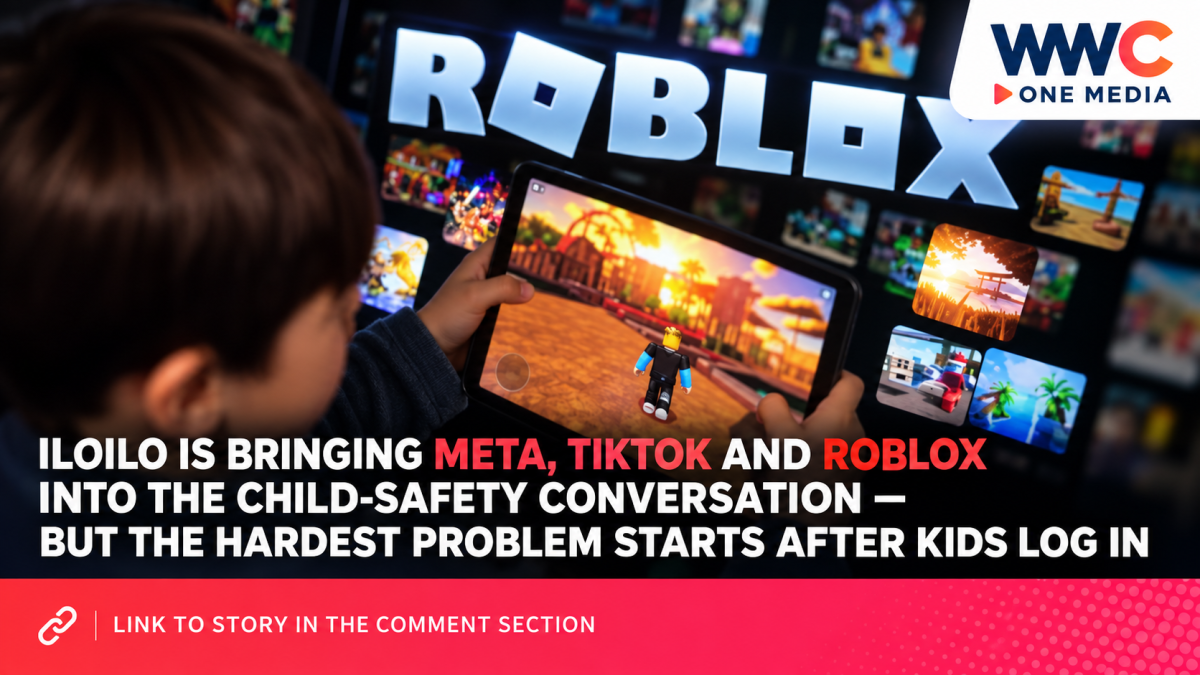
ILOILO, Philippines — What happens when a child carrying a smartphone can reach almost anything on the internet before a parent or teacher even knows what is on the screen?
Iloilo is trying to confront that question directly.
The provincial government and the Department of Information and Communications Technology (DICT) are holding a day-long child online-protection session on Tuesday, September 15, bringing together government regulators, child-rights advocates, educators and representatives from some of the world’s biggest digital platforms.
The program, called “Safe Minds, Safe Online: Learning Session on PRIME – Protecting Children in the Digital Space through Awareness and Action,” is designed to give students, parents, teachers and community leaders practical tools for dealing with cyberbullying, privacy risks, harmful content and unsafe digital behavior.
But the initiative is arriving at a much bigger moment for the Philippines.
Across the country, policymakers are debating age verification, parental controls, platform accountability and even restrictions on how young children use social media.
And tech companies are increasingly being told that putting a “child-friendly” switch somewhere in an app may no longer be enough.
Meta, TikTok and Roblox are part of the conversation
The Iloilo session was scheduled from 8 a.m. to 5 p.m. on September 15 under the provincial government’s PRIME mental-health program.
Invited resource persons include DICT’s Kit Brian Valderrama; Deputy Privacy Commissioner Juan Paolo Fajardo of the National Privacy Commission; TikTok Philippines public-policy head Yves Gonzalez; Roblox public-policy director Priyanka Bhalla; Meta Philippines public-policy head Gio Tingson; broadcaster and mental-health advocate Kim Atienza; and Child Rights Coalition Asia Regional Executive Director Amihan Abueva.
The official Iloilo Provincial Government announcement says the program will cover child online protection, digital safety, privacy, responsible technology use and mental health.
That combination matters.
Cyberbullying is only one part of what children now encounter online.
Today’s risks can include violent material, sexual exploitation, scams, grooming, impersonation, privacy violations, algorithmically recommended harmful content and communities that encourage dangerous behavior.
The problem is no longer simply teaching children not to talk to strangers online.
Increasingly, governments are asking whether platforms themselves should be designed differently when the person using them is 12, 14 or 16.
Iloilo’s governor says he is not calling for a cellphone ban
Gov. Arthur Defensor Jr. has repeatedly expressed concern about what minors can encounter through unrestricted internet and social-media access.
But he has stopped short of calling for a blanket prohibition on smartphones in schools.
His argument is that phones also provide communication, information and emergency access, meaning the answer cannot simply be taking every device away.
Instead, Defensor has urged parents and guardians to take greater responsibility for controlling children’s access to inappropriate material and teaching them how to regulate their digital use.
That distinction reflects a wider debate now taking place nationally.
Should government ban children from social media?
Or should it force technology companies, parents and schools to create safer versions of the online world children are already using?
Philippine child-welfare officials have generally argued for the second approach.
The Council for the Welfare of Children said in June that Filipino minors deserve a safer cyberspace rather than a total social-media ban and has been working with technology and gaming companies on protections built directly into apps.
The national government is already pushing Meta and Roblox much further
What is happening in Iloilo fits into a much broader Philippine campaign.
In August, DICT Secretary Henry Aguda said Meta and Roblox had agreed to pursue stronger safeguards for Filipino users after discussions with Philippine officials.
According to Reuters, the measures discussed include age verification, improved parental controls, quicker removal of harmful material and stronger cooperation with law enforcement. Roblox also planned to establish a Philippine office, while Meta was expected to send a team to the country for further discussions.
The issue moved another step forward this month.
The Cybercrime Investigation and Coordinating Center (CICC) said it would work on privacy protections for a proposed age-verification system and was preparing a technical working group involving Meta and Roblox.
One idea under study is age assurance that confirms whether somebody belongs to a particular age bracket without unnecessarily giving the platform large amounts of personal information.
That privacy question is crucial.
Age verification sounds straightforward until governments have to decide whether children should upload identification documents, submit facial information or link accounts to government databases.
A poorly designed safety system could protect children from one problem while creating another: excessive collection of personal data.
The Philippine national ID could enter the picture
DICT has also discussed whether the Philippine national ID infrastructure could help verify users’ ages.
Aguda told lawmakers that Roblox had explored integration with the country’s eVerify system, which could potentially confirm age information without transferring all of an individual’s identity data to the gaming platform.
Meta was also expected to study possible integration with Philippine identity-verification technology.
That could become one of the most consequential developments in the Philippine social-media debate.
If technically workable and adequately protected, age assurance could allow different online experiences for a 10-year-old, a 14-year-old and an adult.
But it would also raise difficult questions about privacy, government databases and how much information private technology companies should be allowed to access.
Those questions remain under study.
Congress is preparing much tougher rules
Meanwhile, lawmakers are moving toward legislation that could impose direct obligations on social-media and gaming companies.
A consolidated Children’s Social Media and Online Gaming Safety Bill has already been approved at the House committee level.
The proposal would bar children below 13 from social media while restricting potentially harmful or addictive features for users aged 13 to 17.
House officials say those restricted features could include short-form video and group-chat functions, while platforms accessible in the Philippines would be required to register locally so that Philippine regulators can enforce safety obligations.
One of the measures incorporated into that effort, House Bill No. 9965, originally proposed fines as high as ₱50 million for platforms that failed to comply with child-safety standards such as age verification, parental controls and protections against harmful content.
Repeated serious violations could even lead to temporary restrictions or prohibition from operating, subject to due process.
The proposal has also been placed on the Legislative-Executive Development Advisory Council’s priority agenda, giving the issue additional political momentum.
But these measures are still proposals.
They should not be described as existing nationwide law.
Schools already have stronger cyberbullying rules
Even without the proposed social-media legislation, Philippine schools operate under the Anti-Bullying Act of 2013 and its revised implementing rules.
DepEd updated those rules in 2025 and has since issued additional guidance explicitly recognizing cyberbullying.
The department defines cyberbullying broadly enough to cover harmful electronic messages, threatening or inappropriate posts, trolling intended to cause emotional distress, misuse of personal information and online impersonation used to harm another person.
Schools are also required to implement standardized anti-bullying policies, prevention programs, early interventions and clearer procedures for handling complaints.
Western Visayas alone recorded 966 reported school bullying cases during School Year 2025-2026, with DepEd saying about 95% had been resolved by late June.
That figure covers bullying generally, not cyberbullying alone.
But it demonstrates the scale of the problem schools are already trying to manage.
Iloilo is linking online safety with mental health
What makes Iloilo’s strategy different is its attempt to connect digital safety directly with mental-health services.
The province’s Program for the Resilience of Iloilo in Mind and Emotion, or PRIME, now includes a 24-hour mental-health helpline and school-based interventions.
The provincial government launched its dedicated PRIME helpline on April 23, 2026, staffed by social workers and psychometricians providing crisis support, psychological first aid and referrals.
Provincial health data cited at its launch showed 76 recorded suicides in Iloilo in 2024 and 63 in 2025.
Defensor has subsequently described the province as averaging around 70 suicide cases annually, calling the situation a mental-health emergency.
But an important distinction is necessary.
While Defensor has repeatedly identified harmful or unmanaged social-media exposure as one factor affecting young people’s mental health, the available data do not establish that social media caused those suicides.
Suicide and severe psychological distress are complex and can involve many overlapping personal, social, medical and economic factors.
That makes prevention more complicated than simply limiting screen time.
More than 700 young people are already being recruited as frontliners
Earlier this month, Iloilo gathered more than 700 youth peer helpers and teen-center coordinators as part of its effort to identify young people in distress earlier.
The idea is that teenagers may tell a friend about bullying, harassment or emotional problems before they tell a teacher, parent or government worker.
Defensor described peer helpers as the “nerve endings” of the province’s youth-support system because they can recognize warning signs and direct classmates toward professional assistance.
National Youth Commission Chair Joseph Francisco Ortega also said this month that his agency planned to bring a Meta team to Iloilo to work with the provincial government on programs promoting more ethical and responsible social-media use.
That shows Tuesday’s child-safety session is not an isolated event.
It is part of a broader attempt to build a local system connecting platforms, government, parents, schools, mental-health workers and young people themselves.
Tech companies say they are already changing their products
The technology companies involved in the broader debate have also been adding protections.
Meta says it is expanding its revamped Teen Accounts globally across Instagram, Facebook and Messenger, placing teenagers into a default “13+” content setting intended to limit exposure to inappropriate material.
The company is also using age-assurance technology and expanding parental supervision tools.
TikTok, meanwhile, says teen accounts have more than 50 safety, privacy and security features, including private-by-default settings in certain age groups, restrictions on messaging, content controls, a default 60-minute daily screen-time limit for users under 18, and its Family Pairing system for parents.
In August, TikTok also launched a Philippine #ThinkTwice Family Guide with Child Rights Coalition Asia, Child Rights Network and Plan International Pilipinas, aimed at helping parents and teenagers discuss safer digital habits.
Those are company-reported measures, however.
The government debate increasingly centers on whether voluntary features are enough — or whether platforms should be legally required to prove their safeguards actually work.
That may be the biggest shift of all
For years, online child safety was often framed primarily as a parenting issue:
Watch what your children do.
Set a password.
Limit their screen time.
Tell them not to speak to strangers.
That model is now being challenged.
Philippine officials are increasingly asking whether responsibility should also sit with the companies designing the algorithms, recommendation systems, messaging tools and account settings children use every day.
The CWC has explicitly argued that merely offering optional “child-friendly settings” is no longer sufficient and that applications should increasingly be designed to protect younger users by default.
That is a much bigger demand.
It means safety would no longer depend entirely on whether a parent finds the right setting buried inside an app.
The app itself would be expected to know that a child requires a different digital environment.
Iloilo may be a local test of a national argument
Tuesday’s program will not eliminate cyberbullying.
It will not prevent every teenager from encountering disturbing content.
And it will not resolve the debate over whether the Philippines should impose hard age limits on social-media access.
But it reflects a major change in how government is approaching the problem.
Iloilo is no longer treating harmful online behavior as something that stays inside a phone.
It is linking it to schools, privacy, mental health, child protection and the design decisions made by billion-dollar technology platforms.
Parents still have responsibilities.
Schools still have responsibilities.
Children need digital literacy.
But increasingly, the companies controlling the screens are being told they have responsibilities too.
And that may be the real question behind Iloilo’s “Safe Minds, Safe Online” campaign: when a child encounters something dangerous online, how much responsibility belongs to the child and the parent — and how much belongs to the platform that put it on the screen in the first place?


Leave a Reply