
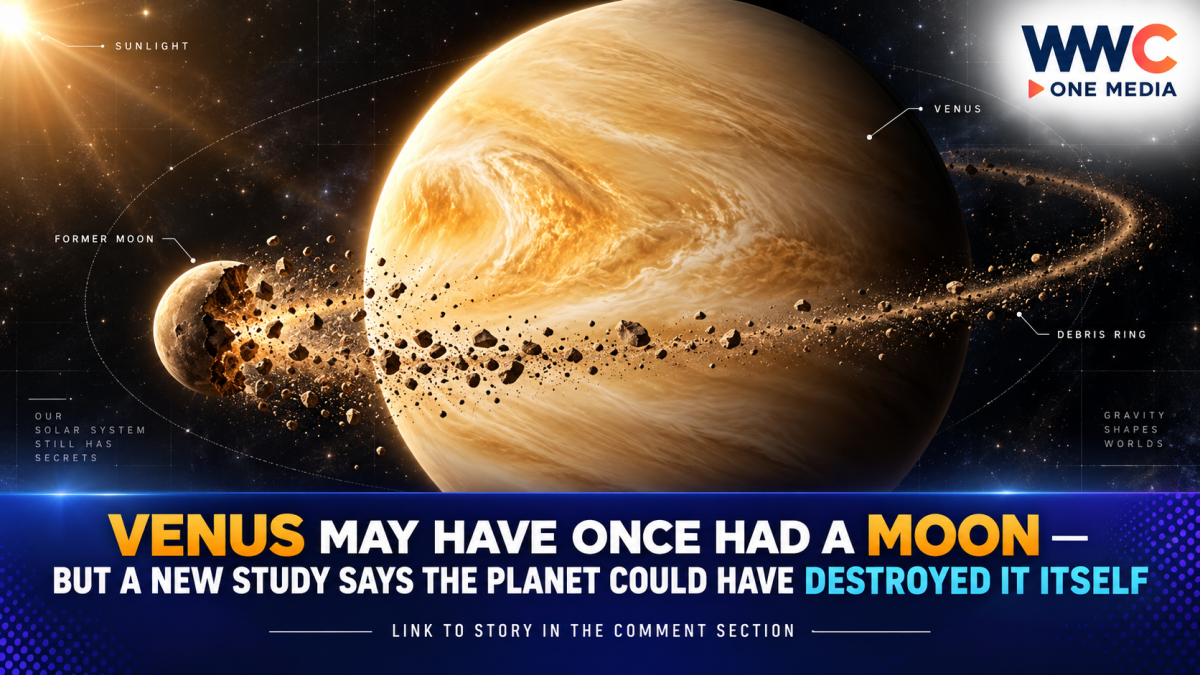
LOS ANGELES — Venus may be hiding the evidence of an ancient act of planetary cannibalism.
The scorching world next door to Earth has no moon today, an oddity that has puzzled planetary scientists because Venus is almost Earth’s size and probably endured the same chaotic era of giant collisions that shaped the early inner solar system.
A new study offers a dramatic possibility:
Venus may once have created a moon — and then destroyed it itself.
Researchers led by University of California, Riverside astrophysicist Stephen R. Kane modeled how a hypothetical Venusian moon and the young planet could have exchanged angular momentum over hundreds of millions of years.
Under a particular range of conditions, their calculations show that the satellite would initially orbit Venus but eventually be overtaken by a critical tidal boundary, begin spiraling inward and ultimately be torn apart near the planet.
That could explain one of Venus’s strangest differences from Earth without requiring a second gigantic collision to blast the moon away.
But there is an equally important caveat:
The researchers have not discovered evidence that such a moon actually existed.
What they have shown is that if early Venus formed the right kind of moon under the right initial conditions, tides alone could potentially explain why that moon is gone today.
First, one correction to the original report
The CNA story, syndicated from Reuters, identifies the study’s lead author as Stephen Krane.
The actual paper lists Stephen R. Kane, an astrophysicist at the University of California, Riverside, together with Franck Selsis, Jeremy Leconte and Sean N. Raymond. The paper is titled Tidal Demise: The Evolution and Fate of a Hypothetical Venus Moon. Its public arXiv record says it has been accepted for publication in The Astrophysical Journal.
Reuters reported that the journal published the work on September 14.
The name difference appears to be an error in the Reuters copy rather than a separate scientist.
Why Venus having no moon is strange in the first place
Venus is often called Earth’s twin for good reason.
The two worlds are rocky, similar in diameter and relatively close in mass.
But their modern environments could hardly be more different.
NASA describes Venus as the hottest planet in the solar system. Its dense atmosphere has produced an extreme greenhouse effect, driving surface temperatures high enough to melt lead.
Another major difference sits above the surface.
Earth has a large moon.
Venus has none.
Mercury does not have one either, but Venus’s size and likely violent early history make its moonlessness particularly intriguing.
The young solar system was filled with planetary embryos smashing into one another. Earth’s Moon is widely thought to have originated after a giant impact between the early Earth and another large object.
If something similar happened to Venus, scientists have long wondered:
Where did its moon go?
The new study starts with a different question
Kane and his colleagues did not claim to find the missing moon.
Instead, they asked a more testable theoretical question:
If Venus formed a substantial moon after a giant impact, could that moon have survived for 4.5 billion years?
Their simulations explored a wide range of conditions.
They varied Venus’s original rotation period from about 5 to 100 hours, tested satellites ranging from only 1% of the mass of Earth’s Moon to 10 lunar masses, and modeled different orbital shapes and assumptions about how efficiently Venus dissipated tidal energy.
That breadth matters because nobody knows exactly how quickly Venus rotated immediately after its final giant impacts.
Its present rotation cannot simply be projected backward billions of years.
Venus today spins almost absurdly slowly
Modern Venus takes about 243 Earth days to rotate once on its axis.
That is actually longer than the approximately 225 Earth days Venus needs to complete one orbit around the Sun.
It also rotates in the opposite direction from most planets.
Earth, by comparison, turns once every roughly 24 hours. Reuters notes that this enormous difference in rotational speed sits at the heart of the new theory.
But the study is not saying Venus began life spinning once every 243 days.
Quite the opposite.
Its simulations begin with much faster post-impact rotations measured in hours.
The question is whether interaction with a moon and the Sun could have helped transform that early fast-spinning Venus into the exceptionally slow rotator we see today — while destroying the satellite in the process.
Earth shows what happens when the planet spins faster
Earth and its Moon are constantly exchanging angular momentum.
Because Earth rotates much faster than the Moon travels around it, tidal interactions transfer rotational energy from Earth into the Moon’s orbit.
The result is that Earth’s rotation very gradually slows while the Moon moves farther away.
Measurements using lunar laser reflectors show the Moon receding by roughly 4 centimeters per year.
Run that basic physics in the opposite direction, however, and something very different can happen.
A satellite located inside the critical synchronous orbit can lose orbital energy and migrate inward.
And if the planet’s rotation is itself slowing, that synchronous boundary can move outward and eventually catch the moon.
That is the destructive mechanism the new Venus model explores.
The moon could initially escape — then discover Venus was catching up
This is where the study becomes more interesting than the simple headline “slow Venus eats moon.”
Under some conditions, an early Venusian moon would initially migrate outward, much as our own Moon does today.
But the moon would simultaneously exert tides on Venus.
The Sun would also act on Venus’s rotation.
Over time, the planet could slow.
As Venus’s spin changed, the location of its synchronous radius — the distance where a moon’s orbital period matches the planet’s rotation — would expand outward.
If that boundary overtook the satellite, the direction of tidal migration could reverse.
Instead of moving away from Venus, the moon would begin losing orbital energy and descending toward it.
Eventually, it could reach the Roche limit, where Venus’s tidal gravity becomes powerful enough to rip the moon apart.
So “Venus swallowed its moon” is a memorable metaphor.
The actual physics may have looked more like:
Venus slowed down, caught its moon gravitationally, pulled it inward and shredded it.
And the destruction could have happened surprisingly quickly
In one of the tidal models tested, the researchers found that certain hypothetical satellites could be destroyed within about 30 million to 1.7 billion years.
That is short compared with the solar system’s roughly 4.5-billion-year age.
Reuters reported that Kane believes any such event most plausibly occurred during roughly the first billion years of Venus’s existence.
UC Riverside’s summary of the research says the inward-moving moon could have been torn apart, potentially leaving a temporary ring of debris before much of that material eventually fell back onto Venus.
Imagine Saturn’s rings — except temporary, violent and ultimately doomed.
Venus could briefly have been surrounded by debris from its own former satellite before consuming much of what remained.
But here is where the viral version of the story needs correcting
The research does not conclude that every moon around Venus must inevitably crash.
The simulations actually identify survival scenarios.
For a roughly lunar-mass moon orbiting a Venus that initially rotated particularly quickly — roughly faster than a 12-hour spin period in some modeled cases — the satellite could survive for the age of the solar system.
The paper also finds that some massive satellites can persist in quasi-synchronous states depending on which tidal model is used.
That is why the headline should say Venus “may have” destroyed a moon.
The scientific claim is conditional.
The study finds a physically plausible path that can simultaneously explain:
why Venus has no moon today; and
how Venus could have slowed dramatically from an early fast rotation.
But only within a restricted region of the parameter space tested.
Stranger still: A bigger moon can die faster
One of the counterintuitive results involves satellite mass.
You might expect a larger moon to be harder for a planet to destroy.
But a more massive satellite also exerts stronger tidal torque on the planet.
That can slow Venus’s rotation more rapidly.
The slowing rotation pushes the synchronous boundary farther outward, which can catch the moon sooner and send it inward.
In the study’s constant-Q tidal model, moons around twice the mass of Earth’s Moon or larger can therefore face destruction under conditions where a smaller satellite might behave differently.
So in this scenario, being more massive is not necessarily protection.
It can help trigger the process that eventually destroys the moon.
Why scientists have proposed other explanations before
Venus’s missing moon is not a new mystery.
Several broad possibilities have existed.
One is simple:
Venus never formed a substantial moon.
Another is that Venus did form one, but a later catastrophic collision stripped it away or destroyed it.
The new model offers a third possibility:
No later external catastrophe was necessary.
Once a moon and Venus began exchanging tidal energy under the right conditions, the eventual destruction of the satellite could emerge naturally from the evolution of the system itself.
That is what makes the theory attractive.
It potentially explains the missing moon and Venus’s extraordinary rotation with the same basic physical mechanism.
But the paper cannot tell us that the moon definitely existed
This is the most important scientific caution.
There is currently no direct observation of an ancient Venusian moon.
No surviving moon has been found.
No unmistakable debris ring remains.
No sample from Venus has been returned to Earth showing material that can definitely be traced to a lost satellite.
And Venus’s surface has been heavily reworked geologically, complicating efforts to reconstruct events billions of years in the past.
The study therefore solves an “if” problem:
If Venus produced a moon, could tidal evolution make it disappear?
The answer appears to be yes under certain plausible conditions.
That is very different from demonstrating that the event actually happened.
The distinction matters because early Venus remains deeply uncertain
Scientists still do not fully understand Venus’s early climate, interior, rotation or impact history.
Even its transformation from a potentially more Earth-like young planet into today’s extreme greenhouse world remains an active research problem.
A 2026 review in Nature Communications describes Venus and Earth as planetary twins that followed dramatically different evolutionary paths and emphasizes that upcoming missions are intended to uncover precisely where those paths diverged.
Other recent research has revived debate over whether Venus once possessed substantial oceans, while studies of its geology continue to investigate how active the planet may remain today.
A vanished moon could potentially become another piece of that much larger puzzle.
Could losing a moon have changed Venus itself?
Possibly.
Large moons can influence their parent planets in profound ways.
They transfer angular momentum.
They raise tides.
They affect rotation.
They may influence long-term dynamical evolution.
Earth’s Moon has played a major role in the history of our own planet, including through tidal interactions that gradually lengthened Earth’s day.
If Venus once had a sizeable moon and lost it early, the event could mark another fundamental point where the histories of Earth and Venus diverged.
The study’s authors explicitly describe the presence or absence of a moon as a potential branch point in that divergence.
That does not mean Venus became hellish because it lost its moon.
The study does not establish that.
But it does mean the satellite question may be connected to the broader story of how the planet’s spin and internal evolution changed over time.
It could also matter for planets far beyond our solar system
The paper does not stop at Venus.
The basic tidal physics applies to rocky planets elsewhere.
Planets orbiting close to their stars experience powerful stellar tides that can slow their rotation.
That may make it particularly difficult for some close-in terrestrial planets to retain large moons over billions of years.
The researchers use a Venus-like planet orbiting a low-mass star as an example of how the survival window can become extremely narrow.
That has implications for exoplanet astronomy.
Astronomers are increasingly interested not just in whether distant worlds exist, but in whether they possess moons — and whether moons might influence planetary climate, rotation or habitability.
Venus could therefore serve as a nearby laboratory for understanding why some rocky planets keep satellites while others do not.
The next generation of Venus missions arrives at an ideal time
Scientists will soon have much better tools for investigating Venus.
NASA’s VERITAS orbiter is currently planned to launch no earlier than 2031 and will map the planet’s surface and geology at much higher resolution than previous missions.
NASA’s DAVINCI mission will send a probe through the Venusian atmosphere to study noble gases, chemistry and the planet’s history, including whether Venus was once wet and potentially habitable. NASA was still testing DAVINCI’s instruments in Utah in mid-2026.
Europe is coming too.
ESA’s EnVision mission is currently targeting a November 2031 launch and is designed to investigate Venus from its interior and surface through to its upper atmosphere, helping scientists understand why Earth and Venus evolved so differently.
None of those missions is specifically designed to hunt for the corpse of an ancient Venusian moon.
But better information about the planet’s geology, interior and atmospheric evolution could constrain the conditions under which such a satellite might have formed and disappeared.
One detail in the original report also needs updating
The CNA/Reuters article says DAVINCI and VERITAS are set for launch in the late 2020s or early 2030s.
NASA’s current VERITAS schedule is more specific: no earlier than 2031.
ESA’s EnVision is likewise targeting November 2031.
Mission schedules can change, but those are the current agency timelines.
The biggest clue may ultimately be Venus’s bizarre rotation
For generations, Venus’s 243-day rotation has been treated as one of the planet’s strangest standalone characteristics.
This new work suggests it may be connected to another mystery:
its missing moon.
The most intriguing version of the theory is therefore not simply that Venus destroyed a satellite.
It is that the satellite may have helped create the slow-spinning Venus we see today while sealing its own fate in the process.
A young Venus could have gained a moon in a colossal impact.
The moon could have exchanged tidal energy with the planet.
Venus could have slowed.
The critical orbital boundary could have marched outward.
The moon could have reversed course.
And tens or hundreds of millions of years later, a companion born from planetary violence could have ended in another planetary catastrophe.
It is an elegant story.
But science has not yet established that it is Venus’s real story.
The paper proves something narrower — and perhaps more interesting:
Venus did not necessarily need another cosmic collision to lose a moon. Under the right conditions, gravity and time were enough.



Leave a Reply