
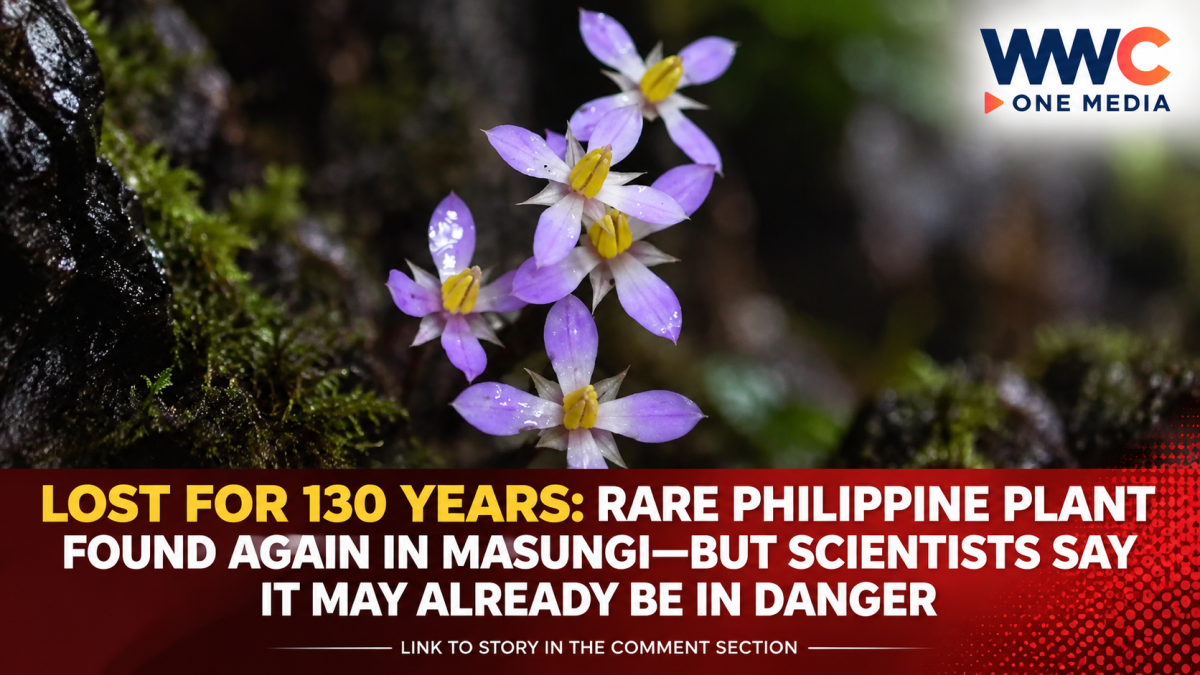
A plant that disappeared from scientific records for more than a century has been found alive in the limestone forests of Masungi Georeserve in Rizal, giving Philippine scientists a remarkable glimpse of a species once considered lost.
The rediscovered plant is Exacum loheri (H. Hara) Klack., a Philippine endemic that was originally collected by Swiss botanist August Loher in 1895 in the Montalban area, now associated with Rizal Province. No reliable record of the species existed for more than 130 years.
What makes the discovery even more extraordinary is that researchers were not initially looking for the plant.
The species was encountered during a malacological reconnaissance study, or fieldwork focused on terrestrial snails, in the “600 Steps” area of Masungi Georeserve in Baras and Tanay, Rizal, on December 8, 2023. Researchers documented an unusual plant and initially identified it only as belonging to the genus Exacum. Further examination of botanical literature and digital herbarium records eventually confirmed its identity as Exacum loheri.
A plant that doesn’t make its own food
Unlike most familiar green plants, Exacum loheri has a remarkable biological adaptation.
The species is achlorophyllous, meaning it lacks chlorophyll and therefore cannot rely on ordinary photosynthesis to produce its own food.
Instead, it is mycoheterotrophic, obtaining nutrients through a relationship with fungi. This unusual strategy is particularly significant because the plant was found growing in humus-rich soil derived from limestone, near a freshwater channel within secondary karst forest.
Researchers say the Masungi population is currently the only known intact living population of Exacum loheri in the wild.
Because of its extremely restricted known distribution, the scientists caution that the species is extremely rare and probably threatened.
First-ever photographs of the living plant
The rediscovery also produced something science had never had before: photographs of living Exacum loheri in its natural habitat.
The findings were published by researchers from the University of the Philippines Diliman Institute of Biology and the Philippine Normal University in the Philippine Journal of Science.
The research note, titled “Notes on the Poorly Known Exacum loheri (H. Hara) Klack. (Gentianaceae) and a Key to the Philippine Species of Exacum,” was published in Volume 154, Issue 5 of the journal in October 2025.
The researchers also developed a taxonomic key covering the known Philippine species of Exacum, adding to the country’s botanical records and making future identification easier.
The discovery could change how scientists view Masungi
The finding is significant beyond one rare plant.
GMA News reported that Masungi is already known for its diverse flora and fauna, while National Geographic has previously highlighted the georeserve as a refuge for rare and endemic wildlife following years of forest restoration.
The latest discovery adds another layer to that biodiversity story: a species believed lost to science was quietly surviving in the area’s karst ecosystem.
Kew’s Plants of the World Online currently recognizes Exacum loheri as an accepted species whose native range is Luzon, Philippines, further supporting its status as a Philippine botanical species of particular significance.
For conservation advocates, the rediscovery is also a reminder that forests can hold species that remain undocumented—or are presumed lost—until researchers return to them.
Masungi Georeserve Foundation has argued that the discovery underscores the importance of protecting the wider Masungi karst landscape from threats including quarrying and large-scale development. The foundation has also raised concerns about a proposed 603-MW wind project in the Masungi Karst Conservation Area. Those claims represent the foundation’s conservation position rather than an independent scientific finding about the project.
A second chance for a species once thought lost
Perhaps the most striking part of the story is that Exacum loheri was not rediscovered through an elaborate search specifically designed to locate it.
Scientists encountered it while studying something else.
More than a century after August Loher collected the original specimen, the tiny plant was found growing quietly among the limestone forests of Rizal—alive, undocumented for generations, and apparently surviving in one of the Philippines’ most biologically important karst landscapes.
And there may be more.
Because the researchers have not found the species during comparable reconnaissance work elsewhere in Rizal, Masungi currently remains its only known living location. That makes the newly documented population both scientifically valuable and potentially vulnerable.
The rediscovery therefore leaves scientists with a bigger question: if one “lost” Philippine plant was still hiding in Masungi after 130 years, what other species could still be waiting to be found?




Leave a Reply