
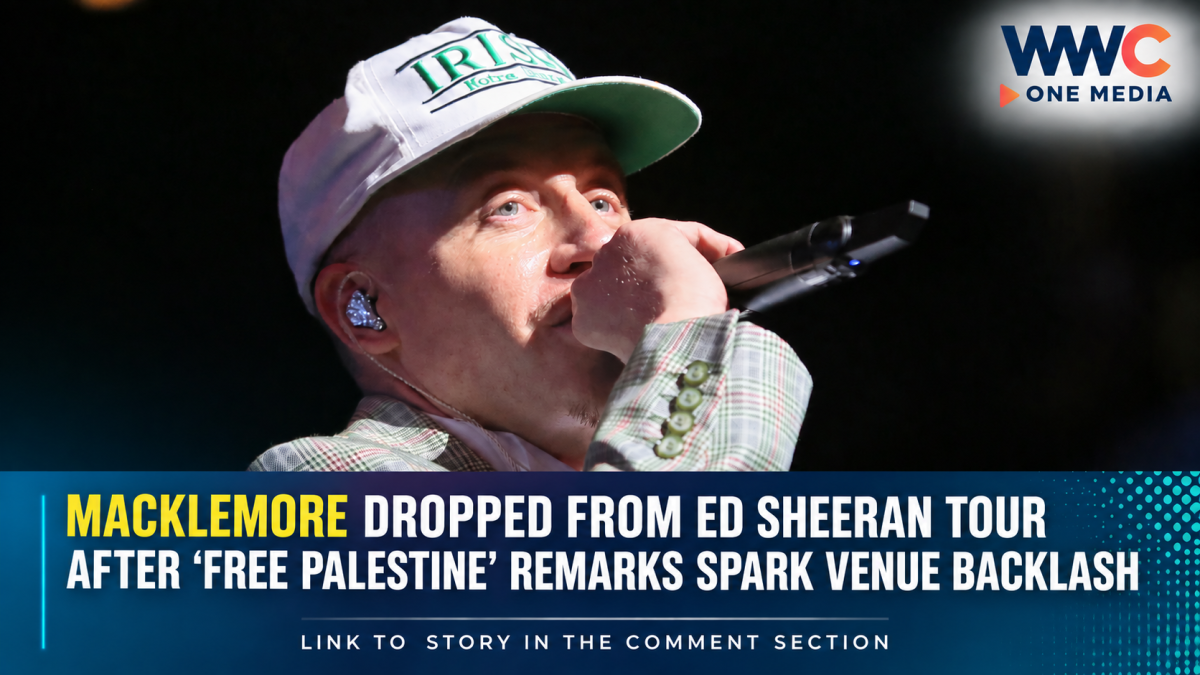
Macklemore has been removed from the remaining US dates of Ed Sheeran’s Loop Tour after his outspoken pro-Palestinian comments onstage triggered backlash and several major venues reportedly refused to host him.
The Grammy-winning rapper was scheduled to perform as Sheeran’s opening act at eight of the remaining 10 US shows. He will now no longer appear on the tour after the promoter said multiple venues would not allow concerts to proceed with Macklemore on the lineup.
The decision follows his performances at New Jersey’s MetLife Stadium on Sept. 4 and 5, where he used part of his set to speak about the war in Gaza, called for a “Free Palestine” and performed his protest song “Hind’s Hall”.
Macklemore says ‘Free Palestine’ onstage
During his first appearance at MetLife Stadium, Macklemore told the audience that one of the reasons he wanted to join the tour was to use major American stadiums to publicly support Palestinian freedom.
He then led the crowd in saying “Free Palestine”.
The rapper also displayed footage showing destruction in Gaza while performing “Hind’s Hall”, a song he released in 2024 in response to the war.
The song references Hind Rajab, a six-year-old Palestinian girl who was killed in Gaza in 2024.
Macklemore has been publicly supporting Palestinians since the war began following Hamas’ Oct. 7, 2023 attack on Israel.
He returned despite the initial backlash
The controversy did not immediately result in Macklemore being removed.
He returned to MetLife Stadium the following night and again spoke about Palestine.
Addressing Jewish members of the audience, he said that criticism of the Israeli government and opposition to what he described as apartheid or genocide should not be interpreted as criticism of Jewish people.
He said his message was ultimately about peace, love and equal treatment for all people.
But the second performance came as criticism of his first speech was intensifying.
Jewish advocacy groups demand his removal
The Israeli American Council launched a petition calling for Macklemore to be removed from the tour, arguing that he had used a major concert platform to promote what it described as a one-sided political message.
StopAntisemitism also criticised the performance.
The Anti-Defamation League condemned the rhetoric surrounding the concert, while social-media users resurfaced a 2014 incident involving Macklemore wearing a costume that he later apologised for after it was criticised as a Jewish caricature.
The controversy also drew the attention of singer Pink.
Pink, who is Jewish, shared criticism of Macklemore’s performance before later clarifying that she was not calling for him to be fired or silenced.
She said she wanted to be able to express fear and concern as a Jewish person without being dismissed or accused of supporting violence against Palestinians.
Several major stadiums reportedly objected
Macklemore later said his removal was driven partly by pressure from venue owners.
He specifically accused Robert Kraft, whose company owns Gillette Stadium in Massachusetts, of telling Sheeran that Macklemore would not be allowed to perform there.
According to Macklemore, Kraft subsequently rallied other stadium owners, creating a situation in which Sheeran’s tour could potentially lose multiple venues if Macklemore remained on the lineup.
The concert promoter, Messina Touring Group, confirmed that several venues had told the company they would not allow a concert to take place with Macklemore performing.
The venues reportedly included stadiums in Philadelphia, Atlanta, Indianapolis, Charlotte, Arlington, Texas, and Tampa, in addition to Gillette Stadium.
The promoter said the decision was made after discussions with stakeholders because cancelling shows would have affected hundreds of thousands of ticket holders.
Robert Kraft rejects accusations of silencing Palestinians
Kraft defended the decision while rejecting the suggestion that it was intended to suppress support for Palestinians.
He said Macklemore’s recent performance and what he described as a broader history of antisemitic rhetoric and imagery crossed a line for the Jewish community.
At the same time, Kraft said the decision was not intended to diminish Palestinian suffering or deny people the right to advocate for Palestinians.
He argued that discussions about the conflict should also acknowledge the actions of Hamas and the suffering of Israelis.
Macklemore says Sheeran was put in a difficult position
Macklemore described Sheeran as a longtime friend and said the two had several conversations about the controversy.
He said Sheeran had been placed in a difficult position because he was being forced to choose between maintaining Macklemore’s place on the tour and protecting the future of his stadium shows.
Macklemore said he understood why Sheeran might have wanted to avoid taking a political position but disagreed with the idea that remaining neutral was possible when discussing the war.
He also said their disagreement would not necessarily end their friendship.
Ed Sheeran has not publicly addressed the dispute
Sheeran has not publicly commented on Macklemore’s removal from the tour.
The British singer has generally avoided taking a prominent political position during his performances, making the dispute particularly complicated given the friendship between the two artists.
Macklemore’s comments effectively placed Sheeran’s own tour in the middle of a wider political and cultural debate.
The controversy now extends beyond the two musicians and into questions about how much political expression artists should be allowed to bring onto major commercial concert stages.
‘Hind’s Hall’ became a symbol of his activism
Macklemore’s song “Hind’s Hall” has become one of the most visible examples of his political activism.
Released in 2024, the track criticised the war in Gaza and drew attention to student protests at universities in the United States.
Macklemore has continued performing the song despite criticism and has used his concerts to speak about Palestinian rights.
His decision to perform it during Sheeran’s stadium tour dramatically increased the size of the audience exposed to his message.
That visibility appears to have been one of the reasons the controversy escalated so quickly.
The dispute highlights a wider entertainment battle
The Macklemore controversy comes amid growing tension over how musicians should address the Israel-Gaza conflict.
Artists supporting Palestinians have faced pressure from advocacy groups, venues and organisers, while Jewish performers and audiences have also raised concerns about antisemitism and rhetoric they believe crosses the line from criticism of Israel into hostility toward Jews.
The debate has become increasingly difficult for major concert promoters because stadium tours depend on agreements involving artists, venues, sponsors and large numbers of ticket holders.
A political statement by one performer can therefore create consequences for an entire tour.
Macklemore’s removal will not end the debate
Macklemore is now off the remaining US dates of Sheeran’s Loop Tour, but the controversy surrounding his decision to speak about Palestine is unlikely to disappear.
For his supporters, the episode demonstrates the risks artists face when they use major commercial platforms to speak about international conflicts.
For his critics, it illustrates the dangers of bringing divisive political messaging into concerts where audiences may not have agreed to participate in a political event.
Macklemore has made clear that he intends to continue speaking about Palestine.
Sheeran, meanwhile, must continue the tour without one of its planned opening acts.
The dispute ultimately leaves a larger question for the music industry: when artists use the world’s biggest stages to take political positions, where should the line be drawn between free expression, advocacy and the responsibilities of a commercial concert tour?



Leave a Reply