
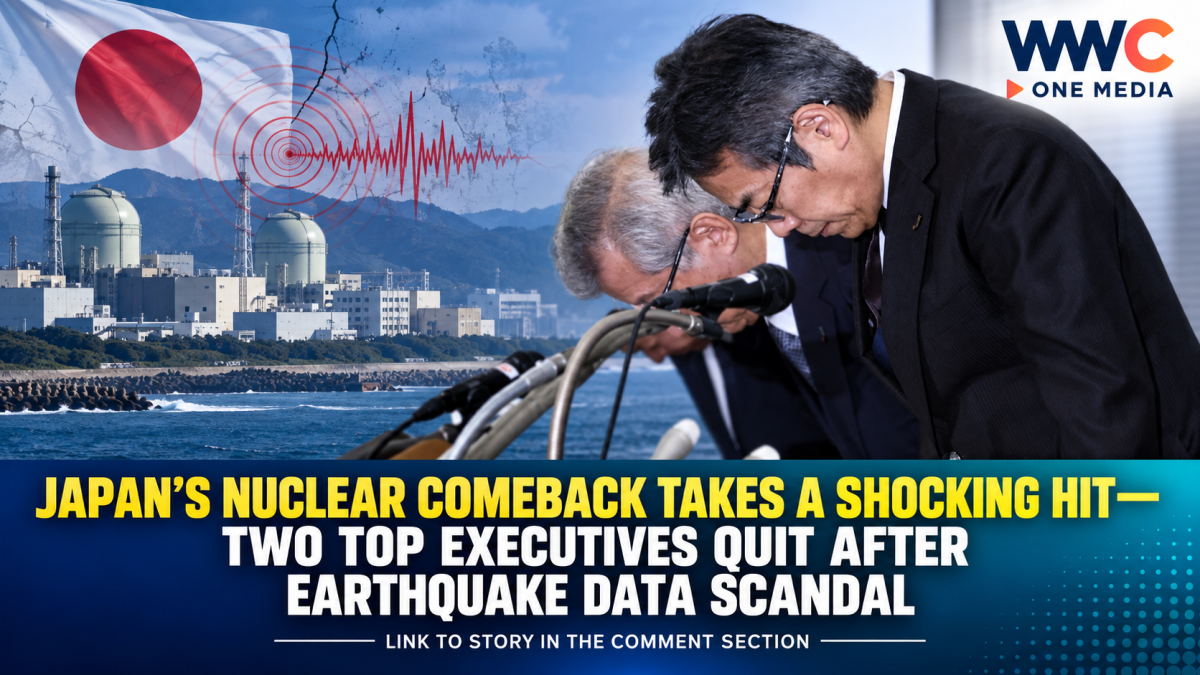
TOKYO — Japan’s push to revive nuclear power has suffered a major setback after the top two executives of Chubu Electric Power announced their resignations amid a scandal involving manipulated earthquake-safety data at the company’s Hamaoka nuclear plant.
Chubu Electric President Kingo Hayashi and Chairman Satoru Katsuno will step down on September 30, taking responsibility for misconduct uncovered during the regulatory review of two reactors at the Hamaoka facility in Shizuoka Prefecture.
The company also said it would withdraw its applications to restart Hamaoka’s No. 3 and No. 4 reactors, effectively putting the long-running restart effort on hold while it works to rebuild confidence in its safety procedures and corporate governance.
Earthquake data at the center of the scandal
The controversy centers on seismic information submitted to Japan’s Nuclear Regulation Authority (NRA) as part of the safety reviews required before the reactors could return to operation.
An independent investigation found that Chubu Electric personnel had used and submitted earthquake-related data in ways that could underestimate the level of seismic shaking expected at the plant. The manipulation reportedly dates back to around 2012.
The issue is particularly serious because Hamaoka sits in central Japan in an area considered vulnerable to major earthquakes, including a potential Nankai Trough megathrust earthquake.
The independent panel’s report found that pressure from management to move the restart process forward was among the factors that contributed to the misconduct. However, investigators did not find evidence that the two departing executives directly ordered employees to falsify the data.
Whistleblower warnings had already surfaced
The scandal also raises questions about how the problem remained unresolved despite earlier warnings.
According to reports on the investigation, concerns about manipulated seismic information had been raised internally, including whistleblower reports in 2019 and 2021. The independent panel concluded that those concerns were not properly addressed.
The Nuclear Regulation Authority subsequently suspended its review of the Hamaoka restart applications after receiving information about the suspected data manipulation.
The findings have placed Chubu Electric under intense scrutiny because the reliability of seismic calculations is fundamental to determining whether a nuclear facility can withstand the forces expected during a major earthquake.
Hamaoka restart plans now face a major delay
Chubu Electric had been pursuing regulatory approval to restart Hamaoka Units 3 and 4 for years.
The company applied for safety reviews of the two boiling-water reactors in 2014 and 2015, respectively. The process was part of Japan’s broader effort to bring nuclear reactors back online following the 2011 Fukushima disaster.
But the data scandal has now forced the company to withdraw those applications.
Chubu said it plans to undertake management and governance reforms before seeking to move forward again, including changes aimed at strengthening compliance, oversight and organizational culture.
Minoru Yasui, a senior executive at the company, is scheduled to become president on October 1.
Why this matters beyond one nuclear plant
The fallout comes at a critical moment for Japan’s energy strategy.
After the Fukushima Daiichi disaster in 2011, Japan shut down its nuclear fleet amid widespread safety concerns. The country has since gradually restarted reactors under tougher regulatory requirements, while attempting to reduce its reliance on imported fossil fuels and meet its climate goals.
Japan’s government has increasingly viewed nuclear power as an important part of its future electricity mix, particularly as demand rises from industries such as advanced manufacturing and artificial-intelligence data centers.
But the Chubu Electric scandal underscores one of the biggest challenges facing that strategy: Japan needs public confidence that nuclear safety reviews are completely reliable and independent.
The country’s nuclear restart campaign has already faced years of delays and regulatory hurdles. The Hamaoka controversy could make that path even more difficult.
A setback for Japan’s nuclear revival
The Hamaoka case is therefore much bigger than an executive reshuffle.
It puts the spotlight on corporate governance, regulatory transparency and the credibility of nuclear safety data at a time when Japan is trying to expand its reliance on nuclear energy again.
Chubu Electric has apologized for the misconduct and pledged fundamental reforms. But the company now faces the difficult task of convincing regulators and the public that the systems used to evaluate earthquake risks can once again be trusted.
For Japan’s nuclear revival, the question is no longer simply when Hamaoka’s reactors can restart.
It is whether the operator can restore enough trust for regulators and the public to believe that the next safety assessment tells the complete story.



Leave a Reply