
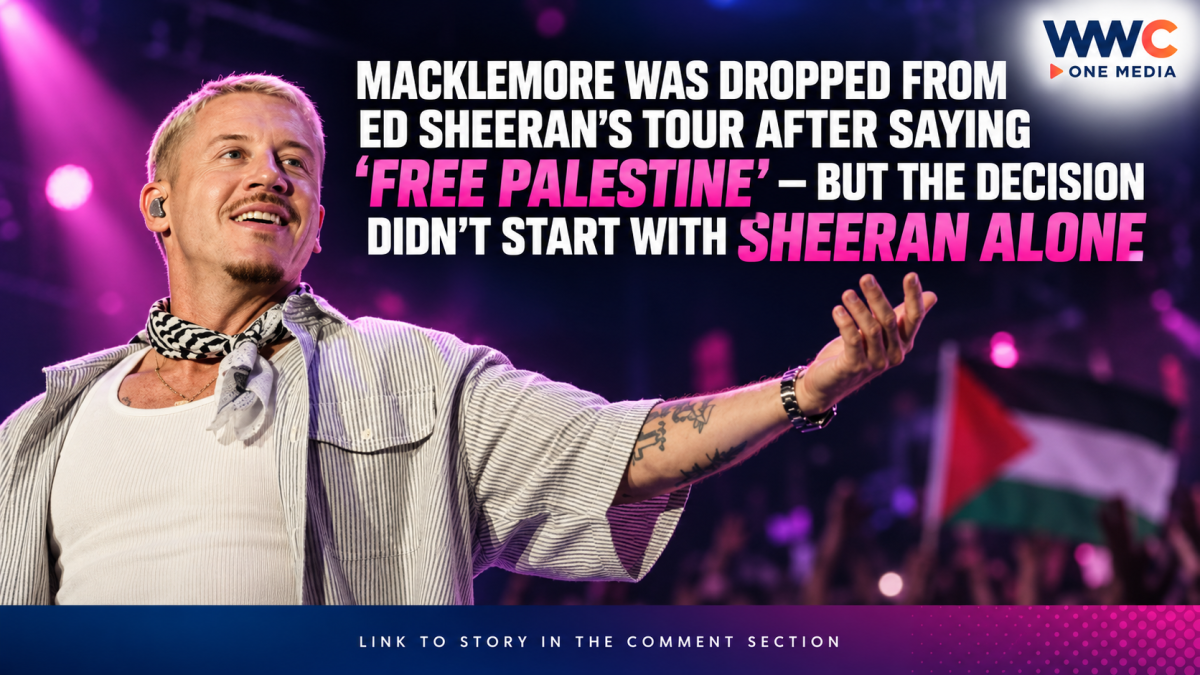
NEW YORK — What began with two words shouted from one of America’s biggest concert stages has now cost Macklemore eight stadium performances and opened a much larger argument over political speech, antisemitism, Palestinian advocacy and who ultimately controls what an artist can say on a major tour.
The Grammy-winning rapper has been removed from the remaining U.S. dates on Ed Sheeran’s Loop Tour after several upcoming venues told the tour promoter they would not host concerts with Macklemore on the bill.
The decision followed Macklemore’s September 4 appearance at MetLife Stadium in New Jersey, where he told the crowd that one reason he wanted to join Sheeran’s tour was to publicly declare “Free Palestine.”
He also performed his protest track Hind’s Hall, accompanied by images connected to the destruction in Gaza and pro-Palestinian demonstrations.
The backlash was immediate.
Days later, the Israeli-American Council was petitioning for his removal.
Jewish advocacy organizations criticized the performance.
Singer Pink entered the debate.
And Macklemore says conversations with Sheeran—his friend of roughly 13 years—became increasingly difficult.
Then the venues started saying no.
This time, the tour promoter has confirmed the central claim
There is an important difference between Macklemore’s personal account and what has been independently confirmed.
Messina Touring Group, which promotes the U.S. portion of Sheeran’s tour, confirmed that venues had informed the company they would refuse to stage concerts if Macklemore remained on the lineup.
The promoter said the situation threatened cancellation of shows affecting hundreds of thousands of ticket holders, and that after discussions with stakeholders, Macklemore would no longer perform on his remaining support dates.
Macklemore had been scheduled for eight of the final 10 U.S. shows.
The tour resumes September 19 at Lincoln Financial Field in Philadelphia before continuing through major NFL stadiums and other venues across the country.
Rolling Stone reported that the venues objecting to Macklemore included stadiums in or near:
Philadelphia, Boston, Atlanta, Indianapolis, Charlotte, Dallas and Tampa.
That makes this more than one promoter independently deciding an opening act had become inconvenient.
According to the promoter itself, venue resistance threatened the viability of multiple stadium dates.
Macklemore says Robert Kraft was the first major domino
Macklemore offered a much more detailed version of what happened behind the scenes.
In a lengthy Instagram statement, he said Sheeran informed him that billionaire Robert Kraft, owner of the New England Patriots and Gillette Stadium, did not want him performing at Sheeran’s September 25 and 26 concerts at the Massachusetts venue.
Macklemore further alleged that Kraft contacted or rallied other stadium owners, leading to a broader ultimatum: remove Macklemore or risk losing venues.
That second claim has not been independently established.
Kraft did, however, confirm his own opposition to Macklemore appearing at Gillette Stadium.
He said the stadium seeks to provide a welcoming environment and does not want its events used to promote what it considers hate speech.
Kraft argued that Macklemore’s recent stage presentation, combined with previous controversies, crossed that line and was hurtful to members of the Jewish community.
At the same time, Kraft said his decision was not intended to dismiss Palestinian suffering or prevent people from advocating for Palestinians. He argued instead that such advocacy should not, in his view, ignore Hamas or come at the expense of Jewish audiences.
That is Kraft’s stated justification.
Macklemore strongly disputes the characterization.
Macklemore: Criticizing Israel is not antisemitism
The rapper has rejected accusations that his advocacy is antisemitic.
His position is that opposition to Israeli government policy, its military campaign in Gaza and its treatment of Palestinians should not automatically be equated with hostility toward Jewish people.
At his second MetLife performance on September 5, Macklemore directly addressed Jewish audience members.
He said his criticism was directed at Israeli policy rather than Judaism or Jewish people and described his broader message as one of dignity and equality for all.
That clarification did not end the controversy.
Critics argue that the total presentation—not merely the phrase “Free Palestine”—created an environment they regarded as one-sided or hostile.
Supporters of Macklemore argue that accusing pro-Palestinian speech of antisemitism can itself become a mechanism for suppressing legitimate political criticism.
Those are sharply contested interpretations, and responsible coverage should distinguish them from established facts.
Pink’s response was more complicated than “Pink demanded he be fired”
Some online discussion has reduced Pink’s involvement to the claim that she wanted Macklemore removed.
That is not what she ultimately said.
Pink had amplified criticism of his MetLife performance but later explicitly stated that she was not asking for Macklemore to be silenced or fired.
Instead, she said aspects of his presentation frightened her and other Jewish people she knew, and she argued that expressing that fear should not automatically lead others to assume she supported the suffering of Palestinians.
She also made clear that she supports Palestinian human rights while condemning Hamas.
That nuance matters because the dispute has increasingly become polarized into two simplistic camps—support Macklemore or oppose Palestinian rights—when several participants have expressed more complicated positions.
The Israeli-American Council wanted him off the tour
The Israeli-American Council took a clearer position.
It launched a petition asking Sheeran and tour organizers to remove Macklemore, arguing that concertgoers had bought tickets to a music event rather than a political rally.
The group said the issue was not whether Macklemore was entitled to political views, but whether an opening act should use another headliner’s stadium platform to deliver what it characterized as one-sided political messaging.
The petition also questioned whether Sheeran’s team had approved Macklemore’s visuals and remarks beforehand.
Macklemore sees the issue very differently.
For him, speaking about Palestine was apparently not an unexpected departure from the purpose of joining the tour.
He said publicly at MetLife that using large American stadiums to speak about Palestinians was one of the reasons he wanted to participate in the first place.
That raises one unanswered question: What did Sheeran know beforehand?
So far, there is no public evidence establishing exactly what Sheeran or his tour organizers knew about Macklemore’s intended political content before the MetLife shows.
That matters.
Macklemore has been publicly advocating for Palestinians for years.
His political position was hardly a secret when he was booked.
But knowing an artist’s general political views is different from explicitly approving particular speeches, images or protest material for a stadium tour.
Neither Sheeran nor his representatives have publicly provided a detailed account addressing that question.
Reuters reported that Sheeran had no immediate comment after Macklemore’s removal was announced.
That means Macklemore’s description of their private conversations should be attributed to him rather than presented as Sheeran’s confirmed position.
Macklemore says the friendship survived—at least for now
The personal dimension makes the dispute unusually uncomfortable.
Macklemore says he and Sheeran have known one another for approximately 13 years.
He described their conversations after the MetLife controversy as difficult and painful but said he hoped the dispute would not end the friendship.
According to Macklemore, Sheeran told him that some people he had spoken with found the phrase “Free Palestine” and images of the Palestinian flag hurtful.
Macklemore said he fundamentally disagreed with that framing and told Sheeran that the suffering of Palestinians outweighed the professional discomfort generated by his statements.
Again, that account comes from Macklemore.
Sheeran has not publicly confirmed the details of those conversations.
That is a significant distinction because social-media posts have increasingly portrayed Sheeran as having personally denounced Palestinian advocacy.
The publicly confirmed facts are narrower:
venues objected, the promoter faced potential cancellations, and Macklemore was removed.
Why ‘Hind’s Hall’ was always likely to make this bigger than a slogan
Macklemore’s stage performance was not limited to saying “Free Palestine.”
He also performed Hind’s Hall, the protest song he released in 2024 in support of pro-Palestinian university demonstrations.
The title refers to Hind Rajab, a Palestinian child killed in Gaza whose death became an international symbol of the civilian toll of the war.
The track sharply criticizes Israel, U.S. political support for Israel and institutional responses to campus protests.
During the MetLife performance, Macklemore also displayed imagery connected to Gaza and student activism.
That broader presentation—not merely two words—is central to the objections raised by Macklemore’s critics.
Macklemore has described Israel’s conduct in Gaza as genocide.
A number of human-rights organizations and a United Nations commission have also used that characterization, while Israel rejects accusations that its military campaign constitutes genocide.
The disagreement is therefore not simply semantic.
It sits directly inside one of the most bitterly contested political and humanitarian debates in the world.
Why did this become a problem now?
Macklemore himself asked essentially that question.
He has spent years publicly supporting Palestinians.
He released Hind’s Hall in 2024.
He has repeatedly criticized Israeli policy.
So why would those positions suddenly make him unacceptable in September 2026?
His answer is exposure.
Sheeran is among the world’s biggest touring artists, and the Loop Tour puts Macklemore in enormous American stadiums before audiences far beyond his usual activist base.
Macklemore argued that once the phrase “Free Palestine” reached that level of visibility, the commercial risk became far greater.
That is his interpretation, not something independently proven.
But the promoter’s account does demonstrate that commercial risk became real: venues were prepared to refuse the shows.
There is also an uncomfortable venue question
Rolling Stone identified another potentially significant complication.
Several venues reportedly objecting to Macklemore are not simply private clubs or theaters. Some are owned by cities, counties, states or other public entities.
That potentially raises legal questions if a publicly controlled venue refuses a performer specifically because of political viewpoints.
But those issues depend heavily on contractual arrangements, the identity of the actual decision-maker and other facts that have not yet been publicly established.
So it would be premature to say Macklemore’s removal violated the First Amendment.
What can be said is that legal questions may become more complicated where government-owned venues are involved.
The distinction between private venue management and government action matters enormously under U.S. constitutional law.
No court has ruled on those questions in connection with Macklemore’s removal.
The tour itself is going forward
For Sheeran, the most immediate consequence appears to be logistical rather than existential.
The U.S. Loop Tour is continuing without Macklemore.
Other support artists, including Lukas Graham and Aaron Rowe, remain part of the schedule.
The U.S. stadium run is expected to continue through November before Sheeran moves on to South American dates.
Curiously, Sheeran’s official website was still listing Macklemore as support on several forthcoming U.S. dates when it was most recently crawled, apparently reflecting a tour page that had not yet been updated to match the promoter’s announcement. The promoter’s newer statement makes clear that Macklemore is no longer scheduled to perform those support dates.
This isn’t really a story about whether musicians are “allowed” to be political
Artists have always brought politics onto stages.
The more difficult question is what happens when an opening artist’s political speech creates commercial and reputational consequences for the headliner, promoter and venues.
Macklemore argues that a moral position loses its meaning if it disappears as soon as there is a professional cost.
Venue operators argue they also have responsibilities to audiences and communities who may experience certain rhetoric or imagery very differently.
Sheeran, caught between them, has not yet publicly explained how he weighed those competing pressures.
And the promoter says it faced something much more concrete than a philosophical disagreement:
multiple venues were threatening not to host the concerts.
That turns an argument about speech into an argument about contracts, ticket holders, stadium access and millions of dollars in touring economics.
The most important unconfirmed claim is about Robert Kraft
There is a tendency in viral versions of the story to say that Kraft personally got Macklemore banned across America.
The evidence currently does not establish that.
What is confirmed is narrower:
Kraft acknowledged that Gillette Stadium would not permit Macklemore to appear.
Messina Touring Group separately confirmed that multiple other venues also objected.
Macklemore alleges that Kraft coordinated or helped create that wider resistance.
Kraft has not publicly confirmed that specific allegation.
That attribution is essential for an accurate headline and article.
And Ed Sheeran’s silence is now becoming part of the story
Sheeran has built much of his public image around avoiding the kind of political confrontation that dominates many celebrity news cycles.
According to Macklemore, that preference for staying publicly neutral became a major source of disagreement between them.
But because Sheeran has yet to offer his own detailed statement, the public is currently hearing his side largely through Macklemore.
That leaves several unanswered questions.
Did Sheeran personally agree that Macklemore crossed a line?
Did he simply conclude that losing multiple stadiums was impossible?
How much of the decision came from Sheeran himself versus promoters, insurers, venue operators and tour management?
And does he view “Free Palestine” itself as objectionable—or only the larger context of Macklemore’s performance?
None of those questions has yet been definitively answered.
The bigger fight may outlast the tour
Macklemore will lose eight stadium appearances.
Sheeran’s concerts will continue.
That is the immediate entertainment-industry story.
But what happened behind those cancellations raises a larger question that will not disappear when the Loop Tour ends.
Major touring artists increasingly play in venues controlled by powerful private owners, professional sports franchises and public authorities.
Those venues are no longer passive buildings.
They can effectively determine which performers get access to audiences of 50,000 or 70,000 people at a time.
Macklemore chose to use that scale to make a political statement.
Some venue operators decided they would rather lose the event than allow him back.
The promoter chose to preserve the tour.
And Sheeran—at least publicly—has yet to explain where he personally draws the line.
So the most consequential part of this dispute may not be that Macklemore said “Free Palestine.”
It may be what happened once some of America’s biggest stadiums decided that saying it in that context, on that stage, carried a price they were no longer willing to accept.



Leave a Reply