
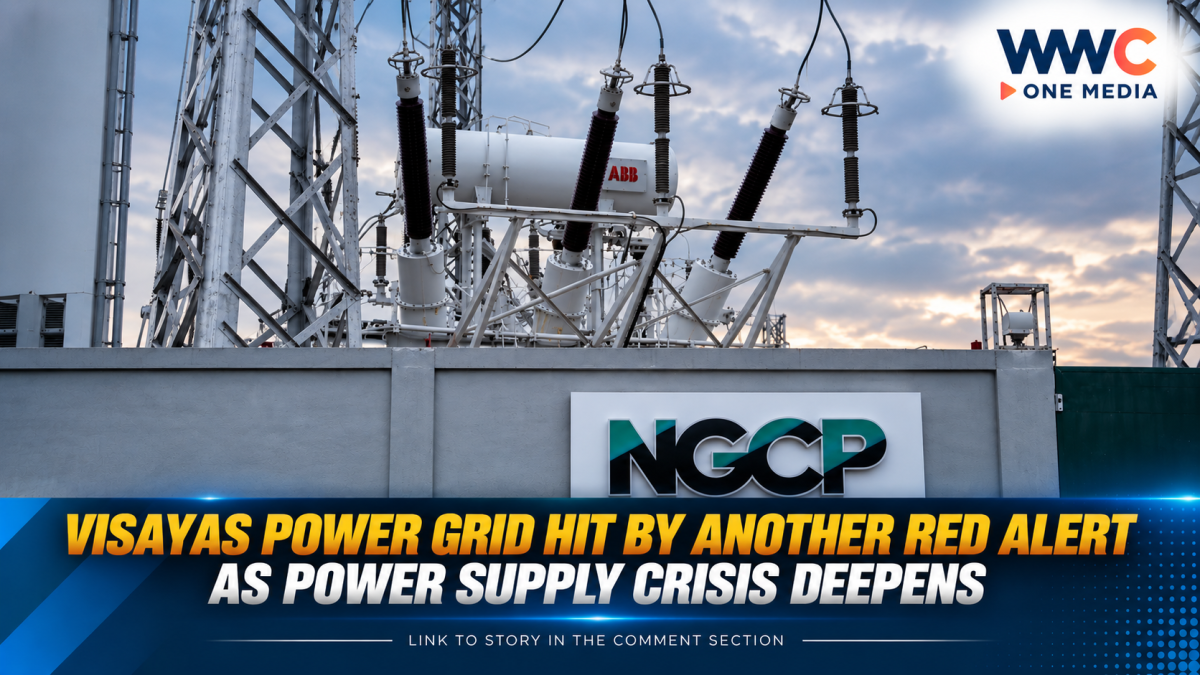
MANILA — The Visayas power grid has once again been pushed to the brink, with the National Grid Corporation of the Philippines (NGCP) raising a red alert Monday as tight supply and repeated power-plant outages continue to strain the region’s electricity system.
NGCP placed the Visayas grid under a red alert from 6 p.m. to 7 p.m. on Sept. 7, followed by a yellow alert from 7 p.m. to 10 p.m., according to the Philippine News Agency.
The latest warning is the newest episode in a string of grid alerts that have repeatedly hit the Visayas in recent weeks.
Another Warning Signs of a Strained Grid
A red alert means available power is insufficient to meet consumer demand while also maintaining the required regulating reserves.
In practical terms, it means the system has very little room for unexpected failures — and the possibility of controlled or rotational power interruptions increases if the shortage persists.
A yellow alert is less severe, but still signals that operating reserves have fallen below the level required to withstand a major contingency.
The latest red alert therefore matters not only because of its one-hour duration, but because it comes after repeated red and yellow alerts across the Visayas throughout August and September.
Power Plants Remain the Biggest Problem
NGCP has repeatedly pointed to the unavailability of several major generating units as one of the principal causes of the supply squeeze.
Recent advisories cited outages involving large coal-fired facilities, including Therma Visayas Inc. (TVI) units and Palm Concepcion Power Corp.’s PEDC 3, while limited electricity imports from Mindanao have further restricted the supply available to the Visayas.
The problem is not confined to a handful of plants.
NGCP’s recent data showed numerous generating units either on forced outage or operating below their full capacity. On Sept. 5, the grid operator reported that 797.8 megawatts of Visayas capacity was unavailable, with multiple plants forced offline and others operating at reduced output.
That leaves the grid increasingly vulnerable whenever demand rises.
This Has Been Building for Weeks
The latest alert follows a pattern that has become increasingly difficult to dismiss as temporary.
On Sept. 3, the Visayas grid entered a prolonged red-alert period from 1 p.m. to 10 p.m., with a yellow alert before and after the red-alert window.
At that time, available capacity was reported at 2,187 MW against projected peak demand of 2,575 MW.
NGCP again cited the unavailability of major coal plants and limited or unavailable imports from Mindanao.
Just two days later, on Sept. 5, the Visayas was again scheduled for a red alert, this time from 5 p.m. to 8 p.m., followed by a yellow alert.
Available capacity was reported at 2,255 MW against peak demand of 2,432 MW.
The frequency of those warnings highlights a deeper problem: the grid is repeatedly operating with insufficient reserves during periods of high demand.
Consumers Could Face Rotational Brownouts
The most immediate concern for households and businesses is the possibility of power interruptions.
When a red alert is declared, utilities may be required to implement manual load dropping or rotational interruptions to prevent a larger and potentially uncontrolled grid failure.
The distinction is important.
A red alert does not automatically mean every consumer will lose electricity. But it means the grid has insufficient capacity and reserves, increasing the risk that interruptions will be necessary if the situation deteriorates.
That makes peak-hour electricity use particularly important during periods of tight supply.
The Visayas Is Not Alone
The electricity problem has also spread across other parts of the country.
The Mindanao grid has repeatedly experienced its own yellow and red alerts, with outages at large coal-fired plants contributing to supply constraints.
On Sept. 3, for example, Mindanao was placed under red alert from noon to 9 p.m., while the Visayas simultaneously faced its own prolonged red-alert period.
This matters because the Visayas relies partly on electricity imports from Mindanao.
When Mindanao itself experiences high demand or generation problems, less power can be transferred northward, making the Visayas shortage worse.
A Problem That Has Already Produced Brownouts
The recurring alerts are not merely warnings on paper.
The Philippine Star reported in late August that the Visayas had already experienced 22 red alerts since the start of 2026, along with rotational power interruptions in several areas.
At the time, NGCP reported nearly 939 MW of unavailable capacity, caused by simultaneous forced outages affecting dozens of generating plants and reduced output from additional facilities.
The continuing outages have raised concerns about the reliability of the region’s electricity supply as the year progresses.
The Bigger Question: When Will Supply Stabilize?
The immediate cause of each red alert can change — a plant outage, high demand, limited imports or a combination of factors.
But the repeated nature of the alerts points to a broader vulnerability.
The Philippines has already experienced severe power shortages elsewhere in 2026. In May, Reuters reported that NGCP warned of potentially serious outages after dozens of power plants went offline amid high demand and extreme heat.
For the Visayas, the challenge is particularly significant because the region depends on a relatively interconnected system in which the failure of several large generating units can rapidly shrink available reserves.
What Consumers Should Watch
For residents and businesses in the Visayas, the most important information remains the daily NGCP grid-status announcements and advisories from local distribution utilities.
Consumers should pay particular attention during late-afternoon and evening peak-demand periods, when electricity consumption can put additional pressure on the system.
The immediate goal is to prevent the supply shortage from becoming a wider grid emergency.
But the longer-term solution is more complicated.
It requires restoring unavailable generating capacity, improving the reliability of existing plants, expanding dependable generation and ensuring adequate transmission and reserve capacity.
Until those problems are addressed, another red alert may be only a matter of time.
And with the Visayas already seeing repeated warnings in just a matter of weeks, the question is no longer whether the grid can survive one difficult evening — but how long it can keep operating this close to the edge.




Leave a Reply