
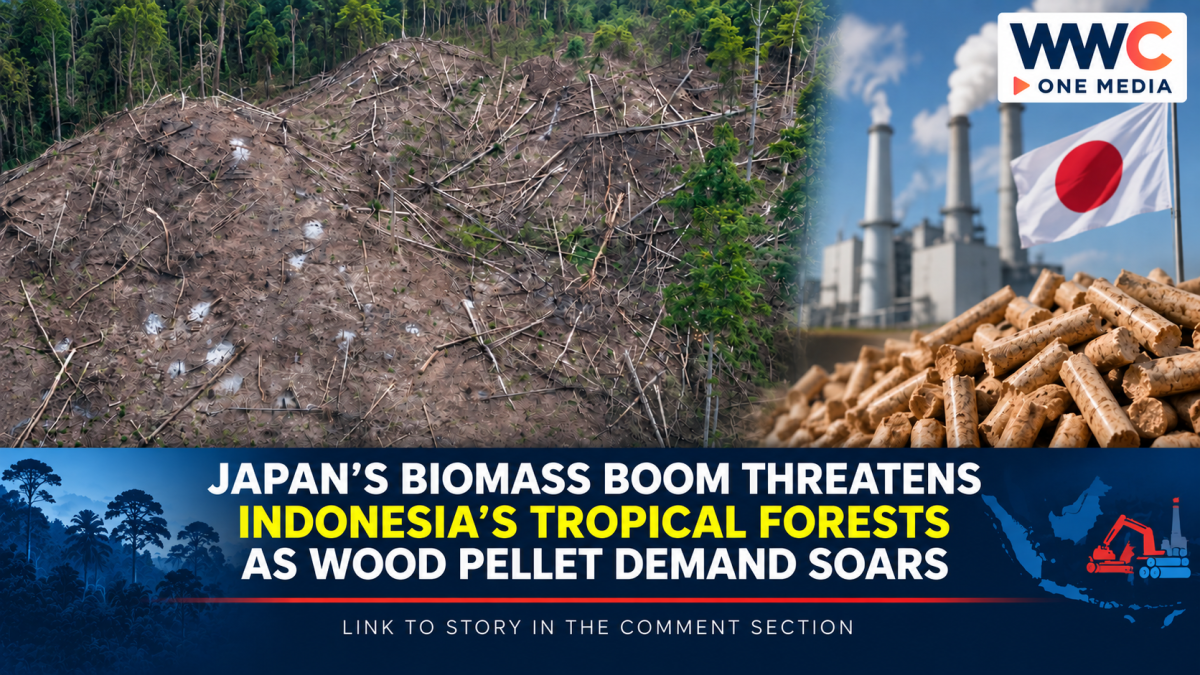
Japan’s growing appetite for biomass energy is driving a surge in Indonesian wood pellet and wood chip production, raising fears that a renewable-energy push is accelerating the destruction of some of Southeast Asia’s most valuable tropical forests.
Environmental groups say the expanding industry is creating a new source of pressure on Indonesia’s forests, biodiversity and Indigenous communities, as Japanese power producers increasingly rely on imported wood to generate electricity.
Wood pellets are widely promoted as a renewable alternative to fossil fuels. But critics argue that burning forest-derived biomass can create substantial carbon emissions and that the climate benefits depend heavily on where the wood comes from and how forests are managed.
Japan’s demand for Indonesian wood is exploding
Indonesia’s exports of wood pellets to Japan have increased dramatically.
Japanese imports of Indonesian wood pellets surged from about 66,460 tonnes in 2023 to roughly 402,310 tonnes in 2025 — an increase of more than 500 per cent.
Japan has become the biggest destination for Indonesia’s biomass exports, according to environmental organisations monitoring the industry.
The surge is linked to Japan’s effort to increase renewable energy generation while reducing its reliance on coal.
Japan imported a record 8.64 million tonnes of wood pellets in 2025, further underscoring the scale of the country’s dependence on biomass fuel.
Forests are being turned into fuel
Environmental groups say the growing demand is creating incentives to clear forests and establish plantations capable of supplying the biomass industry.
New satellite analysis by Indonesian and international environmental organisations has identified areas where forests are being cleared in regions connected to wood pellet and wood chip supply chains.
The concern is particularly acute in Indonesia because the country contains some of the world’s most biologically diverse tropical forests.
Researchers and campaigners warn that natural forests provide far more environmental value than simply storing carbon.
They support endangered wildlife, regulate water systems and provide livelihoods and cultural resources for Indigenous and local communities.
Clearing those forests for biomass therefore risks replacing a complex ecosystem with a much simpler plantation landscape.
Biomass is labelled renewable — but the reality is complicated
The controversy centres on a fundamental question: can burning wood really be considered clean energy if forests have to be cut down to supply it?
Biomass is generally classified as renewable because trees can theoretically be replanted and regrown.
But environmental groups argue that this accounting can overlook the time required for forests to recover and the carbon released when mature trees are harvested and burned.
Natural forests can store enormous amounts of carbon for decades or centuries.
Once they are cleared and the wood is burned, much of that stored carbon is released into the atmosphere.
A replacement plantation may eventually absorb carbon again, but it can take many years or decades to compensate for the emissions from the original forest clearance.
That creates a particular problem when biomass is presented as a rapid climate solution.
Indonesia’s forests face pressure from multiple industries
Biomass is not the only threat to Indonesian forests.
The country has long struggled with deforestation linked to palm oil, logging, mining, agriculture and infrastructure development.
More recently, nickel mining has emerged as another major source of forest loss, particularly on islands rich in mineral resources.
Environmental groups now fear biomass could become another significant driver of forest clearance.
At least 45 biomass-related concessions covering about 750,000 hectares have been identified in Indonesia, according to environmental researchers.
Not all of that land is necessarily being cleared for biomass production, but campaigners say the scale of the concessions demonstrates how rapidly the industry is expanding.
Sulawesi and other biodiversity hotspots at risk
Some of the greatest concerns involve Indonesia’s biodiversity-rich islands.
Sulawesi, in particular, contains species found nowhere else on Earth and has already experienced extensive pressure from mining, plantations and other development.
Environmental organisations have linked Japanese biomass supply chains to forest areas in the region.
The loss of these forests could threaten species that depend on increasingly fragmented habitats.
The impact also extends beyond wildlife.
Indigenous communities and local residents rely on forests for food, livelihoods, water and traditional land use.
When forests are converted into industrial plantations, communities can lose access to resources that have supported them for generations.
Japan’s renewable-energy policy is driving the market
Japan’s biomass boom is closely connected to government incentives designed to encourage renewable electricity.
The country has promoted biomass alongside solar, wind and other renewable sources as part of its efforts to reduce greenhouse-gas emissions and diversify its energy mix.
The policy has helped make imported wood pellets economically attractive to power producers.
But critics say the system can create unintended consequences overseas.
If subsidies encourage utilities to purchase large quantities of wood pellets, producers in countries such as Indonesia have a financial incentive to expand plantations and harvesting operations.
Environmental groups are therefore calling on Japanese companies and policymakers to strengthen checks on the origins of imported biomass.
Supply-chain certification faces scrutiny
Japanese power companies generally rely on sustainability certifications and supply-chain documentation to demonstrate that biomass meets environmental requirements.
Campaigners argue that certification alone may not be sufficient.
Satellite monitoring can reveal forest loss, but tracing individual shipments back to the precise forest where the wood originated can be complicated.
Environmental groups say stronger due diligence is needed to ensure that biomass labelled as sustainable is not indirectly linked to natural-forest destruction.
They are also urging Japanese financial institutions and energy companies to reconsider investments connected to controversial Indonesian biomass projects.
Japan is not the only country facing criticism
South Korea has also been a major importer of Indonesian biomass.
But South Korea has begun reducing some biomass subsidies following concerns over the environmental consequences of its renewable-energy policy.
The experience has become an important comparison for Japan.
Environmental groups argue that Japan risks repeating the same pattern if it continues expanding biomass consumption without tightening rules on the origin of wood.
A difficult climate contradiction
The controversy highlights a growing contradiction within the global energy transition.
Countries are trying to move away from coal, oil and gas, but some renewable technologies can create environmental damage elsewhere if their supply chains are poorly managed.
For Japan, biomass offers a way to generate electricity from a fuel that is officially considered renewable.
For Indonesia, however, the increasing demand could mean more pressure on forests that are already under threat.
That raises questions about whether replacing fossil fuels with imported forest biomass truly delivers the climate benefits claimed for it.
The bigger question for Japan’s energy transition
The debate is unlikely to disappear as Japan continues seeking alternatives to fossil fuels.
The country needs reliable electricity while pursuing its emissions goals, but environmental groups say the solution should not come at the expense of tropical forests thousands of kilometres away.
For Indonesia, the stakes are even higher.
Its forests are crucial carbon stores, biodiversity reserves and sources of livelihoods for millions of people.
If demand for wood pellets continues rising at the current pace, conservationists warn that a fuel promoted as part of the clean-energy transition could become another driver of forest destruction.
The central challenge for Japan will therefore be proving that its biomass strategy can deliver renewable energy without shifting the environmental cost onto Indonesia’s forests and communities.




Leave a Reply