
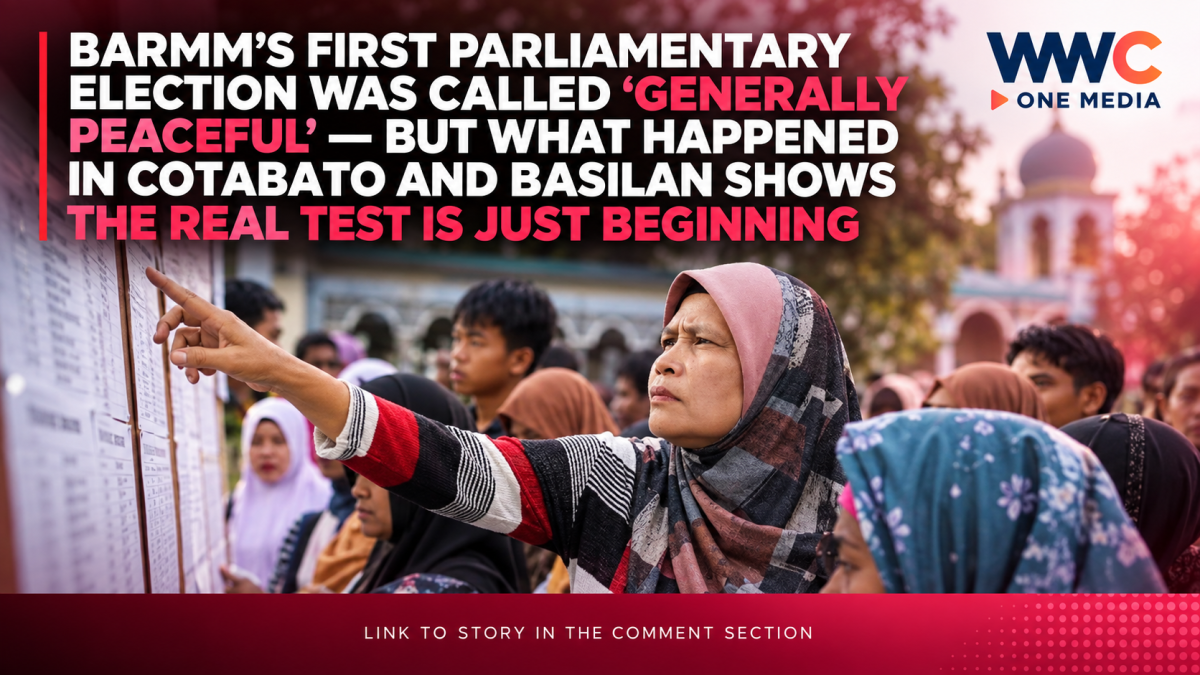
COTABATO CITY, Philippines — The Bangsamoro Autonomous Region in Muslim Mindanao has completed something generations of peace negotiators once struggled to imagine: voters went to the polls to choose the region’s first regular elected parliament.
Philippine military, police and election officials described Monday’s historic vote as generally peaceful, pointing to the fact that voting proceeded across most of the autonomous region despite intense security concerns and isolated outbreaks of violence.
But “generally peaceful” requires context.
Hours before polling opened, gunfire erupted near a voting center in Cotabato City, leaving three people dead and 15 wounded, according to the initial official police count. Authorities also dealt with shootings and explosions elsewhere, while alleged pre-shaded ballots forced intervention in Basilan. Later Associated Press reporting placed the wider death toll from election-period violence at four.
That makes the first BARMM election both a historic achievement and a warning.
The ballots were cast.
The transition worked.
But the region’s deeper experiment — replacing generations of armed struggle and personality-driven politics with an enduring parliamentary democracy — is only beginning.
Most of the region still managed to vote
The scale of the election makes the overall assessment significant.
Nearly 2.4 million registered voters were eligible to participate across the Bangsamoro region. Comelec listed 5,212 voting precincts, while the new parliament contains 80 seats: 40 for regional political parties, 32 for parliamentary districts and eight reserved for sectoral representation.
Comelec reported that about 98.1% of polling precincts opened successfully, while the PNP said monitoring showed a 97.38% voting-start status across tracked areas during election day. Several provinces and special geographic areas reached 100%.
That is why security authorities resisted describing the entire election as violent.
PNP spokesperson Col. Allen Rae Co said the incidents remained isolated rather than widespread, while Comelec Chairman George Garcia likewise said voting was proceeding peacefully in most of BARMM.
In Lanao del Sur — despite the province entering election day with 21 areas classified in the highest-risk red category — provincial election officials reported no major incidents during voting and described the exercise as unusually peaceful. Tawi-Tawi also reported largely orderly polling.
That contrast is important.
The election was neither the bloodless success suggested by the word “peaceful” on its own nor the region-wide breakdown that isolated violent incidents might imply.
It was both a functioning historic election and an electoral exercise conducted under serious security pressure.
Cotabato City showed how quickly things could have gone wrong
The most serious early incident unfolded outside the Datu Usman Mampen Elementary School in Cotabato City shortly before election day formally began.
Initial police reporting said a confrontation involving rival political supporters deteriorated into gunfire, killing three people and injuring 15. Investigators recovered spent ammunition from the scene.
An explosion had also occurred in another part of Cotabato City on Sunday evening.
Because of the deteriorating security situation, Comelec eventually placed Cotabato City under its direct control, giving the election commission greater authority over local government personnel and security arrangements during the vote.
Philippine Star subsequently reported additional violent incidents surrounding the election, illustrating why casualty totals differed as authorities continued receiving information from separate locations.
For accuracy, the safest formulation is therefore this:
At least three people were killed and 15 wounded in the major pre-election Cotabato shooting, while later reports recorded additional deaths and injuries linked to separate election-period incidents.
Then Basilan confronted a completely different problem
Violence was not the only threat to confidence in the vote.
In Maluso, Basilan, authorities discovered allegedly pre-shaded ballots affecting 36 of 68 precincts, according to election-day reporting.
Comelec intervened, ordered replacement ballots and extended voting hours to compensate for the delay. Maluso was also placed under Comelec control.
That episode matters because a credible election depends on more than keeping gunmen away from polling centers.
The ballots themselves must be trusted.
For a political system holding its first parliamentary election after years of postponements, even localized allegations of ballot manipulation can undermine confidence far beyond the municipality where they occur.
Comelec’s decision to replace the affected ballots rather than allow the disputed material to remain in use was therefore an important test of the election machinery.
More than 20,000 security personnel were deployed
Authorities had spent weeks preparing for precisely this kind of risk.
More than 20,000 police and military personnel were assembled to secure polling areas, according to AP and AFP reporting, with quick-response forces and additional military assets positioned in areas considered especially vulnerable.
Before the election, Comelec identified 108 election areas of concern across BARMM.
Of those, 27 were classified red and another 27 orange — categories reflecting combinations of previous election violence, intense political rivalry and serious armed threats.
Lanao del Sur alone had 21 red areas.
The military reinforced the province with additional troops and equipment, including armored vehicles and other assets, while Army units established election monitoring centers to coordinate responses to security developments.
AFP chief Gen. Antonio Nafarrete had made the mission explicit days before voting: protect citizens’ ability to vote freely and prevent election-related violence, intimidation and threats.
Given that preparation, the fact that the majority of polling centers remained operational despite the incidents is one reason authorities view the exercise as an overall security success.
But this was never just another regional election
The significance of September 14 goes much deeper than who won individual seats.
BARMM is the product of decades of insurgency, negotiations and peace agreements involving the Philippine government and Moro revolutionary movements.
The modern political settlement accelerated with the 2014 Comprehensive Agreement on the Bangsamoro between Manila and the Moro Islamic Liberation Front.
Congress subsequently enacted the Bangsamoro Organic Law in 2018, creating a more powerful autonomous government to replace the former Autonomous Region in Muslim Mindanao.
Voters ratified the arrangement in 2019.
Until this week, however, the region had been governed by the appointed Bangsamoro Transition Authority.
Monday’s vote finally begins the transition from that interim arrangement to a government possessing a direct electoral mandate.
That is what makes this election fundamentally different.
It is not simply about replacing one group of politicians with another.
It is about whether political competition can permanently replace armed struggle as the principal way power is contested in the Bangsamoro.
The parliament works differently from almost anywhere else in the Philippines
BARMM is unique in the Philippine political system because it operates under a parliamentary form of regional government.
Voters do not directly elect the chief minister.
Instead, the 80-member parliament will ultimately choose the chief minister from among its members.
Half of the parliament — 40 seats — is allocated through the regional party system.
Another 32 seats represent geographic parliamentary districts, while eight are reserved for sectors including women, youth, traditional leaders, religious scholars and other communities.
The arrangement was intended partly to encourage politics organized around regional parties and policy platforms rather than relying entirely on the political clans that have historically dominated parts of Mindanao.
Whether that actually happens is one of the biggest questions after election day.
Traditional political families remain highly influential, while former MILF figures and newer regional parties are competing inside the same system. Reuters described the vote as a contest involving former rebels, established factions and traditional clans.
It took years — and four postponements — just to reach election day
The election itself almost became a symbol of transition indefinitely postponed.
BARMM’s first regular parliamentary polls were originally supposed to take place in May 2022.
They were moved to May 2025 as the region struggled to complete transition work during the COVID-19 pandemic.
The election was then rescheduled again amid legal and institutional issues.
A particularly important complication came from the Supreme Court’s ruling that Sulu was not part of BARMM because voters in the province had rejected ratification of the Bangsamoro Organic Law.
That required the parliamentary map to be redrawn.
Further Supreme Court rulings later invalidated BARMM redistricting laws, creating another obstacle to holding the vote.
Comelec ultimately concluded that a March 2026 schedule could not legally and operationally proceed after new districting legislation came too late to satisfy election-law requirements.
Congress eventually passed Republic Act No. 12317, setting the election for September 14, 2026.
After years of resets, many voters could therefore be forgiven for wondering whether the election would ever actually happen.
It finally did.
One of the greatest achievements may be something easy to overlook
Perhaps the most remarkable aspect of the vote is not any individual result.
It is who was campaigning.
People and organizations connected to a movement that spent decades confronting the Philippine state are now competing for votes, forming parties and seeking parliamentary seats.
President Ferdinand Marcos Jr. has repeatedly portrayed that transformation — former combatants pursuing political power through elections rather than armed rebellion — as one of the central achievements of the peace process.
The MILF signed the 2014 peace agreement after decades of conflict, accepting expanded autonomy within the Philippine state rather than continuing its pursuit of separation.
BARMM emerged from that compromise.
That is why the election’s success cannot be measured only by counting security incidents.
The larger benchmark is whether groups that once settled political disputes with weapons increasingly accept ballots, parliamentary negotiations and electoral defeat.
Yet the peace process is still unfinished
The election is a milestone, not an endpoint.
Associated Press noted ahead of the vote that portions of the normalization and former-combatant decommissioning process remain incomplete.
Longstanding clan rivalries, localized armed groups, poverty and weak institutions also remain challenges across parts of the region.
BARMM has nevertheless recorded signs of economic progress. Reuters reported that the regional economy grew 5% in 2025, while poverty has declined from earlier levels.
Political stability matters because continued economic improvement depends partly on businesses and investors believing that conflict will not repeatedly interrupt development.
That means election day was only one stage of the experiment.
What happens after the winners are proclaimed may be even more important.
Losing peacefully may matter as much as winning
In mature democracies, concession can seem routine.
In regions shaped by armed rivalry, clan disputes and contested political authority, accepting defeat can itself become a measure of democratic consolidation.
Before election day, candidates in Lanao del Sur publicly signed commitments rejecting violence and promising to accept the electoral process peacefully.
The coming days will test whether similar restraint holds after official results become clear.
The first elected parliament must also demonstrate that parliamentary government can deliver something residents can see in everyday life: better services, infrastructure, jobs, education, security and credible institutions.
If it cannot, frustration with the political process could ultimately become a threat to the same peace the election was designed to strengthen.
So was the election really “peaceful”?
The most accurate answer is: generally, yes — but with serious exceptions that should not be minimized.
Most voters were able to cast ballots.
The overwhelming majority of polling places operated.
Security forces prevented isolated incidents from shutting down voting throughout the wider region.
Lanao del Sur and Tawi-Tawi reported notably orderly elections despite pre-election security concerns.
But people were also killed.
Others were wounded.
Explosions and shootings were investigated.
And dozens of allegedly pre-shaded ballots in Basilan required extraordinary intervention from Comelec.
Calling the election “generally peaceful” therefore makes sense as an assessment of the overall regional situation.
It should never be interpreted to mean nothing went wrong.
The biggest victory may not be known for years
Election officials can count ballots within days.
It will take considerably longer to determine whether September 14 truly changed the Bangsamoro.
The real success test is whether political rivals return for the next election rather than returning to armed confrontation.
Whether defeated candidates accept results.
Whether parliament can govern through coalition and debate.
Whether former combatants remain invested in civilian politics.
And whether ordinary Bangsamoro voters conclude that participating in democratic institutions improves their lives.
For decades, the story of this region was dominated by negotiations about how to end war.
On Monday, millions of people were finally asked a different question:
Who should govern them?
That alone makes the first BARMM parliamentary election historic.
But the far more consequential question begins now:
Can the institutions created by the peace process survive the politics that come after the vote?



Leave a Reply