
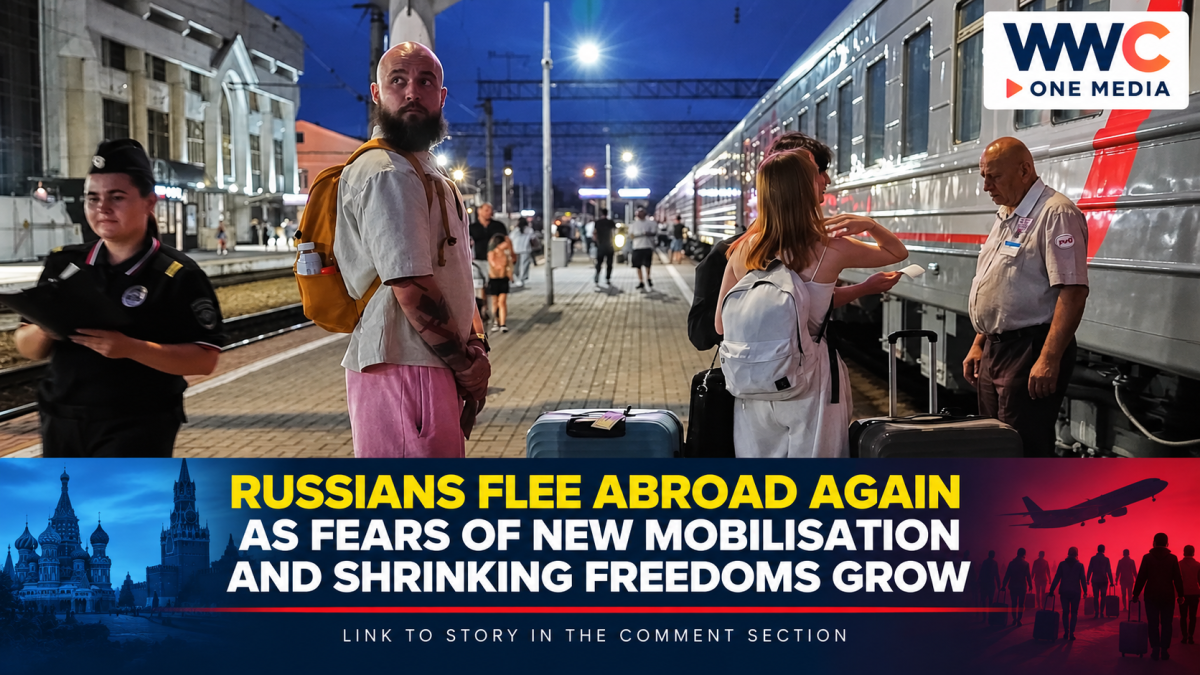
A growing number of Russians are once again preparing to leave the country, driven by fears of a new military mobilisation, worsening restrictions on daily life and a steady erosion of personal freedoms.
The latest wave is nowhere near the scale of the mass exodus that followed Russia’s 2022 mobilisation, when hundreds of thousands of people fled the country.
But organisations supporting Russian emigrants say interest in leaving has risen sharply in recent months, suggesting that anxiety over the war in Ukraine and the direction of Russian society is spreading.
Emigration inquiries surge
Kovcheg, a group that helps Russians relocate abroad, reported receiving nearly eight times as many inquiries in August as it did in May.
The organisation said the increase does not necessarily mean that huge numbers of people are currently crossing Russia’s borders.
Instead, many are researching their options, preparing documents and considering whether they should leave before circumstances become more difficult.
Anastasia Burakova, who founded Kovcheg, said the organisation was seeing people actively preparing for emigration rather than simply discussing the possibility.
The surge has coincided with growing speculation that Russia could announce another mobilisation after its parliamentary elections.
The Kremlin has repeatedly rejected claims that a new mobilisation is imminent.
Nevertheless, the rumours have become a significant source of anxiety for Russians of military age.
Memories of the 2022 mobilisation remain fresh
For many potential emigrants, the fear is rooted in what happened in September 2022.
President Vladimir Putin announced a partial mobilisation of about 300,000 reservists, prompting thousands of men to leave Russia within days.
Border crossings became crowded, flights to visa-free destinations sold out and ticket prices surged.
Four years later, memories of that episode remain strong.
Some Russians who returned after leaving in 2022 are now considering leaving again because they fear that another mobilisation could happen with little warning.
A 28-year-old digital marketing worker who recently left Russia for Georgia said he had previously departed in 2022 to avoid being called up.
He returned in 2025 but decided to leave again after growing concerned about military mobilisation, restrictions on internet access and the broader political environment.
For him, the uncertainty itself has become a reason to stay abroad.
Internet restrictions add to the pressure
The war has also transformed how Russians access information and conduct everyday business online.
Thousands of websites, platforms and digital services have been blocked or restricted by Russian authorities.
More recently, authorities have cited security concerns following Ukrainian drone attacks to justify tighter restrictions on internet connectivity.
For Russians working remotely or running businesses that depend on international platforms, the restrictions can create practical difficulties.
The digital marketing worker who moved to Georgia said he increasingly had to switch VPN servers simply to access services required for his work.
For some, the issue has therefore moved beyond politics and into everyday economic life.
Ukrainian drone attacks fuel anxiety
Russia has also experienced a sharp increase in Ukrainian drone attacks during the war.
The attacks have struck infrastructure and industrial facilities in several parts of the country and have contributed to disruptions in fuel supplies.
The resulting uncertainty has reinforced fears that the war is becoming increasingly difficult to contain within Ukraine.
For Russians already worried about mobilisation, the attacks provide another reason to question what the coming months could bring.
Some families fear being separated
Potential emigrants include not only people opposed to the war but also ordinary families concerned about compulsory military service.
One young Moscow woman who recently left Russia said she feared her husband could be drafted after losing his deferment following the completion of his master’s degree.
Her father had previously avoided being drafted in 2022 by leaving the country.
The family now fears that her husband could face the same situation.
Other young Russians have also expressed concern about reports that conscripts or other men pressured into military service could eventually be sent to the battlefield.
For some families, leaving the country is therefore viewed less as a political statement than as a way to avoid potentially irreversible consequences.
Shrinking freedoms push others out
Military mobilisation is not the only reason Russians are leaving.
Some emigrants say they are escaping increasing restrictions on political expression, civil society and personal freedoms.
Daniil Neonov, a queer activist, left Russia after being detained several times and receiving a jail sentence over a social-media post involving a rainbow-coloured image.
Russian authorities have designated what they call the “international LGBT movement” as extremist, creating legal risks for activists and others associated with LGBT-related symbols or activities.
Opposition supporters have also faced increasing pressure.
The liberal Yabloko party, one of the few Russian political groups openly opposing the war, was removed from the parliamentary election ballot after a court decision.
Some supporters who protested against the decision were subsequently detained.
For those people, emigration is increasingly seen as a means of avoiding further confrontation with the authorities.
Georgia and Armenia remain major destinations
Georgia and Armenia have become important destinations for Russians seeking to leave without travelling far from home.
Both countries can be reached relatively easily from Russia, while their proximity allows emigrants to maintain connections with relatives and businesses inside the country.
Tbilisi and Yerevan have consequently developed sizeable Russian expatriate communities since the 2022 invasion.
Armenian officials have also signalled that they would not prevent Russians from entering the country to avoid military service.
That position has angered Moscow, which has criticised neighbouring countries for providing refuge to Russians attempting to evade mobilisation.
Other Russians have moved to Turkey, Kazakhstan, Serbia and destinations farther afield.
The new exodus is different from 2022
Despite the surge in interest, there is an important difference between the current situation and the crisis of 2022.
There are no widespread queues at Russian border crossings and no comparable shortage of flights to visa-free destinations.
The current movement is more cautious and gradual.
People are researching countries, securing accommodation, moving money, obtaining documents and considering temporary relocation before making a final decision.
That makes the scale of the exodus difficult to measure.
Support organisations say the increase in inquiries is nevertheless an important warning sign because it shows that uncertainty is influencing decisions even without an official mobilisation order.
Kremlin continues to deny a new mobilisation is planned
Russian officials have repeatedly dismissed speculation about another mass mobilisation.
The Kremlin has maintained that Russia has sufficient manpower through its contract recruitment system and has no immediate need for another nationwide call-up.
But reports of recruitment pressures, large financial incentives for new soldiers and alleged coercion have kept mobilisation fears alive.
With the war continuing into its fifth year, Russia faces the challenge of sustaining its military campaign while maintaining domestic stability.
That has created a difficult environment in which official reassurances compete with rumours circulating through social media and private conversations.
A growing test for Russia’s future
The renewed interest in emigration highlights a broader problem for the Kremlin.
People are leaving for different reasons: fear of military service, opposition to the war, concerns about internet restrictions, political repression, economic uncertainty or simply a desire for greater personal freedom.
Not all of those preparing to leave are committed political opponents.
Some are ordinary professionals and families who simply do not want to gamble their futures on what might happen next.
The numbers remain far below the dramatic exodus of 2022.
But the renewed desire among Russians to prepare an escape route shows that memories of mobilisation and repression have not disappeared.
As the war continues and fears over another mobilisation persist, Russia may once again face a difficult choice between retaining its population and maintaining the policies that are pushing some of its citizens to look for a future elsewhere.




Leave a Reply