
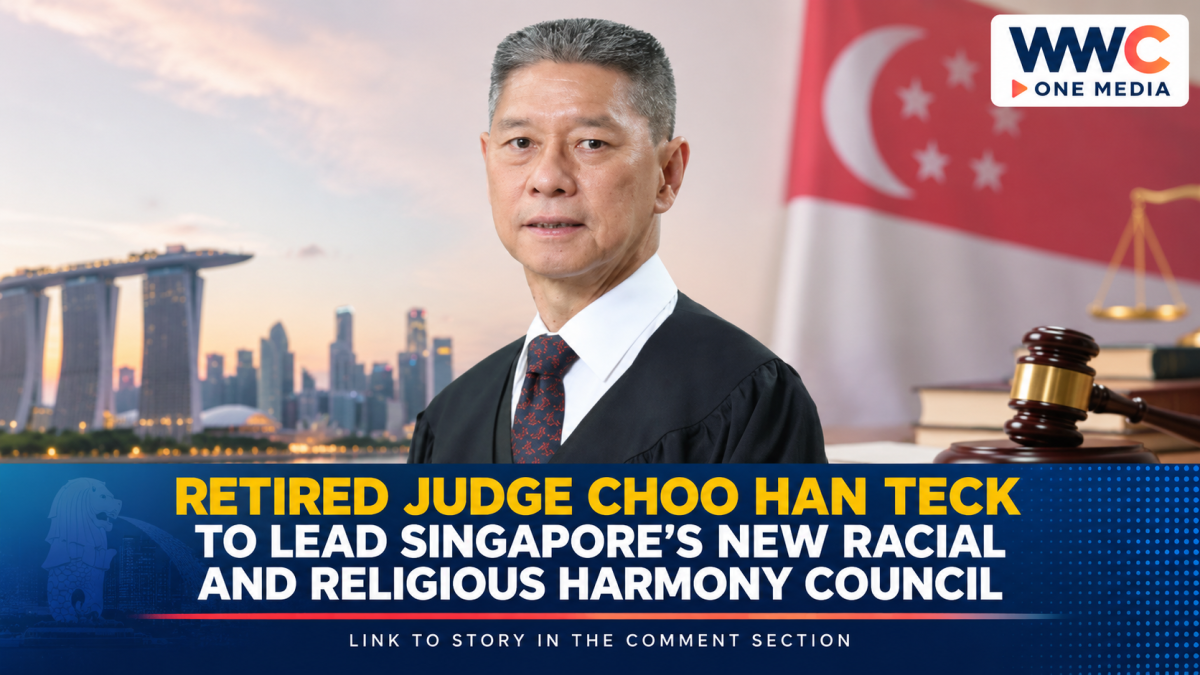
Retired Supreme Court judge Choo Han Teck has been appointed chairman of Singapore’s new Presidential Council for Racial and Religious Harmony, a body that will play a key role in the country’s strengthened legal framework for protecting social cohesion.
The new council begins its inaugural three-year term on Sept. 15, the same day Singapore’s Maintenance of Racial Harmony Act comes into force.
The council replaces the existing Presidential Council for Religious Harmony and expands its remit to cover both racial and religious harmony.
New council takes effect alongside tougher racial-harmony law
The new council comes as Singapore introduces a broader legal framework aimed at dealing with threats to racial harmony.
Under the Maintenance of Racial Harmony Act, the Minister for Home Affairs can issue restraining orders against people who communicate, produce or distribute content that prejudices Singapore’s racial harmony.
Such orders can restrict the communication or distribution of specified material, require content to be removed and, in certain circumstances, prevent individuals from holding editorial positions or contributing to specified publications.
The powers are designed to allow authorities to act quickly when potentially inflammatory material could spread widely, particularly online.
Council will provide independent advice
The Presidential Council for Racial and Religious Harmony will be responsible for exercising independent judgement and working collectively to advise on issues affecting racial and religious harmony in Singapore.
It will also consider and make recommendations to the President on restraining orders issued under the new racial-harmony law or under the existing Maintenance of Religious Harmony Act.
The council can also consider and report to the Minister for Home Affairs or Parliament on matters concerning racial or religious harmony when referred to it.
Its role is therefore intended to provide an additional layer of independent review within Singapore’s legal framework.
Choo Han Teck brings more than three decades of public service
Justice Choo Han Teck retired from the Supreme Court on Feb. 20, 2026, after more than three decades in public service.
He was appointed a Judicial Commissioner in 1995 and became a Supreme Court judge in 2003.
Chief Justice Sundaresh Menon previously described Choo as a judge with exemplary judicial temperament.
His appointment places a senior former member of the judiciary at the head of a council dealing with some of Singapore’s most sensitive issues involving race, religion and social cohesion.
Council brings together religious and community leaders
The new council includes representatives from Singapore’s major racial and religious communities, alongside individuals with experience in public service and community relations.
Its members include Buddhist, Hindu, Muslim, Christian and Taoist representatives, as well as figures from Singapore’s Eurasian, Chinese and other communities.
Among them are Mufti of Singapore Nazirudin Mohd Nasir, Archbishop William Goh, Hindu Advisory Board chairman K. Sengkuttuvan and Singapore Buddhist Federation president Seck Kwang Phing.
The broad membership is intended to give the council a range of perspectives when assessing issues that could affect Singapore’s multicultural society.
New law also targets foreign influence
The legislation is not focused only on offensive racial content.
It also introduces safeguards intended to protect Singapore’s race-based organisations from foreign interference.
Around 300 clan associations and business associations are expected to be designated as “race-based entities”.
These organisations will be required to disclose certain donations from foreign principals and anonymous donors.
The government has said the measures are intended to prevent external actors from exploiting community organisations to influence Singapore’s domestic social environment.
Less serious offences may qualify for community remedial measures
The new framework also introduces a community remedial initiative.
People involved in less serious conduct that prejudices racial harmony may be offered an opportunity to repair community ties instead of immediately facing prosecution.
Successful completion of the programme can be taken into account when deciding whether formal charges should proceed.
The approach reflects Singapore’s attempt to combine enforcement with measures aimed at repairing relationships between communities.
Why the changes matter
Singapore has long treated racial and religious harmony as a core part of its national security and social stability.
The country’s population is made up of several major ethnic and religious communities, making tensions involving race or religion particularly sensitive.
The government has repeatedly warned that inflammatory material can spread rapidly through social media and online platforms, potentially turning a local incident into a much wider conflict.
The new law therefore gives authorities stronger powers to intervene before such tensions escalate.
A stronger role for the President and council
The new framework also gives the President and the council an important constitutional role in reviewing restraining orders.
If the council’s recommendation differs from the Cabinet’s advice, constitutional provisions allow the President to confirm, cancel or vary the order under the prescribed process.
That creates an additional institutional safeguard around the use of the new powers.
The council’s composition is also designed to ensure that decisions affecting racial and religious harmony are considered from multiple community perspectives.
Singapore enters a new phase of racial-harmony protection
The creation of the Presidential Council for Racial and Religious Harmony marks a significant expansion of Singapore’s existing approach to managing racial and religious tensions.
For more than three decades, the Presidential Council for Religious Harmony has operated under the Maintenance of Religious Harmony Act.
The new structure brings racial harmony into the same broader framework while adding new powers covering online and other forms of potentially harmful content.
With Choo Han Teck at the helm, the council now begins its first three-year term at a time when social tensions can spread rapidly through digital platforms.
Its central challenge will be balancing strong protection of Singapore’s multicultural society with the careful and independent exercise of the powers entrusted to it.




Leave a Reply