
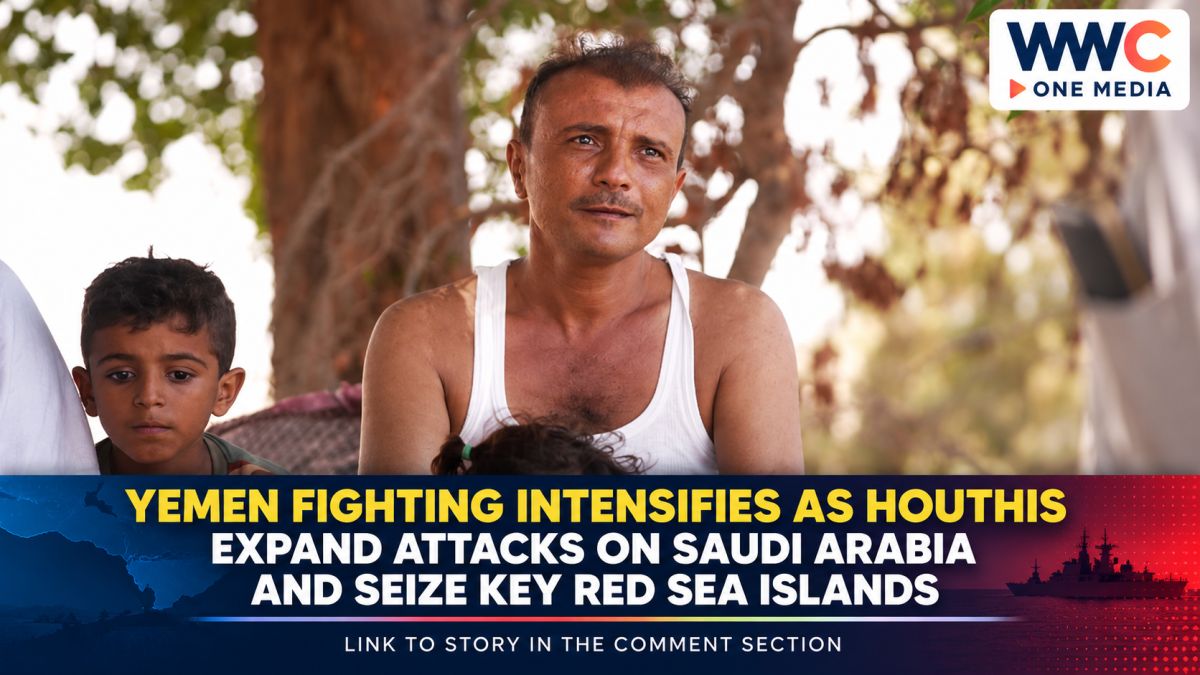
Fighting in Yemen is rapidly intensifying as Iran-aligned Houthi forces expand their offensive along the country’s Red Sea coast and launch fresh missile and drone attacks against Saudi Arabia, raising fears that the long-running conflict could develop into a wider regional war.
The escalation comes as Yemen’s internationally recognised government and Saudi-backed forces launch counteroffensives against the Houthis across several provinces.
The latest clashes have also taken on greater international significance because the Houthis are moving closer to the Bab al-Mandeb Strait, one of the world’s most important maritime chokepoints.
Houthis launch fresh attacks on Saudi Arabia
The Houthis have launched a new series of missile and drone attacks against Saudi Arabia, including strikes targeting a military airbase in Khamis Mushait.
Saudi authorities said 13 civilians were injured in the latest attacks.
The new strikes follow a much larger Houthi assault earlier this month that Saudi Arabia said wounded 73 people in the cities of Abha, Khamis Mushait, Jizan and Najran.
The Houthis have said their attacks are retaliation for Saudi military operations against their positions in Yemen.
Saudi Arabia, meanwhile, has warned that it will defend its territory and interests while leaving the door open to diplomacy.
The repeated attacks are nevertheless increasing pressure on Riyadh to respond more forcefully.
Yemen’s government launches counteroffensive
The escalation is not limited to attacks on Saudi territory.
Yemen’s internationally recognised government has launched a broad military campaign against Houthi positions, with fighting reported across Taiz, Marib, Al Jawf, Al Bayda and Hodeidah.
Government forces have claimed advances on several fronts, including areas west of Taiz.
The Houthis have also claimed to have repelled government advances and inflicted casualties.
Because the battlefield is changing rapidly, many of the competing claims from both sides cannot be independently verified.
What is clear is that the conflict has entered its most serious phase since the large-scale fighting that was largely halted by a UN-brokered truce in 2022.
Houthis seize strategic Red Sea islands
One of the most significant developments has been the Houthis’ reported seizure of Greater Hanish and Lesser Hanish, two strategically located islands in the Red Sea.
The islands sit near vital maritime routes leading toward the Bab al-Mandeb Strait.
Control of these locations could give the Houthis greater ability to monitor and potentially threaten shipping passing through the region.
The group has also been pushing along Yemen’s western coastline toward areas near the strait.
That gives the latest offensive a strategic dimension that goes far beyond the internal Yemeni power struggle.
Bab al-Mandeb has become a critical pressure point
The Bab al-Mandeb Strait connects the Red Sea with the Gulf of Aden and provides a crucial route between Europe and Asia.
Its importance has increased dramatically because the Strait of Hormuz has effectively been closed amid the wider regional conflict.
Saudi Arabia has therefore become more dependent on routes through the Red Sea to move oil to international markets.
That has made Houthi control or disruption around Bab al-Mandeb particularly sensitive for Riyadh and global energy markets.
The waterway carried an average of roughly 4.1 million barrels of crude oil and petroleum products a day in 2024, equivalent to about 5 per cent of global flows.
Saudi oil infrastructure is already under pressure
The Yemen escalation comes as Saudi Arabia is dealing with another major disruption to its energy infrastructure.
A key East-West oil pipeline was severely damaged in a drone attack attributed to Iran-backed militias in Iraq.
The pipeline carries Saudi crude from the country’s eastern oil fields toward the Red Sea, allowing exports to bypass the Strait of Hormuz.
The damage has forced the pipeline largely offline and could take several weeks to repair.
The disruption has already pushed global oil prices higher, adding to fears that further attacks on Saudi infrastructure could tighten supplies even more.
US support stops short of direct intervention
Saudi Arabia has sought US military assistance as the Houthi attacks have intensified.
Saudi Crown Prince Mohammed bin Salman met US Central Command chief Admiral Brad Cooper in Jeddah to discuss the worsening security situation.
Washington has so far stopped short of authorising direct US strikes against the Houthis.
Instead, the United States has committed intelligence-sharing and targeting assistance to Saudi Arabia.
The restraint reflects the wider risk that direct American military involvement could open another major front in an already expanding regional conflict.
Gulf-Iran diplomacy is now under strain
The escalation has also disrupted diplomatic efforts involving Iran and the Gulf states.
A planned meeting between Gulf Arab countries and Iran to discuss a temporary arrangement for commercial shipping through the Strait of Hormuz was postponed.
Saudi Arabia was reported to have requested the delay.
The diplomatic setback is significant because the talks were intended to find a way to ease pressure on one of the world’s most important oil and shipping routes.
Instead, the worsening Yemen conflict has deepened mistrust between Saudi Arabia and Iran.
Iran’s role remains central
The Houthis are closely aligned with Iran and have received substantial military and political support from Tehran.
Iran denies directly controlling Houthi military operations, but the group is widely considered one of the most important members of Iran’s regional network of allied armed groups.
The conflict therefore risks becoming another battleground in the broader confrontation between Iran and Saudi Arabia.
The Houthis’ growing presence along the Red Sea also gives Tehran-aligned forces influence over a second major maritime chokepoint after the Strait of Hormuz.
That combination has alarmed Gulf governments and international energy markets.
Yemen’s humanitarian crisis is worsening
The military escalation is also producing a growing humanitarian disaster.
Thousands of Yemenis have been forced from their homes as fighting spreads across western and central parts of the country.
Recent fighting has displaced tens of thousands of people, many of whom had already been displaced multiple times by earlier rounds of conflict.
The World Health Organization has reported hundreds of people killed or wounded since the latest escalation began.
Aid agencies have warned that continued fighting could worsen food insecurity, damage already fragile healthcare systems and make it increasingly difficult to reach communities trapped in conflict zones.
The conflict is becoming regional
Yemen’s war was once primarily viewed as a domestic conflict involving the Houthis and the internationally recognised government.
That description is becoming increasingly inadequate.
The Houthis are now directly attacking Saudi Arabia, while Saudi-backed forces are conducting operations inside Yemen.
The group is also expanding toward the Red Sea’s strategic shipping routes, while Iran remains a major Houthi ally.
At the same time, the United States is providing support to Saudi Arabia and the wider Middle East is already experiencing severe instability.
The result is a conflict that increasingly connects Yemen’s battlefield with the security of global shipping and energy supplies.
A dangerous fight over the Red Sea
The next phase of the conflict could depend heavily on whether the Houthis can maintain their advances toward Bab al-Mandeb and whether Saudi Arabia decides to escalate its military response.
If fighting reaches the strategic shipping corridor, the consequences could extend far beyond Yemen and Saudi Arabia.
Disruption around Bab al-Mandeb, combined with continuing restrictions around Hormuz and damage to Saudi oil infrastructure, could place extraordinary pressure on global energy markets.
For Yemen itself, however, the consequences are even more immediate.
After years of war, economic collapse and humanitarian suffering, another prolonged escalation threatens to push millions of civilians deeper into crisis.
The latest fighting therefore represents more than another chapter in Yemen’s civil war. It is becoming a struggle over territory, regional power and two of the world’s most important energy and shipping corridors — with the potential to reshape the wider Middle East.




Leave a Reply