
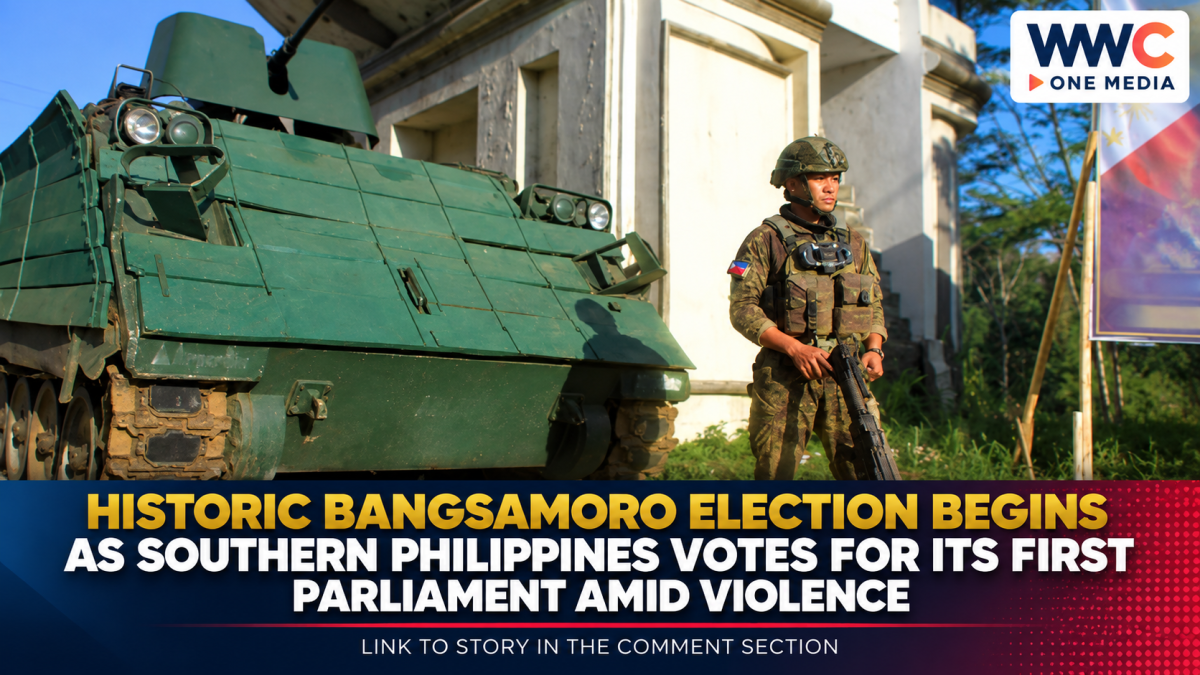
The Bangsamoro Autonomous Region in Muslim Mindanao has held its first parliamentary elections, marking a historic step toward self-government after decades of insurgency, political conflict and violence in the southern Philippines.
Nearly 2.4 million registered voters were eligible to take part in the Sept. 14 election, which will determine the members of the region’s first elected parliament.
The landmark vote is the latest and most significant stage in a peace process that transformed the region from a long-running insurgency into an autonomous government with its own political institutions.
But the historic election was also overshadowed by violence and allegations of ballot tampering in several areas.
First parliamentary election marks a new era
The Bangsamoro Autonomous Region in Muslim Mindanao, commonly known as BARMM, was established following a 2014 peace agreement between the Philippine government and the Moro Islamic Liberation Front, or MILF.
The agreement represented a major shift in the decades-long conflict.
Instead of pursuing an independent Muslim state, the MILF agreed to pursue greater autonomy within the Philippines. The peace process eventually led to the creation of BARMM in 2019.
The region had been governed by an interim parliament during the transition.
The 2026 election is intended to replace that transitional arrangement with an elected parliamentary government.
80 seats are up for grabs
Voters are choosing representatives for an 80-seat Bangsamoro Parliament.
The parliament will consist of representatives from political parties, parliamentary districts and sectors of society.
Unlike the presidential and congressional system used elsewhere in the Philippines, BARMM operates under a parliamentary structure.
The parliament will have broad authority over regional legislation and governance and will also choose the region’s chief minister.
That makes the election particularly important because the outcome will determine not only the composition of the legislature but also the political leadership of the autonomous government.
Violence casts a shadow over the historic vote
The election was preceded by deadly violence in Cotabato City.
A shooting late on Sept. 13 killed three people and wounded 15 others, prompting the Commission on Elections to place the city under its control.
A separate incident at a polling centre on election day resulted in another death, according to authorities.
There were also reports of other security incidents, including an explosion and gunfire.
Despite the violence, election officials said the overall voting process remained generally peaceful and that most polling stations were able to open.
More than 20,000 police officers and soldiers were deployed across the region to provide security.
Pre-shaded ballots cause voting delays in Basilan
The election also faced a serious ballot problem in Maluso, Basilan.
Authorities discovered pre-shaded ballots in 36 of the municipality’s 68 precincts.
The Commission on Elections ordered replacement ballots to be printed and placed Maluso under its direct control.
Voting in the affected area was delayed while officials secured the replacement ballots and prepared them for distribution.
The discovery raised concerns about possible attempts to influence the election before voters even entered polling stations.
Election officials said those responsible would be investigated and held accountable.
A region shaped by decades of conflict
The significance of the election can only be understood against the history of Mindanao.
For decades, the southern Philippines was affected by armed conflict between the government and various Muslim separatist groups.
Thousands of civilians and combatants were killed over the years, while poverty and underdevelopment remained particularly severe across many parts of Mindanao.
The region also became associated with extremist groups linked to al-Qaida and Islamic State.
In 2017, militants aligned with Islamic State seized large parts of Marawi City, triggering a five-month military campaign that destroyed much of the city’s urban centre.
The conflict killed more than 1,100 people, most of them militants, and displaced tens of thousands of residents.
The peace agreement changed the political landscape
The 2014 peace agreement with the MILF was designed to address many of the political and economic grievances that had fuelled the insurgency.
Under the agreement, the MILF abandoned its demand for an independent state in exchange for greater regional autonomy.
Thousands of former fighters were expected to leave the battlefield and transition into civilian life.
The creation of BARMM was therefore intended to provide a constitutional and political pathway for resolving a conflict that had resisted military solutions for generations.
The first parliamentary election represents a critical test of whether that political transition can succeed.
Former rebels and political clans compete for power
The election features a mixture of former rebel leaders, regional political parties, traditional political clans and other candidates competing for influence.
That creates a complicated political landscape.
While the peace process has transformed the role of former combatants, traditional clan politics remain deeply influential in parts of Mindanao.
Political analysts have warned that the success of the parliamentary system will depend on whether political parties can develop beyond personalities, family networks and local power structures.
The election is therefore not simply about choosing lawmakers. It is also a test of whether parliamentary politics can take root in a region where political power has historically been shaped by armed groups, clans and local alliances.
Voters hope for peace and development
For many voters, the election carries expectations that go beyond political representation.
The region remains among the poorer parts of the Philippines, and residents continue to face challenges involving employment, infrastructure, education, healthcare and investment.
Young voters in particular have grown up in an environment shaped by conflict and political instability.
The new parliament will be expected to demonstrate that autonomy can deliver tangible improvements to everyday life.
For supporters of the peace process, better governance and economic development are essential to preventing a return to armed conflict.
Election delays had tested patience
The first regular BARMM parliamentary election had been postponed several times, extending the region’s transition period.
The election was eventually reset for Sept. 14, 2026, under legislation signed earlier this year.
That long delay increased the importance of the vote.
For years, the region had operated under an interim political structure rather than a fully elected parliamentary government.
The election now offers voters the opportunity to directly choose the politicians who will govern the autonomous region.
The next test comes after the ballots
The election itself is only the beginning of BARMM’s political transition.
Once the results are finalised, the newly elected parliament will choose a chief minister who will head the regional executive.
The new government will then face the much harder task of turning political autonomy into functioning institutions and economic progress.
It will also have to maintain the peace process, address remaining security concerns and manage political divisions among former rebel factions and traditional power holders.
The government in Manila, meanwhile, will be watching closely to ensure that the autonomous region remains within the framework established by the peace agreement.
A turning point for the southern Philippines
The first Bangsamoro parliamentary election represents one of the most important political milestones in the southern Philippines in decades.
The region has moved from armed separatism toward elected self-government, but the violence and election irregularities surrounding the vote show how fragile that transformation can remain.
The challenge now is to prove that the ballot box can succeed where decades of conflict failed.
If the new parliament can establish credible institutions, improve living conditions and preserve the peace agreement, the election could become a defining moment in the region’s transition from insurgency to self-rule.
For millions of Bangsamoro voters, the historic vote is ultimately about whether the promise of peace can finally translate into a government chosen by the people and capable of delivering a more stable future.

Leave a Reply