
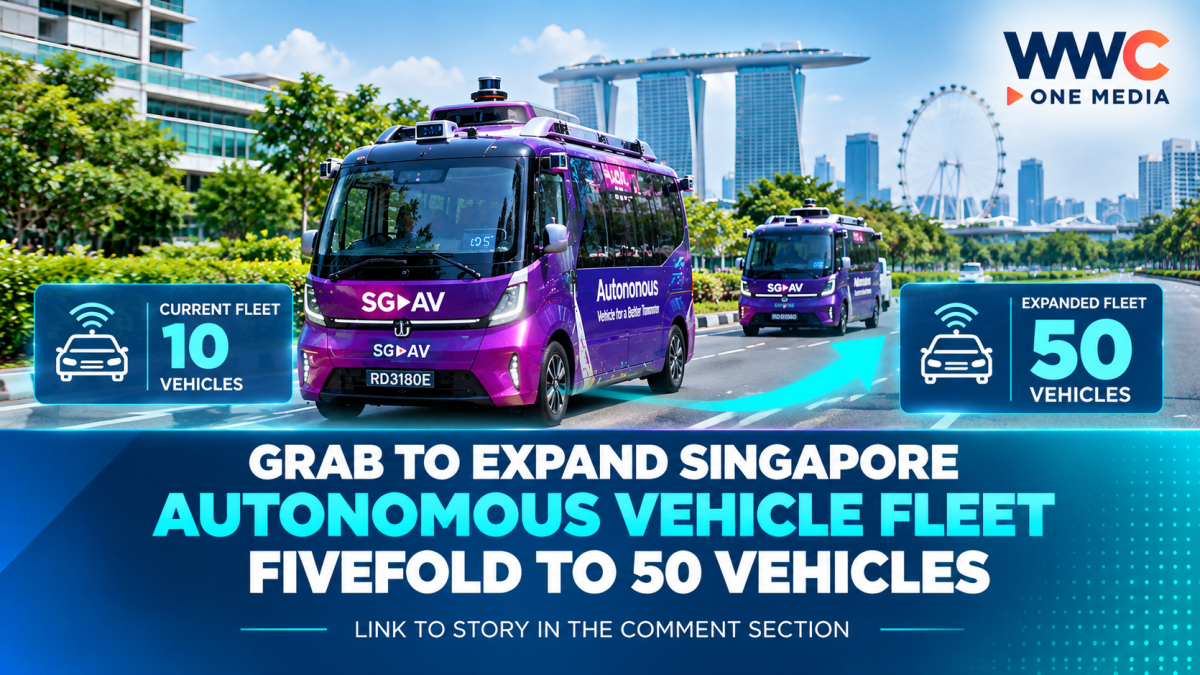
Grab is set to dramatically expand its autonomous vehicle fleet in Singapore, increasing the number of self-driving vehicles from 10 to 50 as the ride-hailing company prepares to broaden its autonomous transport services beyond Punggol.
The fivefold expansion comes after months of testing and public operations of Grab’s autonomous vehicle service, marking another major step in Singapore’s push to integrate driverless technology into everyday transport.
Grab launched its Ai.R autonomous public ride service in Punggol in April, giving members of the public access to self-driving shuttle rides along designated routes.
Fleet expansion follows thousands of rides
The autonomous service has gained significant experience since beginning community trials earlier this year.
Grab said its autonomous fleet has already served more than 9,000 unique riders since the start of 2026 and clocked about 90,000 kilometres of autonomous driving on Singapore roads.
The company said feedback from passengers has also been encouraging, with 99 per cent of respondents in post-ride surveys conducted with the Land Transport Authority indicating that they felt safe during their rides and would recommend the service to others.
Passengers, however, also highlighted areas where they wanted improvements, including more destinations, direct connections and greater flexibility when booking rides.
Those requests are now shaping the next stage of Grab’s autonomous transport strategy.
From fixed shuttle routes to on-demand rides
Grab currently operates autonomous shuttles along fixed routes in Punggol.
The company is preparing to introduce an on-demand autonomous vehicle service that will allow riders to book a dedicated vehicle between existing pick-up and drop-off points rather than following a fixed shuttle loop.
The pilot is expected to begin with trial users before gradually becoming available to the wider public in the fourth quarter of 2026, when commercial fares will apply.
The service is intended to improve connections between residential areas and important destinations such as schools, markets, medical clinics and transport hubs, including Punggol Coast MRT station.
The planned fleet expansion will give Grab more capacity as it develops these services.
Grab eyes expansion beyond Punggol
Punggol has effectively become Singapore’s testing ground for autonomous public transport.
Grab’s Ai.R service currently uses autonomous vehicles developed by Chinese self-driving technology company WeRide, including the five-seater GXR and the eight-seater Robobus.
The initial deployment was deliberately limited to selected routes while the companies gathered data and feedback and worked with Singapore’s transport authorities.
With the fleet now set to grow substantially, Grab is expected to have greater flexibility to expand its autonomous operations beyond the current Punggol network.
The company has not indicated that every one of the 50 vehicles will immediately be deployed across Singapore, with the expansion likely to be carried out progressively as regulatory approval and operational readiness allow.
Driverless vehicles will not necessarily mean fewer jobs
The rapid expansion of autonomous transport has raised questions about the future of taxi and private-hire drivers.
Singapore authorities have said the country’s transition towards autonomous vehicles will be accompanied by measures to help existing drivers adapt to changing roles.
Grab has already created new positions linked to its autonomous fleet, including Safety Operator and Remote Operator roles.
The company has also been working with WeRide to train interested driver-partners for positions in the emerging autonomous vehicle ecosystem.
This means the transition is not being framed simply as replacing human drivers with machines, but also as creating new technical and operational roles around autonomous transport.
Singapore accelerates autonomous transport push
The expansion comes as Singapore moves ahead with plans to make autonomous vehicles a larger part of its transport network.
Authorities have described autonomous vehicles as a potential way to address manpower constraints while improving connectivity and the efficiency of moving people and goods.
Fixed-route autonomous shuttle services have already been introduced progressively in Punggol, with public rides beginning in 2026.
Singapore is also developing policies and safety frameworks to determine how autonomous vehicles can operate alongside conventional cars, buses, taxis and private-hire vehicles.
For Grab, expanding from a small pilot fleet to 50 vehicles represents a significant escalation in its commitment to the technology.
A major test for Singapore’s driverless future
Grab’s next phase will test whether autonomous transport can move beyond limited demonstrations and become a practical part of everyday commuting.
The company will have to balance convenience, safety, passenger demand and operating costs while working within Singapore’s regulatory framework.
If the larger fleet performs successfully, it could pave the way for autonomous ride services to expand to more neighbourhoods and eventually operate on a much wider scale.
For commuters, the change could eventually mean more flexible transport options without a human driver behind the wheel.
For Singapore’s transport industry, the fivefold fleet expansion signals that driverless mobility is moving from an experimental concept towards a more permanent part of the country’s urban transport landscape.




Leave a Reply