
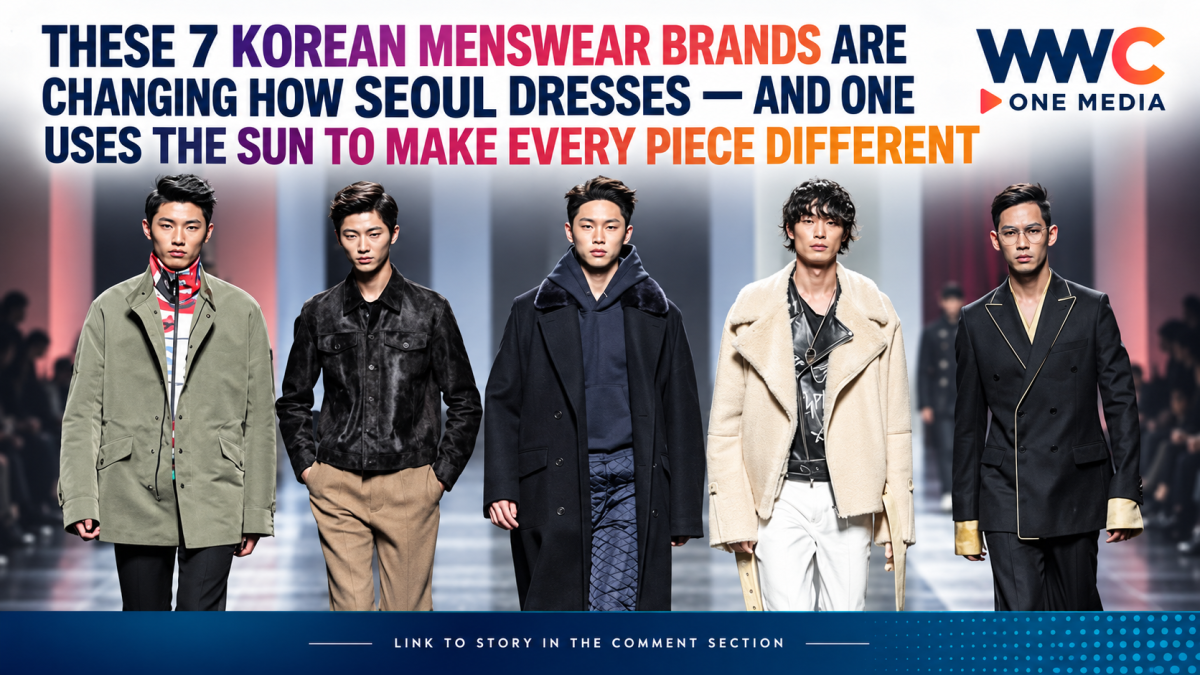
SEOUL — For years, the global conversation around Korean fashion has tended to follow a familiar formula: K-pop idols, oversized streetwear, Ader Error and whatever jacket happened to appear in the latest hit K-drama.
That picture is becoming outdated.
A new generation of South Korean labels is building something far broader — moving from experimental techwear and naturally weathered fabrics to understated tailoring that would look just as convincing in Milan, Tokyo or Paris.
And increasingly, international fashion is paying attention.
Seoul Fashion Week’s Spring/Summer 2027 edition, staged earlier this month, brought more than 100 Korean labels into its trade program and attracted international buyers as the city continues its push to turn cultural influence into a serious fashion-export business. Earlier in 2026, Seoul’s Fall/Winter trade show recorded US$7.54 million in order consultations involving 99 buyers from 23 countries, according to the Seoul Metropolitan Government.
Vogue’s latest reporting from Seoul describes a scene where sleek minimalism collides with gothic styling, chains, neckties, unconventional proportions and experimentation — another reminder that there is no longer a single identifiable “Korean look.”
That is precisely why these seven menswear labels deserve attention.
1. JiyongKim: Clothes deliberately left outside in the sun
Start with perhaps the most conceptually distinctive name on the list.
JiyongKim, founded by designer Kim Ji-yong in 2021, has developed an international reputation around something fashion normally tries desperately to prevent:
sun damage.
Kim deliberately exposes garments and fabrics to sunlight for extended periods, allowing ultraviolet light, weather and time to bleach the material naturally.
The result is impossible to reproduce perfectly. Different sections fade at different rates, creating irregular colours and patterns — meaning individual pieces can emerge with their own character.
JiyongKim says the technique uses prolonged sunlight rather than chemical bleaching, turning the passage of time itself into part of the design process.
Kim arrived at the concept after studying at Bunka Fashion College in Tokyo and Central Saint Martins in London. His résumé later included experience with Lemaire and Louis Vuitton, while his label became one of 20 semi-finalists for the 2024 LVMH Prize for Young Fashion Designers.
His rise has continued rapidly.
Samsung named him winner of its 19th Fashion & Design Fund award in late 2023, highlighting both the originality and environmental qualities of his work. Samsung said the award included US$100,000 in support.
Vogue reported this year that JiyongKim is now stocked internationally and has worked with companies including Puma and Kolon Sport. The designer is also deliberately limiting production of some sun-bleached garments because of how labour- and time-intensive the technique is.
This is Korean menswear at its least mass-produced.
The fading isn’t a defect.
It’s the entire point.
2. Pottery: The antidote to disposable fashion
At the opposite end of the visual spectrum is Pottery, also styled PTRY.
There are no elaborate deconstructed panels or futuristic fabrics fighting for attention here.
Instead, Pottery concentrates on the difficult things that minimalist clothes have nowhere to hide: fabric, proportion, construction and fit.
Think relaxed tailored trousers, clean shirts, blazers, restrained knitwear and substantial coats — pieces designed to survive the fashion cycle rather than dominate it.
CNA Lifestyle places Pottery somewhere between traditional workwear and smart casual, with tailoring relaxed enough to move easily between an office and weekend wardrobe.
It illustrates a wider shift happening in Korean fashion.
Not every successful Seoul brand is trying to become louder.
Some are becoming quieter — but more precise.
Vogue has identified a similar dynamic at Amomento, another Seoul label that has gained attention for neutral colours, unusual proportions and relatively trend-resistant designs. The publication reported in April that Amomento had reached around US$15 million in annual brand revenue and was expanding internationally.
That commercial momentum suggests Korean minimalism is no longer merely a domestic niche.
3. San San Gear: What happens when hiking clothes meet science fiction
Then there is San San Gear, where practicality starts getting strange.
The Seoul label operates in the space between technical outdoor wear, streetwear and futuristic design.
Trousers may feature curved seams, sculptural legs, straps and adjustable hardware. Jackets use intricate piping and panelling. Rather than depending heavily on bright prints, much of the visual drama comes from construction and texture.
The aesthetic makes sense in a menswear market increasingly comfortable mixing performance clothing with everyday fashion.
What was once specialist hiking equipment has spent years migrating into streetwear — the movement widely labelled gorpcore — but Korean designers frequently take that crossover somewhere more experimental.
San San Gear has also expanded its reach through collaborations associated with Puma, ASICS, League of Legends and NCT Wish, according to CNA Lifestyle.
The result doesn’t look like traditional outdoor clothing.
It looks like someone designed a hiking wardrobe for a city that hasn’t been built yet.
4. Insilence: Minimalism without becoming invisible
Minimalist fashion has one obvious problem:
Take away prints, logos and embellishment, and badly designed clothes become painfully easy to spot.
Insilence has built its identity around avoiding that trap.
Founded in 2013, the Korean label works largely in restrained shades — black, charcoal, beige, khaki and navy — while making silhouette the feature.
Oversized coats, boxy jackets, straight trousers and carefully controlled proportions create the interest that logos would normally provide.
There is another reason the aesthetic feels particularly current.
Menswear globally has spent much of the past several years moving away from the ultra-slim silhouettes that dominated the 2010s.
The Korean interpretation isn’t simply “make everything enormous.”
It is about controlling volume: a wider trouser against a shorter jacket, an oversized outer layer against a cleaner base, or soft tailoring that hangs rather than grips.
That approach was visible again during Seoul Fashion Week this year, where Vogue documented plenty of layered, elongated and proportion-driven street style.
For shoppers who like Korean fashion but don’t necessarily want to look like they walked directly off a K-pop music-video set, Insilence may be one of the easiest entry points.
5. Post Archive Faction: The Korean label that treats clothing like industrial design
If Insilence makes clothes easier to understand, Post Archive Faction seems determined to ask whether clothes need to look familiar at all.
Better known as PAF, the label was launched in 2018 by Dongjoon Lim and Sookyo Jeong.
Lim did not follow a conventional fashion-school path. He studied industrial and spatial design and worked in user-experience design before moving into clothing.
That background is visible everywhere.
PAF pulls familiar garments apart and reconstructs them through asymmetric pattern cutting, curved zippers, distorted pockets, technical fabrics and unusually engineered silhouettes.
The LVMH Prize selected Lim as a 2021 semi-finalist, describing PAF as a label exploring new structural formulas rather than following conventional seasonal collections.
Its international breakthrough has also been helped by a continuing partnership with Swiss performance company On.
On describes the collaboration as an attempt to create a new design language by combining performance materials with PAF’s experimental approach. The partnership has included apparel and reinterpretations of the Cloudmonster running shoe.
That collaboration says something important about the direction of modern menswear.
The old barriers between a running shoe, a technical jacket, a luxury garment and streetwear are collapsing.
PAF sits almost perfectly in the middle.
6. Coor: Why ‘basic’ is becoming a compliment again
Coor proves that understatement can still have personality.
Its name comes from “Common Origins,” and the Seoul label has built its wardrobe around relatively straightforward shapes, restrained colours and minimal branding.
The distinguishing features are mostly in the details: fabric choices, oversized proportions, washed finishes and carefully controlled silhouettes.
SSENSE describes the label as founded in 2017 and built around simplicity, balance and understated tailoring, with outerwear playing a particularly important role in its collections.
That might sound almost too sensible in an era dominated by attention economics.
But therein lies the appeal.
A good leather jacket, clean pair of trousers or well-cut coat doesn’t need to scream that it is fashionable.
And as consumers become increasingly exhausted by microtrends, clothing that can survive multiple seasons may start looking radical in its own way.
7. Tonywack: Tailoring after the office dress code died
Finally, there is Tonywack.
Designer Kim Tae-wan takes classic men’s tailoring and removes much of the corporate stiffness.
The reference points lean toward 1960s and 1970s European menswear: suede, corduroy, narrow vintage influences and jackets with enough structure to sharpen an outfit without turning it into office uniform.
CNA describes the formula neatly: tailored enough for dinner, relaxed enough to work over a tank top or casual knit.
That places Tonywack directly inside one of menswear’s biggest post-pandemic questions:
What is a suit jacket for when fewer men actually need to wear suits?
The answer emerging from Seoul is increasingly simple.
Wear tailoring because it looks good, not because a dress code tells you to.
That small distinction has helped blazers, tailored trousers, ties and formal references return to younger wardrobes — often combined with sneakers, denim, tanks, technical jackets or intentionally casual styling.
Korean coverage of 2026 menswear has similarly highlighted this collision of categories, including oversized hoodies under tailored blazers, wide denim with fitted knits, and track jackets combined with slacks.
Korean menswear’s secret weapon is that there isn’t one Korean aesthetic
That may be the biggest takeaway from these seven brands.
Trying to define Korean menswear with a single look now makes increasingly little sense.
JiyongKim is using sunlight as a textile treatment.
Pottery is refining quiet everyday tailoring.
San San Gear is pushing technical streetwear.
Insilence is manipulating minimalist proportions.
PAF is reconstructing garments almost like industrial objects.
Coor is turning elevated basics into its identity.
Tonywack is making tailoring desirable after traditional business dressing lost much of its authority.
The common denominator isn’t a specific silhouette.
It’s the willingness to combine categories that menswear once kept separate.
CNA’s original feature describes contemporary Korean fashion as thriving on those contradictions: tailoring with streetwear, outdoor clothing with fashion, and minimalist garments with exaggerated proportion.
The broader industry is noticing.
Seoul Fashion Week has been expanding its commercial focus, bringing overseas buyers together with roughly 100 domestic labels. Vogue, meanwhile, described the latest edition as another demonstration of Korean culture’s ability to translate innovation, entertainment and design into global soft power.
And Korean labels no longer need to rely entirely on celebrity exposure to travel overseas.
Amomento is opening stores internationally.
JiyongKim has reached LVMH Prize recognition.
PAF has built a global performance-fashion collaboration with On.
Seoul’s government-backed fashion trade program is generating millions of dollars in prospective international orders.
K-pop may have helped teach the world to look toward South Korea for style.
But the next stage of Korean fashion looks considerably more interesting:
the clothes are beginning to make the argument on their own.




Leave a Reply