
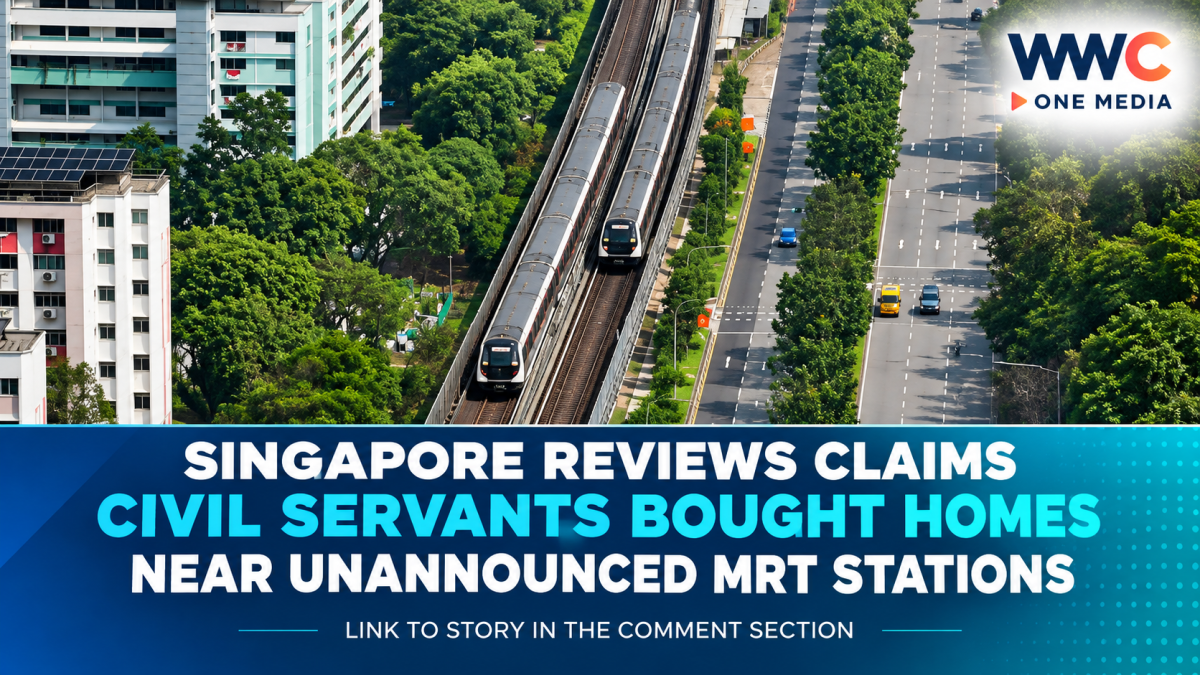
Singapore’s Public Service Division is reviewing an academic paper that alleges some civil servants bought private homes near future MRT stations before the locations were publicly announced.
The paper has raised questions about whether government officials with access to sensitive planning information may have benefited financially from advance knowledge of upcoming rail developments.
The PSD said it is examining the paper’s data and methodology and will refer the matter to the Corrupt Practices Investigation Bureau if there is a material basis to do so.
Study examines property purchases before MRT announcements
The research paper, titled Do Social Norms Substitute for Enforcement? Evidence from Public Officials’ Home Purchases in Singapore, was published as a working paper by the US-based National Bureau of Economic Research in September.
The researchers examined property transactions around planned expansions of Singapore’s MRT network.
They assembled private-property transaction records and linked buyers to the Singapore Government Directory Interactive to identify civil servants and examine their property purchases.
The researchers then focused on transactions made near planned MRT stations before those stations were publicly announced.
Researchers claim civil servants showed unusual buying patterns
According to the paper, property purchases near planned MRT stations were more concentrated among civil servants than among a comparison group of non-civil servants with similar demographic and housing characteristics.
The researchers said the effect was particularly noticeable one to two years before MRT station plans were publicly announced.
They also reported stronger patterns among mid-level officials and employees of agencies connected to rail planning.
The study further claimed that similar patterns appeared among relatives of some officials, which the researchers said could be consistent with the possibility of information being passed on.
However, the findings do not establish that any individual civil servant obtained or misused confidential information.
PSD says integrity concerns are taken seriously
The PSD, which sits under the Prime Minister’s Office, said it takes the allegations seriously and is examining the research.
If its review finds a material basis for possible wrongdoing, the matter could be referred to the CPIB for further investigation.
The distinction is important because the academic paper itself is not an official finding of misconduct.
The PSD’s review will focus on whether the underlying data and methodology support the conclusions drawn by the researchers.
Paper has not been peer-reviewed
The researchers themselves note that the document is a working paper circulated for discussion and comment.
It has not undergone the standard peer-review process used by academic journals, nor has it been reviewed by the NBER board associated with its official publications.
That means its findings should be treated as preliminary rather than established evidence of wrongdoing.
The distinction is particularly important given the seriousness of the allegations involving public officials and potential access to confidential government information.
Why MRT plans can affect property values
Future MRT stations can significantly influence property prices because improved transport connectivity can make nearby neighbourhoods more attractive to residents and investors.
Advance knowledge of an upcoming station could therefore potentially provide a financial advantage to someone purchasing property before the information becomes public.
That is the central issue examined by the researchers.
Their study attempts to determine whether property purchases by public officials show patterns that would be difficult to explain through ordinary investment behaviour alone.
But identifying an unusual statistical pattern is not the same as proving that confidential information was deliberately leaked or misused.
Rail-planning agencies face particular scrutiny
The paper’s finding that the effect was stronger among officials connected to rail planning is likely to attract particular attention.
Employees involved in transport planning can potentially have access to information about infrastructure projects before announcements are made publicly.
Singapore’s public service operates under strict rules governing conflicts of interest, confidentiality and the use of official information.
Any proven misuse of confidential information for personal financial gain could therefore raise serious disciplinary and legal questions.
Review could determine whether further action is needed
The PSD’s review will effectively determine whether the allegations warrant further investigation.
If the department finds weaknesses in the study’s data or methodology, the claims may not provide a sufficient basis for further action.
If the evidence does raise credible concerns, however, the case could be referred to the CPIB, which investigates corruption and related offences in Singapore.
That process would be separate from the academic research itself and would require investigators to establish evidence against specific individuals.
The bigger question is public trust
Beyond the property market, the controversy touches on a broader issue: public confidence in the integrity of Singapore’s civil service.
Singapore has long emphasised strict standards for public officials and strong enforcement against corruption.
The allegation that officials could have benefited from confidential infrastructure plans therefore strikes at the heart of that system.
For now, there is no finding that civil servants committed wrongdoing.
The working paper has raised questions, but the PSD’s review will determine whether those questions are supported by sufficiently strong evidence.
Until that assessment is completed, the claims remain allegations rather than proof of misconduct.



Leave a Reply