
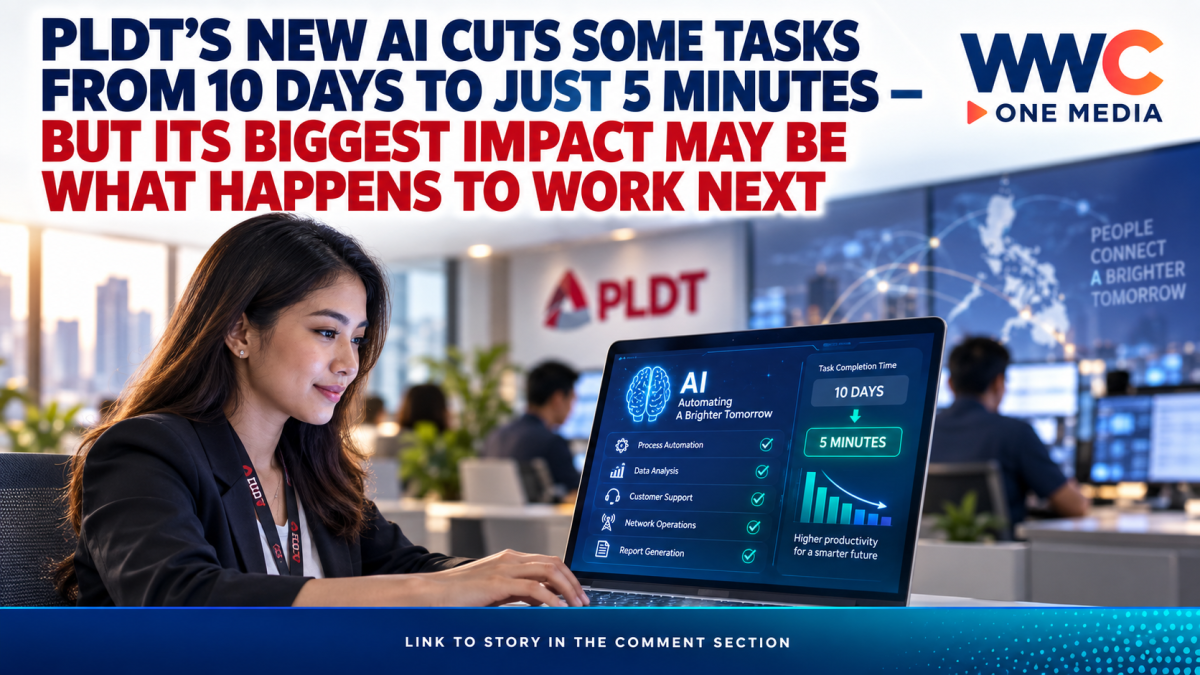
MANILA, Philippines — PLDT is pushing artificial intelligence deeper into its day-to-day operations, deploying UiPath-powered automation tools that the telecommunications giant says can turn some processes that once took days into results delivered in seconds.
The Philippine telecom group has expanded its use of UiPath’s automation and agentic AI platform across knowledge retrieval, enterprise customer support and risk management as demand grows for 5G, broadband and satellite connectivity.
Three systems — KAI, Ellie and ERICA — are now at the center of that push, with PLDT and UiPath reporting substantial reductions in manual work and faster response times.
KAI turns a five-day information hunt into seconds
One of the most striking results comes from KAI, or Knowledge, Automation, Intelligence, an AI assistant built to help PLDT Enterprise teams retrieve product, network and service information.
According to UiPath, tasks that previously required employees to search through documents and other information sources for as long as five days can now generate contextual answers in roughly one to three seconds.
The companies estimate that KAI eliminates about 25,000 to 30,000 hours of manual work every year, representing productivity capacity roughly equivalent to 12 full-time employees.
UiPath’s case study says KAI now handles around 11,000 of 11,300 monthly queries, with responses drawn only from PLDT-approved sources. That restriction is significant because businesses deploying generative AI are increasingly concerned about inaccurate or unsupported responses generated from uncontrolled data.
KAI is not a brand-new experiment. The Philippine Star reported in April that PLDT was introducing the conversational agent for its enterprise operations, describing the rollout as a major Southeast Asian telecommunications deployment of UiPath’s agentic AI technology.
Ellie targets the work behind customer engagements
PLDT is also using Ellie, short for Enablement and Intelligence Engine, as an internal digital assistant for enterprise employees.
The system brings together product information, sales materials, customer-related knowledge and other internal resources so employees can retrieve information and prepare client-facing materials more quickly.
PLDT Enterprise previously described Ellie as an AI-powered workplace assistant accessible through Microsoft Teams, designed to improve productivity, collaboration and customer engagement.
UiPath now says Ellie is reducing manual work by an estimated 25% to 35%, saving roughly 18,000 to 25,000 employee hours annually and allowing some customer responses to be delivered up to 80% faster.
Those figures could make Ellie one of the more commercially significant pieces of PLDT’s AI program because its impact reaches beyond simply answering employee questions. The system can assist with proposal development, product comparisons, solution recommendations and other preparation work involved in enterprise sales and customer support.
ERICA brings AI into one of PLDT’s more sensitive functions
Perhaps the highest-stakes deployment, however, is taking place away from the customer-service front line.
ERICA, or Enterprise Risk Intelligence Companion Agent, was deployed in February 2026 to assist PLDT and Smart with enterprise risk assessments.
The system can synthesize information, generate structured risk statements, score risks and recommend possible treatments.
PLDT and UiPath say complex assessments that previously took two to 10 days can now be completed in anywhere from five minutes to one day, cutting manual effort by an estimated 97% to 99%.
But PLDT has also emphasized an important safeguard: human oversight remains part of the process.
BusinessWorld reported earlier this year that ERICA’s outputs are reviewed and validated by risk professionals, while existing governance systems maintain traceability and accountability. That is particularly important because automated risk scoring can influence decisions with operational, financial and regulatory consequences.
PLDT’s AI strategy is becoming much broader
The UiPath deployment is part of a wider AI transformation unfolding across the PLDT Group.
PLDT Home, for example, has separately introduced AI-powered tools for round-the-clock sales and customer acquisition, allowing potential subscribers to browse offers and begin fiber applications outside normal business hours. Human agents continue handling interactions that require more complex assistance.
Its home broadband business has also rolled out an AI-enabled customer-support platform developed with Amdocs across Sales and Service Centers, targeting faster ticket diagnostics and potentially thousands of hours in reduced customer waiting time each month once fully deployed.
Taken together, the initiatives suggest PLDT is moving beyond the chatbot phase of corporate AI adoption. The bigger goal is to connect AI with actual business workflows — retrieving information, preparing customer responses, analyzing risk and triggering actions rather than merely generating text.
Gilbert Gaw, PLDT and Smart first vice president and head of the IT and Transformation Office, said the UiPath partnership is intended to bring more intelligence into the company’s operations while improving consistency and personalization in customer service.
The numbers are impressive — but context matters
PLDT’s reported gains are substantial, but readers should treat them as company-reported operational estimates rather than independently audited performance results.
TechNode Global noted that PLDT did not disclose the measurement period, sample sizes or detailed methodology behind some of the productivity calculations. It also said the company had not provided an independent audit of the reported savings.
Still, the deployments offer a revealing look at where enterprise AI may be heading.
Instead of asking whether AI can write an email or answer a question, PLDT is testing a much bigger proposition: whether intelligent agents can remove hours — or even days — from operational processes while employees retain control over the decisions that matter most.
And if the reported productivity gains hold as the technology scales, the real story may not be how much work PLDT’s AI can automate.
It may be how dramatically telecom work itself is about to change.




Leave a Reply