
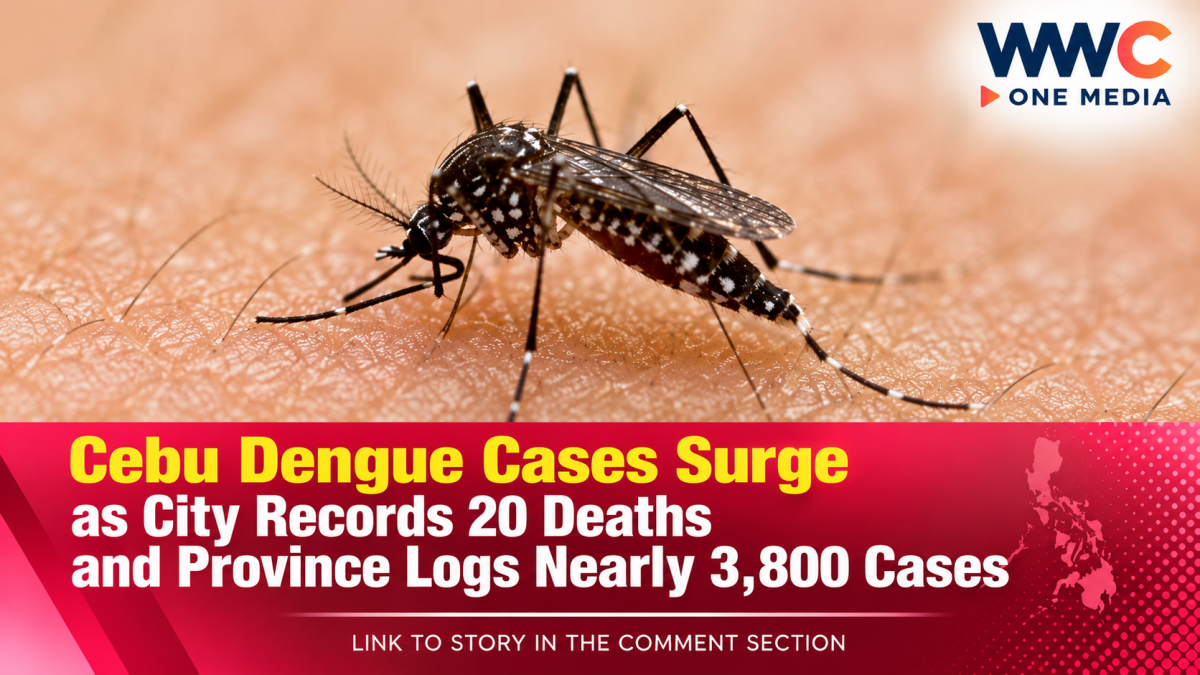
Cebu is facing a sharp rise in dengue cases, with Cebu City recording more than 2,400 infections and 20 deaths while the province has logged nearly 3,800 cases as health officials intensify prevention and early-treatment efforts.
The increase has prompted local governments to strengthen cleanup campaigns, mosquito-control operations and public health advisories as the rainy season continues to create conditions favourable for dengue transmission.
Cebu City cases jump 65 percent
Cebu City recorded 2,456 dengue cases from Jan. 1 to Sept. 5, 2026, according to City Health Department data.
That is 972 more cases than the 1,484 recorded during the same period in 2025, representing a 65.5 percent increase.
The number of deaths has risen even more sharply.
Twenty dengue-related deaths were recorded during the period, compared with six deaths during the same period last year. That represents an increase of 14 fatalities, or about 233 percent.
The figures have raised concern among city officials, particularly because dengue infections can become severe when patients delay seeking medical attention.
Health records show different figures
Officials have also acknowledged a difference between the City Health Department’s figures and those recorded by Cebu City Medical Center.
CCMC reported 844 dengue patients from Jan. 1 to Sept. 13.
Of those, 297 were admitted while 547 were treated through consultations. The hospital recorded 16 dengue-related deaths during the same period.
The discrepancy is largely because the City Health Department receives reports not only from public facilities but also from private hospitals.
Officials said the broader citywide figures therefore provide a wider picture of dengue activity across Cebu City.
Poor cleanup blamed for part of the increase
Cebu City officials have linked part of the increase to difficulties in maintaining regular cleanup activities in barangays.
Stagnant water remains a major concern because dengue-carrying mosquitoes can breed in relatively small containers and poorly drained areas.
Potential breeding sites include uncovered buckets, barrels, flower vases and other containers where rainwater can collect.
Officials stressed that dengue prevention cannot focus only on streets and public spaces.
Homes, workplaces and other private areas can also become breeding grounds if standing water is left unattended.
The city has therefore instructed barangay health workers to step up information campaigns and remind residents to maintain cleanliness both indoors and outdoors.
Misting operations to target high-risk areas
Cebu City is also strengthening mosquito-control measures.
Mayor Nestor Archival has ordered misting operations and instructed city personnel to proactively target barangays with high dengue case counts instead of waiting for formal requests.
The 10 barangays with the highest reported numbers are Guadalupe, Lahug, Basak San Nicolas, Tisa, Labangon, Talamban, Mambaling, Kalunasan, Punta Princesa and Apas.
The city government also ordered a cleanup of Cebu City Hall after an employee contracted dengue.
Officials warned that dengue is not only a concern for children.
Children remain particularly vulnerable because of outdoor activities, but adults can also be exposed, especially in workplaces where standing water may go unnoticed.
Cebu Province records 3,759 cases
The situation is also being closely monitored outside Cebu City.
Cebu Province recorded 3,759 dengue cases and 21 deaths as of September 2026.
That is a significant increase from roughly 2,000 cases recorded during the same period in 2025.
Despite the increase, Provincial Health Officer Sheila Faciol said the province has not reached the official threshold for declaring a province-wide outbreak.
She noted that dengue cases typically increase during periods of continuous rainfall but said the situation remains controlled based on current surveillance figures.
Several towns and cities report high case numbers
Provincial surveillance data showed several local government units recording significant numbers of dengue infections during August and September.
In August, Medellin recorded 240 cases and one death, while Talisay City reported 214 cases. Toledo City recorded 161 cases and one death.
Other areas with high August figures included Dalaguete with 93 cases, Minglanilla with 84 cases and one death, Cordova with 67, Consolacion with 64 and Liloan with 51.
Argao and Danao City each recorded 50 cases.
For September, Talisay City led the provincial list with 72 cases, followed by Medellin with 60 and Toledo City with 38.
Dalaguete recorded 30 cases, Minglanilla 21 and Argao 19. Cordova and Liloan each reported 16 cases, while Danao City recorded 14 and Daanbantayan 13.
Officials urge residents not to wait
Health authorities are urging residents to seek medical attention as soon as dengue symptoms appear rather than waiting for the illness to become severe.
Faciol particularly stressed the importance of early consultation when a family member develops a fever.
Early assessment can help doctors identify warning signs and prevent complications from becoming life-threatening.
The Provincial Health Office said provincial and district hospitals across Cebu maintain round-the-clock laboratory operations, while dengue fast lanes have been activated to speed up patient assessment.
Hospitals also have diagnostic kits and intravenous fluids available to handle patients who require immediate treatment.
Cleanup remains the first line of defence
With dengue cases climbing across both Cebu City and the province, health officials are emphasizing that government operations alone cannot contain transmission.
Regular removal of standing water, proper disposal of containers and consistent household and community cleanup remain essential to reducing mosquito breeding sites.
The sharp increase in cases serves as a warning that dengue prevention needs to continue even outside periods of heightened alerts.
For Cebu residents, health officials’ message is straightforward: eliminate places where mosquitoes can breed, watch for symptoms and seek medical care early if fever develops.




Leave a Reply