
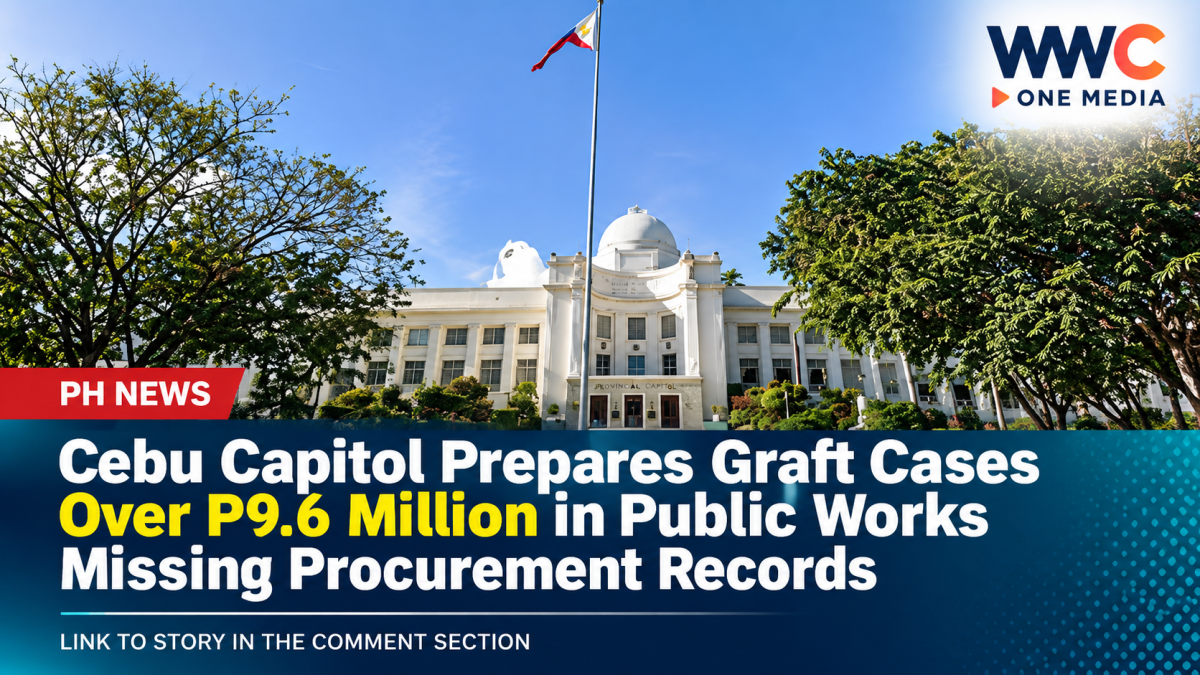
The Cebu Provincial Capitol is preparing possible graft complaints after investigators found that public works projects worth at least P9.6 million were missing mandatory procurement documents, leaving payments to contractors frozen and raising questions over the province’s handling of government records.
The document gaps were uncovered after an audit ordered by Cebu Gov. Pamela Baricuatro in 2025 following concerns over unpaid and flagged provincial obligations.
The Provincial Legal Office is now preparing to submit its findings to the Office of the Ombudsman, while a separate complaint is expected to be filed with the National Bureau of Investigation.
15 projects remain without complete records
The investigation initially covered 20 infrastructure-related payables.
By September 2025, the Provincial Engineering Office had issued suspension orders covering the affected projects while personnel searched for missing files.
Documents for five contracts were eventually recovered, but 15 projects continued to have unresolved paperwork problems.
Four of those contracts account for P9.6 million in public funds.
Three project folders were found to be completely empty of procurement records.
They include a P580,000 project involving 112 lamp post units in Asturias, Barili, Carmen and Toledo City; a P2.4 million project covering 466 lamp post pedestals in Balamban and Toledo City; and a P4.7 million road shoulder concreting project in Aloguinsan.
A fourth project, involving P1.9 million for road concreting in Balamban, was located but was still missing several required documents.
Another 11 projects were found to have less serious administrative gaps, including missing performance bonds, Department of Labor and Employment clearances, Contractor’s All Risk Insurance and other required attachments.
Officials say the projects were not “ghost” projects
Despite the missing paperwork, investigators said the issue does not appear to involve nonexistent projects.
Physical inspections conducted with provincial engineering personnel confirmed that several of the infrastructure projects had actually been completed.
The problem is instead centered on the procurement trail and the absence of documents needed to establish that the projects went through the required procedures.
That distinction has become critical because government payments cannot simply be released without the supporting records required for auditing.
Payments remain frozen
The Capitol has withheld payments for the 15 unresolved projects while the documentation issues are being investigated.
Provincial legal officials said contracts without the required procurement records could be considered legally defective under government procurement rules.
Sending incomplete documents to the Commission on Audit could also expose the province to audit disallowances.
The payment freeze has created additional pressure on contractors and suppliers, particularly smaller businesses that may already have carried the costs of completing government projects.
The province has been working through a broader backlog of unpaid obligations.
By late August, the administration had reportedly settled around P63 million in back payables dating from 2018 to 2025, covering areas such as catering services, scholarships, infrastructure, professional fees and university commitments.
Officials said only claims backed by sufficient documentation are being cleared for payment.
Missing records linked to 2025 leadership transition
The Capitol’s investigation points to the transition between provincial administrations as a major factor behind the missing records.
When the current administration took office in 2025, officials said there was no formal turnover of governance files, procurement records and financial documents.
Incoming procurement personnel reportedly inherited disorganized archives without a signed handover identifying which documents and contracts had been turned over.
Former procurement Secretariat personnel were later brought back to help locate files because they were familiar with the previous filing system.
Some documents were eventually found in storage areas and other locations, but 15 projects continued to have unresolved deficiencies.
The issue has now moved beyond an administrative problem and into a potential legal case.
Graft complaints being prepared
The Provincial Legal Office is finalizing its investigation report for possible referral to the Office of the Ombudsman.
The review is expected to identify the Capitol personnel who may be responsible for the missing procurement records and determine whether their actions or omissions warrant graft and corruption charges.
A separate complaint involving a private complainant is also expected to be filed with the NBI.
Officials have not released the names of the employees under investigation, citing privacy considerations and the need to avoid prejudging cases before formal complaints are assigned case numbers.
The deadline for concerned employees and contractors to submit missing documents expired on Sept. 11, with officials saying no further extensions would be granted.
Capitol tightens procurement safeguards
The controversy has also prompted the provincial government to overhaul parts of its procurement system.
The Bids and Awards Committee has been reconstituted through an executive order, while bidding sessions are now being publicly livestreamed to increase transparency.
The province has also introduced third-party monitoring involving representatives from government agencies and civil society organizations.
The aim is to ensure that procurement documents are complete and properly reviewed before contracts reach the governor’s desk for approval.
For the Capitol, the missing records have become more than a paperwork problem.
The P9.6 million in affected projects has exposed weaknesses in the province’s document turnover and procurement controls, while the impending graft complaints could determine whether those failures were simply administrative lapses or involved violations that warrant criminal prosecution.




Leave a Reply