
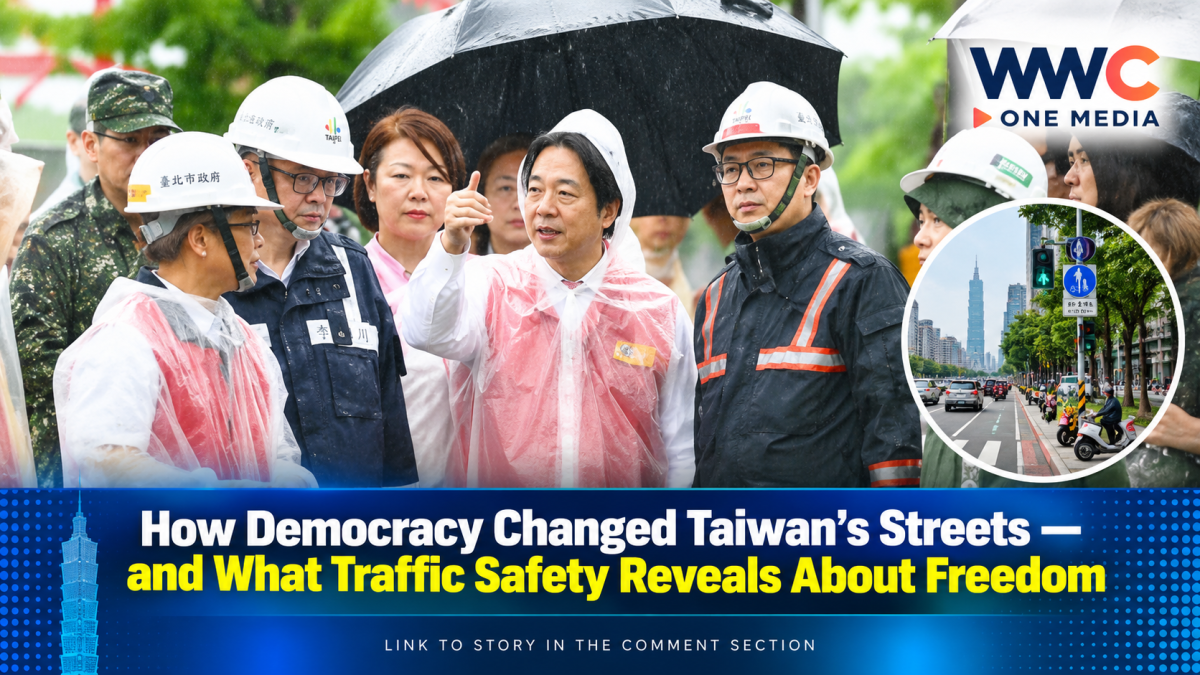
TAIPEI, Taiwan — Taiwan’s roads are often criticized for being dangerous, chaotic and unforgiving.
For years, international media and frustrated residents have pointed to poor pedestrian protection, reckless driving and the country’s high number of traffic accidents as evidence that Taiwan still has a long way to go.
But according to a new feature by columnist Courtney Donovan Smith, Taiwan’s changing traffic culture may also reveal something far bigger than road safety.
It may show how profoundly Taiwan has changed since the end of authoritarian rule.
The argument is simple: democracy did not just transform Taiwan’s elections and political institutions. Over time, it also changed the way people understand accountability, responsibility and the rights of others.
And one of the clearest places to see that transformation, Smith argues, is on the street.
From ‘Living Hell’ to a National Reckoning
Taiwan’s traffic problems gained international attention in December 2022 when CNN described the country’s roads as a “living hell” and said dangerous traffic conditions were damaging Taiwan’s image as a tourist destination.
Smith argues that the description was exaggerated, noting that Taiwan’s official 2019 road death rate was below the global average, although still alarmingly high compared with several similarly wealthy countries — particularly for pedestrians and motorcyclists.
Then came a series of tragedies that pushed traffic safety to the center of public debate.
A particularly devastating incident in Taichung in early 2023 killed a woman and her one-year-old son and injured the child’s father after they were struck by a bus.
Other serious pedestrian accidents followed.
Public anger grew.
Authorities responded by increasing oversight of bus operators and strengthening penalties and license sanctions for drivers who failed to yield to pedestrians.
But according to Smith, something else happened that was even more important.
People began changing their behavior.
When Drivers Started Stopping Because They Wanted To
The most significant transformation, Smith writes, was not simply the introduction of stricter rules.
It was the gradual change in how ordinary people behaved.
In Taichung, he observed more drivers voluntarily stopping for pedestrians — sometimes even when no police officer, traffic camera or other authority was watching.
Vehicles began waiting patiently for pedestrians to cross.
For Smith, that shift represented something deeper than fear of punishment.
It reflected civic responsibility.
People were increasingly recognizing that road safety was not simply a matter of avoiding a fine.
It was about respecting another person’s right to safely use public space.
That distinction is important.
Laws can force people to obey.
But a functioning society depends on people choosing to act responsibly even when nobody is watching.
What Taiwan’s Authoritarian Past Looked Like
Smith contrasts today’s Taiwan with his memories of the country during the authoritarian era.
He describes a society where power, wealth, political connections and social status could often matter more than ordinary people’s rights.
In traffic, he writes, people learned to judge who had power.
The larger vehicle often dominated the smaller one.
Pedestrians were at the bottom.
Police authority, wealth and connections could influence how people behaved and how they expected institutions to respond.
Smith also recalls witnessing accidents in which bystanders were reluctant to help injured people because they feared becoming involved or even being blamed themselves.
Those experiences, he argues, reflected a broader problem.
When people do not trust institutions to determine right from wrong fairly, they may protect themselves rather than help others.
Democracy Changed More Than Elections
Taiwan’s democratization created new ways for people to demand change.
Citizens gained greater freedom to criticize government policies.
Media could report more openly.
Civil society groups could organize campaigns.
Victims and their families could demand accountability.
Public anger over traffic deaths could become political pressure.
And political pressure could lead to new rules.
Smith argues that this process — imperfect as it may be — is one of democracy’s most important strengths.
Change can be slow.
Government institutions can become deadlocked.
Political parties can clash.
Public debate can be frustrating.
But those same institutions give people opportunities to challenge power and demand reform.
Attempts to bypass opposition or institutional checks might appear to offer a quick solution to political gridlock, Smith warns, but they can also create a dangerous path toward authoritarianism.
Freedom Also Comes With Responsibility
The column’s central argument is not that democratic Taiwan is perfect.
It clearly is not.
Taiwan still faces political polarization.
Public confidence in institutions is not universal.
Traffic safety remains a serious concern.
And many people continue to feel frustrated by government failures and political gridlock.
But Smith argues that the contrast with the past should not be forgotten.
Today’s Taiwanese citizens have far greater ability to challenge unfair treatment and expect legal accountability than they did under authoritarian rule.
Democracy gives people rights.
But it also requires them to recognize the rights of others.
That lesson can appear in the most ordinary moments.
A driver stops at a crosswalk.
A pedestrian feels safe enough to cross.
A witness helps an injured stranger.
A citizen challenges an unfair decision.
These may seem like separate acts.
But together, they help define the kind of society people live in.
Taiwan’s Roads Still Have a Long Way to Go
None of this means Taiwan’s traffic problems have disappeared.
Pedestrian safety remains a major public concern.
Scooter-heavy traffic, inconsistent road design and dangerous driving behavior continue to create risks.
Government agencies and local authorities still face pressure to improve road infrastructure, enforcement and transportation policy.
But Smith’s observation offers another way of looking at the issue.
Traffic safety is not only about roads, vehicles and regulations.
It is also about culture.
It is about whether people believe rules apply fairly.
It is about whether citizens trust institutions.
And it is about whether individuals recognize that their freedom comes with a responsibility not to endanger others.
A Country Changed in Ways That Are Easy to Miss
Taiwan’s democratic transformation is often measured through elections, presidential transitions and changes in political power.
Those milestones are important.
But some of the most meaningful changes may be found in everyday life.
On a busy street.
At a pedestrian crossing.
In the decision to stop and wait.
In the decision to help a stranger.
Taiwan’s roads are still far from perfect.
Yet the growing expectation that drivers should yield, that institutions should respond and that citizens have the right to demand safer streets reflects a profound change from the past.
Democracy did not magically fix Taiwan’s traffic problems. But it gave people the power to demand change — and, increasingly, the responsibility to create it themselves.
WWC ONE MEDIA J.M.D




Leave a Reply