
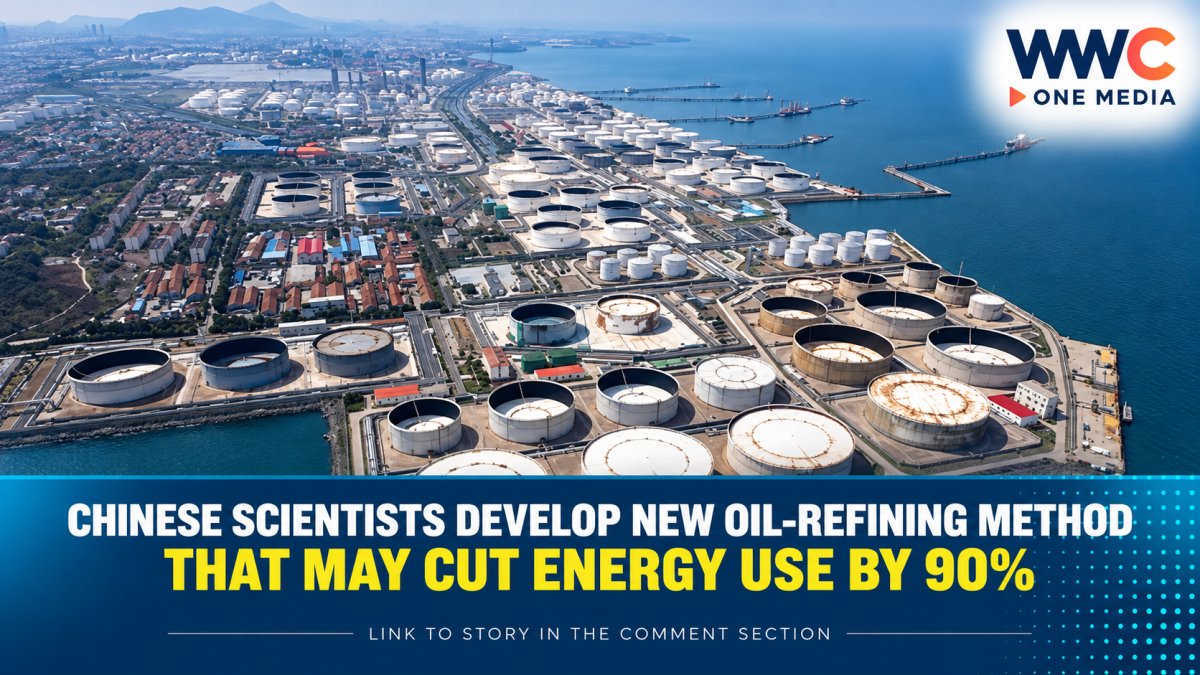
Chinese scientists have developed a new method for refining oil that could reduce energy consumption by about 90 per cent, potentially offering a more efficient alternative to the energy-intensive processes traditionally used in refineries.
The research focuses on separating the different chemical components of light naphtha, a product obtained during the initial processing of crude oil. These hydrocarbons can be used to produce materials including petrochemical feedstocks, high-octane petrol components and chemical intermediates.
Traditional refining relies heavily on distillation, which requires substantial amounts of heat because different hydrocarbons must be separated according to their boiling points. The Chinese research team instead developed a cascading membrane-separation system that works at the molecular level, potentially reducing the amount of energy needed for the process.
Researchers from the Chinese Academy of Sciences’ Dalian Institute of Chemical Physics and collaborating institutions used two types of membranes. The first separates molecules according to their size, while the second uses differences in chemical properties to distinguish between closely related compounds.
The system was tested on simulated light naphtha containing 15 components. Researchers were able to divide the mixture into three higher-value product groups: material rich in straight-chain and single-branched hydrocarbons for ethylene production, aromatic-rich chemical intermediates, and gasoline-blending components containing more highly branched hydrocarbons and cycloalkanes.
Each of the three product streams achieved a recovery rate of roughly 85 to 90 per cent in the study. Overall energy consumption was about 91 per cent lower than that of conventional distillation, according to the Chinese Academy of Sciences.
The approach represents a shift from conventional “fraction cutting”, in which crude oil is separated mainly according to boiling ranges, toward what researchers describe as “molecular refining”. The idea is to separate individual components more precisely and direct them toward higher-value uses.
The potential energy savings are particularly significant for an industry that consumes large amounts of heat and electricity. China also has one of the world’s largest refining sectors, although its domestic oil demand is expected to decline as electric vehicles and other forms of electrification reduce consumption of traditional transport fuels.
The researchers said the work provides a scientific foundation for applying membrane-based molecular separation to petroleum processing. However, the reported results come from research using simulated feedstock, meaning further development and larger-scale testing would be needed before the technology could be widely deployed in commercial refineries.
If successfully scaled up, the technology could offer refineries a way to reduce energy consumption while producing more targeted and potentially higher-value chemical products from the same petroleum feedstock.




Leave a Reply