
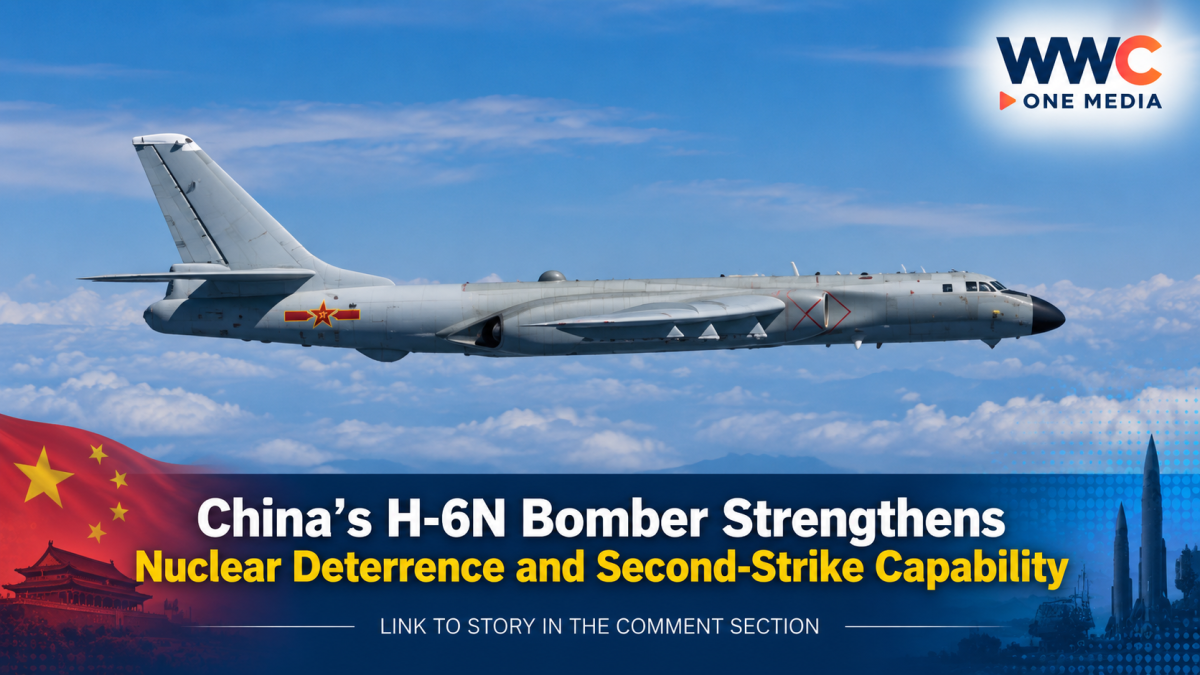
China’s H-6N strategic bomber is playing a growing role in the country’s nuclear deterrent, with the aircraft and its air-launched ballistic missile helping complete Beijing’s nuclear triad, according to a South China Morning Post report.
The H-6N is a modified version of China’s long-serving H-6 bomber and is designed to carry the JL-1 air-launched ballistic missile. The combination gives the People’s Liberation Army an airborne nuclear strike option alongside its land-based intercontinental ballistic missiles and submarine-launched ballistic missiles.
The development is significant because a nuclear triad is designed to give a country several ways to retaliate after a nuclear attack. By having nuclear forces based on land, at sea and in the air, China can make it more difficult for an adversary to eliminate its ability to respond.
The H-6N has been part of China’s strategic aviation development for years. The H-6 family has served as Beijing’s principal strategic bomber for about six decades, while the newer H-6N has been adapted to carry larger and more advanced weapons.
The bomber’s ability to carry the JL-1 is particularly important to its nuclear role. The missile was publicly displayed during China’s 2025 military parade, and subsequent Chinese military footage has highlighted the H-6N operating with the weapon. The system is intended to provide a longer-range strike option while allowing the bomber to launch from outside some heavily defended areas.
China has also demonstrated the growing reach of its strategic bomber force. In July 2024, H-6 bombers conducted a joint patrol near Alaska with Russian Tu-95 bombers, prompting US and Canadian aircraft to respond. The flight demonstrated that the H-6 platform can operate far beyond China’s immediate region.
The development comes as China continues to expand and modernise its nuclear forces. Analysts have also pointed to improvements in its submarine-based deterrent, including the development of more capable ballistic-missile submarines and recent tests involving submarine-launched ballistic missiles.
Together, these developments indicate a broader effort to make China’s nuclear forces more survivable and capable of retaliation. The goal of a second-strike capability is to ensure that even after suffering a major first attack, enough nuclear forces would remain to respond.
The H-6N therefore represents more than an upgrade to an ageing bomber family. Its integration with the JL-1 gives China an additional component of its nuclear deterrent and strengthens the airborne leg of a nuclear triad that is becoming increasingly important to Beijing’s military strategy.




Leave a Reply