
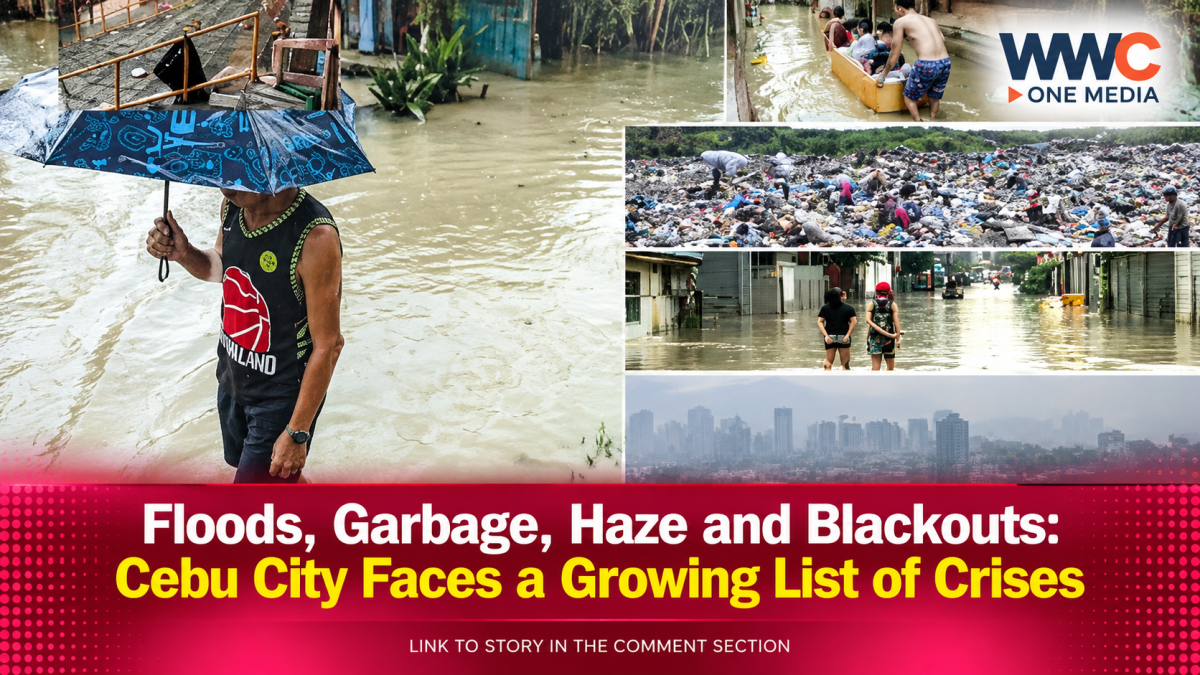
CEBU CITY, Philippines — Recurring floods. Mounting garbage problems. Dangerous haze. Rotational power outages.
For Cebu City residents, the past week has highlighted a troubling reality: several major problems are hitting the city at the same time, testing the ability of local authorities to respond while leaving communities frustrated over issues that many say have remained unresolved for years.
In his weekly column, veteran Cebu journalist and lawyer Pachico A. Seares described the situation as a growing list of woes confronting the city — with flooding, waste disposal, poor air quality and electricity shortages all demanding immediate attention.
Flooding Remains Cebu City’s Oldest Problem
Flooding has been one of Cebu City’s most persistent problems, surviving changes in administrations, City Councils and political leadership.
Heavy rains can quickly leave roads submerged and communities vulnerable, while questions continue over whether development, drainage systems and land-use decisions have worsened the problem.
The issue has also taken a political and legal turn.
Mayor Nestor Archival is facing a complaint before the Office of the Ombudsman connected to allegations involving his handling of concerns surrounding the Monterrazas de Cebu development and flooding.
The complaint alleges misconduct and a potential conflict of interest. Archival’s position and any legal findings remain matters for the appropriate authorities to determine.
The column argued that the case has intensified public scrutiny of a problem that has existed for decades: why has Cebu City still been unable to find a lasting solution to recurring floods?
Recent reports have also shown increased attention on developments and their possible connection to flooding, with dozens of projects facing flood-related checks.
Garbage Crisis Continues to Pressure City Hall
Cebu City’s waste problem has become another major source of public concern.
The city has faced continuing difficulties in finding reliable and affordable ways to collect, transfer and dispose of its daily garbage, particularly following disruptions to its waste disposal system.
The closure of the Binaliw landfill earlier this year forced officials to examine alternative disposal sites and reassess the costs of hauling waste outside the city.
A previous SunStar report showed that Cebu City was still studying the financial and logistical challenges of sending garbage to alternative facilities in Aloguinsan and Toledo, while also relying on temporary arrangements and transfer stations.
The financial pressure has since become a growing concern, with recent reporting highlighting a potential budget crisis tied to daily garbage hauling.
For residents, however, the issue is much simpler.
Garbage has to be collected every day.
Any disruption can quickly lead to overflowing waste, foul odors and potential health concerns.
The longer-term challenge for Cebu City is finding a system that is not only environmentally sustainable, but also financially and operationally reliable.
Dangerous Haze Adds Another Health Concern
As Cebu City struggled with flooding and garbage, residents also faced a serious environmental threat from transboundary haze.
Smoke from forest and land fires in Indonesia was carried into the Philippines by prevailing winds, causing air quality in Metro Cebu to deteriorate sharply during the first week of September.
Air quality reached the “Acutely Unhealthy” category at its peak, prompting class suspensions, health warnings and calls for residents to limit outdoor exposure and wear protective masks when necessary.
Conditions improved over the weekend, however.
The Environmental Management Bureau in Central Visayas recorded an Air Quality Index of 136 in Metro Cebu on Sept. 6, placing conditions in the “Unhealthy for Sensitive Groups” category — a significant improvement from the peak levels earlier in the week.
Authorities nevertheless warned that vulnerable groups, including children, older adults and people with heart or respiratory conditions, should continue taking precautions.
The haze crisis also demonstrated how Cebu can be affected by environmental disasters occurring far beyond Philippine territory.
Rotational Blackouts Hit Cebu at the Same Time
Adding to the pressure, Metro Cebu and other parts of the Visayas experienced rotational power outages caused by a shortage of available generating capacity in the regional grid.
According to the column, outages lasted from about one hour to two and a half hours in some areas as the Visayas grid struggled with a severe supply deficit.
The shortage was linked to generating units being unavailable or operating at reduced capacity.
The distinction is important.
A brownout generally refers to a reduction in voltage or a partial reduction in electricity supply.
A blackout, on the other hand, means a total loss of electrical power.
For residents suddenly left without electricity, however, the technical difference provides little comfort.
Power interruptions affect homes, businesses, hospitals, traffic systems and daily life — particularly when they arrive during a period already marked by environmental and infrastructure problems.
When Multiple Problems Become One Crisis
Each of Cebu City’s problems has its own causes.
Flooding involves drainage, development, infrastructure and land management.
Garbage requires an efficient collection, transfer and disposal system.
Haze is an environmental and public health emergency influenced by regional weather patterns and fires outside the country.
Power outages involve electricity generation and the stability of the regional grid.
But when all of them happen within the same period, they create something larger.
They test the resilience of the city itself.
Residents begin asking whether local and national authorities are prepared to manage multiple emergencies at once — especially when some of those problems have existed for years.
Cebu City’s Biggest Challenge: Turning Response Into Solutions
Emergency measures can help people survive a crisis.
But long-term solutions require planning that continues long after public attention fades.
Cebu City faces difficult questions about flood control, responsible development, waste management and disaster preparedness.
Some problems cannot be solved by City Hall alone.
The haze, for example, is part of a wider regional environmental challenge.
The power shortage also involves the entire Visayas grid.
But residents will still look to local leaders for protection, preparation and clear communication.
That may be the biggest lesson from Cebu City’s difficult week.
A city does not become resilient simply because it responds to disasters.
It becomes resilient when it learns from them and reduces the chances of facing the same crisis again.
Floods, garbage, haze and blackouts may be separate problems. But for Cebu City residents dealing with all of them at once, they raise one urgent question: how many more warnings will it take before recurring crises are finally turned into lasting solutions?
WWC ONE MEDIA J.M.D



Leave a Reply